Why In News?
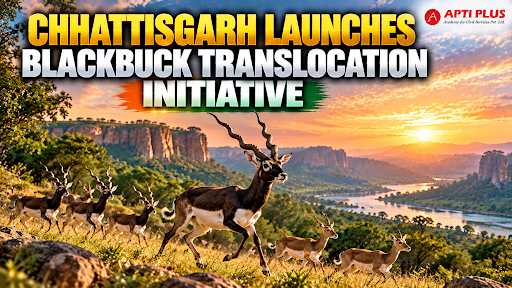
The Chhattisgarh Forest Department has initiated a phased translocation of 50 Blackbucks (Antilope cervicapra) into the Gomarda Wildlife Sanctuary.
What Is The Blackbuck?
The blackbuck (Antilope cervicapra), commonly known as the Indian Antelope, is a diurnal ungulate species native to the Indian subcontinent (primarily India and Nepal). Adult males feature distinctive ringed spiral horns and a dark blackish-brown upper coat.
-
Habitat: Mainly in open grasslands, scrublands, and alluvial plains. Key native habitats in India include Velavadar Blackbuck Sanctuary (Gujarat), Point Calimere Wildlife Sanctuary (Tamil Nadu), and Tal Chhapar Sanctuary (Rajasthan).
-
Significance: Bio-indicator of grassland ecosystem health, blackbucks function as specialized coarse-grass grazers. By feeding on coarse grasses, they suppress invasive and unpalatable vegetation, enhance native grass germination, boost primary grassland productivity, and expand the prey base for apex and mesopredators.
-
Reproductive: Blackbucks have a gestation period of approximately six months and possess the biological capacity to breed throughout the year.
-
Threats: Populations face severe pressures from poaching, agricultural land encroachment, habitat fragmentation, and high fawn mortality caused by free-ranging feral dog and jackal predation.
-
Legal Protection & Conservation Status:
-
Wildlife (Protection) Act, 1972: Placed under Schedule I, affording the highest degree of legal protection against hunting and commercial trade.
-
IUCN Red List: Classified globally as Least Concern.
-
CITES: Listed under Appendix III to monitor international commercial trade.
-
Cultural & State Symbolism: The species is officially recognized as the State Animal of Punjab, Haryana, and Andhra Pradesh.
About Gomarda Wildlife Sanctuary
-
Location: Located near Sarangarh in the Sarangarh-Bilaigarh district of Chhattisgarh. Officially declared a protected area in 1975.
-
Vegetation: Comprises rolling hills, riverine grasslands, reservoirs, waterfalls, and a mixture of moist and dry tropical deciduous forests.
-
Mammals: Supports key mammalian species including the Bengal tiger, leopard, gaur (Indian bison), sambar, spotted deer (chital), sloth bear, and wild boar.
-
Reptiles & Avifauna: Home to the monitor lizard, softshell turtle, and over 100 species of birds, including the Asian paradise flycatcher and white-throated fantail.
-
Blackbucks became locally extinct in Gomarda during the 1970s due to uncontrolled hunting, poaching, human encroachment, and development projects
Source: THEHINDU
|
PRACTICE QUESTION Q. The "Gomarda Wildlife Sanctuary", which recently reintroduced blackbucks after five decades, is located in which of the following States? (a) Odisha (b) Madhya Pradesh (c) Chhattisgarh (d) Jharkhand Answer: (c) Explanation: Gomarda Wildlife Sanctuary is located in the Sarangarh-Bilaigarh district of Chhattisgarh. The sanctuary is currently reintroducing 50 blackbucks translocated from Barnawapara Wildlife Sanctuary. |