Why In News?
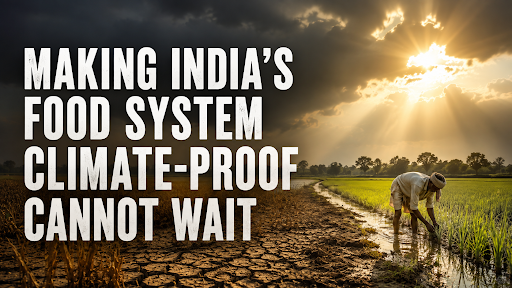
Agricultural experts stress that India must adopt climate-resilient food systems to protect farm output from extreme heat, volatile monsoons, and depleting groundwater.
What is a Climate-Proof Food System?
A Climate-Proof Food System is an integrated, farm-to-fork agricultural and supply chain framework designed to withstand, absorb, and rapidly recover from climate-induced shocks (droughts, floods, heatwaves, pest outbreaks) while guaranteeing uninterrupted national nutrition security.
Core Pillars of Climate-Proofing:
-
Production Resilience: Cultivating climate-hardy crop varieties (heat-, drought-, and submergence-tolerant seeds).
-
Hydrological Sustainability: Aligning cropping patterns with local groundwater realities and scaling precision micro-irrigation.
-
Post-Harvest Protection: Building temperature-controlled, flood-resilient storage silos and cold-chain transport networks to prevent perishable food loss.
-
Nutritional Diversification: Expanding the production and public distribution of climate-smart nutri-cereals (millets), pulses, and oilseeds.

How is Climate Change Affecting Indian Agriculture?
Terminal Heat Stress: Rising temperatures during reproductive stages reduce wheat yields by 3% to 10% per 1°C rise above the optimal threshold.
Monsoon Volatility & Extreme Rainfall: More frequent dry spells interspersed with short-duration, high-intensity downpours lead to severe soil erosion and crop damage.
Shifting Pest & Pathogen Dynamics: Warmer winter temperatures accelerate pest breeding cycles, increasing infestations of desert locusts, pink bollworms, and fall armyworms.
Sea-Level Rise & Coastal Salinisation: Inundation of fertile deltaic farmlands in West Bengal, Odisha, and Andhra Pradesh reduces arable rice acreage.
Why is India Vulnerable?
High Dependence on Rainfed Farming: Over 51% of India's net sown area (70 million hectares) is rainfed, directly tying agricultural GDP to unpredictable monsoon precipitation.
Dominance of Small and Marginal Farmers: Nearly 86% of Indian farmers cultivate land parcels smaller than 2 hectares, lacking capital buffers to invest in climate-smart technologies.
Severe Groundwater Over-Extraction: Agriculture consumes over 85% of India's extracted groundwater; breadbasket states like Punjab and Haryana face extraction rates exceeding 150% of annual recharge.
Intensive Rice-Wheat Monoculture: Distorted subsidies (free power, subsidized urea) incentivize water-intensive paddy cultivation in water-stressed semi-arid regions.
What are the Major Impacts?
Macroeconomic & Food Inflation Risks: Supply shocks in climate-sensitive vegetables (tomato, onion, potato) and pulses generate volatile retail inflation spikes, straining household budgets.
Threat to Farm Incomes: Without adaptation, climate change could reduce annual agricultural incomes by 15% to 18% overall, and up to 25% in unirrigated areas.
Nutritional Security Degradation: Elevated atmospheric CO₂ levels reduce protein, zinc, and iron concentrations in staple cereal crops like wheat and rice.
Rural-to-Urban Distress Migration: Recurring droughts and crop failures force marginal agricultural laborers to migrate to urban centers as distress informal labor.
What is Climate-Resilient Agriculture (CRA)?
Climate-Resilient Agriculture (CRA) is an integrated approach to agricultural management that sustainably increases productivity, enhances system adaptation and resilience to climate stress, and mitigates greenhouse gas emissions where possible.
Key Technical Interventions:
-
Direct Seeded Rice (DSR) & System of Rice Intensification (SRI): Saves up to 25–30% water and reduces methane emissions by 30%.
-
Zero-Tillage & Crop Residue Mulching: Retains soil moisture, prevents stubble burning, and enriches soil organic carbon.
-
Micro-Irrigation (Drip & Sprinkler): Enhances water-use efficiency up to 85–90% compared to traditional flood irrigation.
-
Agroforestry & Mixed Cropping: Provides alternative income streams and acts as windbreaks against extreme weather.
Government Initiatives Supporting Climate Resilience
National Innovations in Climate Resilient Agriculture (NICRA): Implemented by Indian Council of Agricultural Research (ICAR) across 151+ vulnerable districts, establishing village-level seed banks, fodder banks, and custom hiring centers.
National Mission for Sustainable Agriculture (NMSA): Focuses on soil health management, water-use efficiency, rainfed agriculture, and integrated farming systems.
PM Krishi Sinchayee Yojana (PMKSY - Per Drop More Crop): Subsidizes micro-irrigation equipment for over 80 lakh hectares of farmland.
Pradhan Mantri Fasal Bima Yojana (PMFBY): Provides comprehensive weather-based and yield-based crop insurance coverage against natural non-preventable risks.
National Millets Mission (Shree Anna Initiative): Promoting climate-resilient, drought-hardy nutri-cereals (bajra, jowar, ragi) through minimum support prices (MSP) and PDS inclusion.
PM-KUSUM Scheme: Deploying solar-powered irrigation pumps to decouple rural water pumping from fossil fuels and erratic grid power.
What India Can Learn from Domestic and International Models
Domestic Best Practices
-
Odisha Millet Mission (OMM): Successfully revived climate-resilient millet farming across 140+ blocks, integrating millets into the Public Distribution System (PDS) and Integrated Child Development Services (ICDS) through women-led Self-Help Groups.
-
Andhra Pradesh Community-Managed Natural Farming (APCNF): Scaled chemical-free regenerative farming to over 10 lakh farmers, improving soil organic matter and moisture retention during droughts.
-
Kuttanad Below Sea-Level Farming System (Kerala): A FAO-recognized Globally Important Agricultural Heritage System (GIAHS) utilizing saline-resistant paddy and bio-dykes in flood-prone coastal backwaters.
-
Project on Climate Resilient Agriculture (POCRA, Maharashtra): Utilizes village-level micro-watershed planning and real-time water budgeting to drought-proof drought-prone districts of Marathwada and Vidarbha.
International Best Practices
-
Israel’s Water Recycling & Precision Drip Irrigation: Treats and reuses nearly 90% of wastewater for agriculture and utilizes sensor-driven drip systems with automated nutrient dosing.
-
Vietnam's 'Alternate Wetting and Drying' (AWD) in Rice: Scaled in the Mekong Delta to reduce farm water consumption by 25% and slash agricultural methane emissions by 30%.
-
Brazil’s Integrated Crop-Livestock-Forestry (ILPF) System: Integrates trees, livestock pastures, and grain crops on the same land parcel, capturing carbon and restoring degraded soils.
-
Africa’s Drought-Tolerant Maize for Africa (DTMA) Initiative: Developed open-source, drought-tolerant seed varieties that enhanced smallholder yields by 20–30% under erratic rainfall.
Way Forward
Diversify Public Procurement (PDS & NFSA Basket): Rebalance Food Corporation of India (FCI) procurement by expanding decentralized procurement of millets, pulses, and oilseeds to incentivize sustainable crop rotation.
Rationalize Power and Fertilizer Subsidies: Shift from flat power subsidies to Direct Benefit Transfer (DBT) of power and nutrient-based fertilizer subsidies to encourage water and soil conservation.
Build Climate-Resilient Rural Storage & Cold Chains: Modernize rural warehouses with solar-powered climate-control systems and silo bags to safeguard national buffer stocks from extreme floods and heat.
Scale Community Seed Banks and Climate-Adapted Varieties: Accelerate commercial seed multiplication of ICAR's 1,500+ biofortified and climate-resilient seed varieties through Farmer Producer Organisations (FPOs).
Hyper-Local Agromet Advisory Services: Expand artificial intelligence and satellite-driven agromet advisories down to the Gram Panchayat level to guide precise planting, irrigation, and pest control.
Innovative Climate Risk Financing & Green Bonds: Mobilize dedicated climate adaptation funds, parametric crop insurance, and sustainability-linked agricultural credit for smallholders.
Conclusion
Climate-proofing India’s food system is indispensable for national sovereignty, requiring a decisive shift from calorie-focused intensive farming to resilient, water-smart, and diversified agriculture.
Source: THEHINDU
|
PRACTICE QUESTION Q. While the Green Revolution transformed India from a ship-to-mouth existence to food self-sufficiency, climate change now poses an existential threat to this hard-won security. Discuss (10 Marks, 150 Words) |