Why In News?
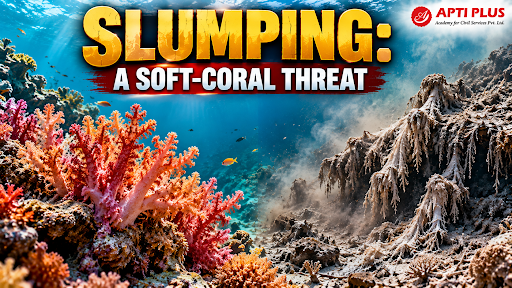
Marine scientists documenting unprecedented soft-coral mortality off South Korea's Jeju Island identified "coral slumping".
What is Coral Slumping?
Coral slumping is the collapse and loss of structural integrity in soft corals caused by the failure of their hydrostatic skeleton (internal fluid pressure).
Unlike hard, reef-building corals (Scleractinia) that secrete rigid calcium carbonate external skeletons, soft corals (order Alcyonacea / subclass Octocorallia) lack a solid mineralized framework.
-
Soft corals stay upright via internal hydrostatic pressure and calcium carbonate spicules (sclerites) in fleshy tissue (mesoglea).
Under extreme compound environmental stress, soft corals suffer systemic cellular breakdown, loss of internal turgor pressure, and progressive tissue necrosis, causing colonies to droop and liquefy.
The Five Morphological Stages of Slumping: Research led by the Korea Institute of Ocean Science and Technology (KIOST) identifies five distinct stages of collapse:
-
Inflation: Corals swell abnormally as internal fluid regulation and hydrostatic equilibrium fail.
-
Drooping: Loss of structural rigidity; upright branches bend and sag toward the seafloor.
-
Dangle: Coral colonies hang completely limp from vertical rock walls, unable to extend tentacles for feeding.
-
Deflation: Severe loss of internal coelenteron fluid, causing the fleshy tissue mass to shrink and collapse.
-
Disintegration: Massive necrosis, tissue liquefaction, and sloughing off from rocky substrates, leaving behind bare rock.
How is Coral Slumping Different from Coral Bleaching?
|
|
Coral Bleaching (Hard Corals) |
Coral Slumping (Soft Corals) |
|
Target Organisms |
Hard / Stony corals (Scleractinia) with calcified skeletons. |
Soft corals (Alcyonacea / Octocorallia) with flexible tissue. |
|
Biological Mechanism |
Expulsion of photosynthetic microalgae (Zooxanthellae). |
Loss of hydrostatic turgor pressure, tissue necrosis, and cellular breakdown. |
|
Visual Appearance |
Corals lose pigmentation and turn stark white (calcified ghost reefs). |
Corals droop, sag, deflate, and physically dissolve into necrotic sludge. |
|
Skeletal Retention |
Rigid calcium carbonate skeleton remains intact. |
No rigid skeleton exists; colonies completely disintegrate. |
|
Reversibility |
Bleached corals can recover if sea temperatures normalize within weeks. |
Once tissue disintegration begins, mortality is rapid and irreversible. |
Factors Triggering Coral Slumping
Prolonged Marine Heatwaves (MHWs): Anthropogenic ocean warming elevates Sea Surface Temperatures (SSTs) well above thermal tolerance thresholds (exceeding 28°C–30°C for prolonged periods).
Hypo-Saline Osmotic Shock: Intense, unseasonal monsoon downpours and riverine flood plumes discharge massive volumes of freshwater into coastal waters, causing acute salinity drops that rupture delicate soft coral cell membranes.
Coastal Eutrophication and Turbidity: Untreated agricultural fertilizer runoff and domestic sewage discharge introduce high nitrogen and phosphorus loads, fueling bacterial pathogens and suffocating algae.
Compounded Environmental Stress: The lethal combination of high water temperature, reduced salinity, and low dissolved oxygen triggers rapid metabolic collapse in soft-coral colonies.

Source: THEHINDU
|
PRACTICE QUESTION Q. With reference to 'Coral Slumping' and marine ecology, consider the following statements: 1. Coral slumping primarily affects hard, reef-building corals belonging to the order Scleractinia. 2. Unlike coral bleaching, slumping involves the progressive physical loss of hydrostatic turgor pressure, tissue drooping, and structural disintegration. 3. Marine heatwaves and sudden drops in coastal salinity caused by heavy rainfall are primary triggers for coral slumping. Which of the statements given above are correct? (a) 1 and 2 only (b) 2 and 3 only (c) 1 and 3 only (d) 1, 2, and 3 Answer: (b) Explanation: Statement 1 is incorrect: Coral slumping affects soft corals (such as non-symbiotic octocorals belonging to the subclass Octocorallia / family Nephtheidae), not hard, reef-building stony corals (order Scleractinia). Hard corals possess rigid calcium carbonate skeletons, whereas soft corals rely on hydrostatic internal pressure to maintain their structure. Statement 2 is correct: As documented in studies published in Nature Scientific Reports, slumping is defined as the collapse of an organism's hydrostatic skeleton. It involves stages of physical deflation, tissue drooping, dangling, and eventually tissue disintegration and colony mortality. Statement 3 is correct: The primary drivers identified for coral slumping events (notably observed around Jeju Island, South Korea) are compound environmental stressors—specifically marine heatwaves (elevated sea surface temperatures) and sustained hypo-saline conditions resulting from heavy rainfall, typhoons, and coastal river discharge. |