Why In News?
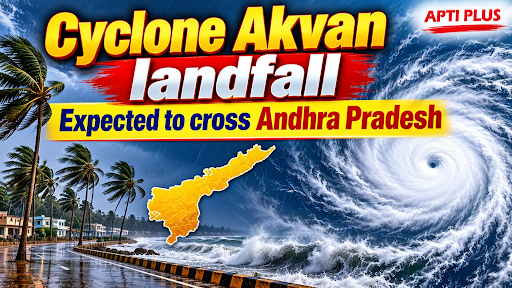
The India Meteorological Department (IMD) says Cyclone Akvan is likely to cross the Andhra Pradesh coasts around noon on 20 November 2026.
What Are Cyclones?
A cyclone is a large system of winds rotating around a low-pressure centre. The winds spiral inward, anticlockwise in the Northern Hemisphere and clockwise in the Southern Hemisphere, because of the Coriolis force.
Types Of Cyclones
-
Tropical Cyclones: They form over warm tropical oceans between about 5° and 30° latitude. They are intense and cause most of the damage. They have names such as hurricanes (Atlantic and Northeast Pacific), typhoons (Northwest Pacific) and willy-willies (Australia).
-
Extra-Tropical (Temperate) Cyclones: They form in the middle and high latitudes along the polar front. They are larger and weaker, and they move from west to east. They cause much of the winter rain in these regions.

How A Tropical Cyclone Forms
-
Warm Sea Surface: It needs sea surface temperature of at least 26.5°C to a depth of about 50 metres. Warm water supplies the evaporation that fuels the storm.
-
Low Pressure And Moist Air: Warm, moist air rises, and condensation releases latent heat. This lowers the pressure further and draws in more air.
-
Coriolis Force: It deflects the inflowing winds into a spiral. It is negligible near the equator, so cyclones rarely form within 5° of it.
-
Weak Vertical Wind Shear: Strong shear would tear the storm apart.
-
Pre-Existing Disturbance: A tropical disturbance or trough provides the starting circulation.
Structure
-
Eye: A calm, clear, low-pressure centre, usually 30 to 50 km wide.
-
Eye Wall: A ring of towering clouds around the eye. It has the strongest winds and heaviest rain.
-
Spiral Rain Bands: Outer bands of thunderstorms that spread the rain over a wide area.
Why Cyclones Weaken
A cyclone weakens after landfall because it loses its supply of warm, moist air. Friction with land also slows the winds.
What Is Cyclone Akvan?
-
Origin: Akvan developed from a low-pressure system over the southeast Bay of Bengal. It first became a deep depression moving slowly at about 6 km/h before intensifying into a cyclonic storm.
-
Expected Track: The system is expected to move northwestwards towards the Andhra Pradesh coast.
-
Season: The post-monsoon season of October to December is the main cyclone period in the Bay of Bengal. Warm sea surface temperatures and low wind shear favour intensification.
-
Recent Storms: Cyclone Montha crossed near Kakinada in October 2025, and Murasu crossed south Andhra Pradesh in early November 2026. Akvan is the next storm in the naming queue.
How Are Cyclones Named In The North Indian Ocean?
-
Naming Panel: The World Meteorological Organization (WMO)/United Nations Economic and Social Commission for Asia and the Pacific (ESCAP) Panel on Tropical Cyclones maintains the list of names for the Bay of Bengal and Arabian Sea.
-
India Meteorological Department (IMD), as a Regional Specialised Meteorological Centre, names storms in this basin.
-
List Structure: Each member country submitted 13 names, creating a list of 169 names used column by column. Names are not repeated once used.
-
Akvan's Origin: Iran proposed the name, which refers to Akvan-e Div, a demon-like figure in Ferdowsi's Shahnameh.
-
Criteria: Names must be neutral to politics, religious beliefs, cultures and gender. They must be short, easy to pronounce and not hurt the sentiments of any group.
-
Misconception: The proposing country has no link to the cyclone's destination. A name proposed by Iran can hit India.
How Does IMD Classify Cyclones?
-
Cyclonic Storm: Maximum sustained winds of 62–88 km/h. A deep depression has 51–61 km/h.
-
Severe Cyclonic Storm: Winds of 89–117 km/h.
-
Very Severe Cyclonic Storm: Winds of 118–165 km/h, the category forecast for Akvan at landfall.
-
Extremely Severe And Super Cyclonic Storm: Winds of 166–220 km/h and above 221 km/h respectively.
-
Colour-Coded Warnings: IMD uses four stages: green (all is well), yellow (watch), orange (alert) and red (take action).
Initiatives Taken By Government For Cyclone Preparedness
-
Disaster Management Act, 2005: It created the National Disaster Management Authority (NDMA) under the Prime Minister, State Disaster Management Authorities and District Authorities. It legally mandates preparedness, mitigation and response plans.
-
National Disaster Management Guidelines On Cyclones (2008): The NDMA guidelines set standards for early warning, shelters, evacuation and coastal land-use planning. Their principles guide the state plans.
-
IMD Cyclone Warning System: IMD issues bulletins every three hours near landfall and uses the four-stage colour code. The Cyclone Warning Standard Operating Procedure of 2021 prescribes the warning chain from forecast to response.
-
National Cyclone Risk Mitigation Project (NCRMP): The World Bank-assisted project builds multipurpose cyclone shelters, saline embankments, underground cabling and early warning dissemination systems. It covers cyclone-prone states along both coasts.
-
National Disaster Response Force (NDRF): The force pre-positions specialised teams in likely landfall districts and works with State Disaster Response Forces. Teams carry boats, cutters and medical kits for rescue after landfall.
-
State-Level Evacuation Model: Odisha's State Disaster Management Authority, created after the 1999 Super Cyclone, uses cyclone shelters, village volunteers and large-scale evacuation. Its approach to Cyclone Phailin in 2013 moved over ten lakh people and sharply limited deaths.
-
Sendai Framework Alignment: India is a signatory to the Sendai Framework for Disaster Risk Reduction 2015–2030. The India Disaster Management Plan of 2019 aligns national priorities with its targets.
Source: THEHINDU
|
PRACTICE QUESTION Q. Discuss the impact of climate change on cyclones in the Bay of Bengal and suggest measures to strengthen coastal resilience. (10 Marks, 150 Words) |