Why In News?
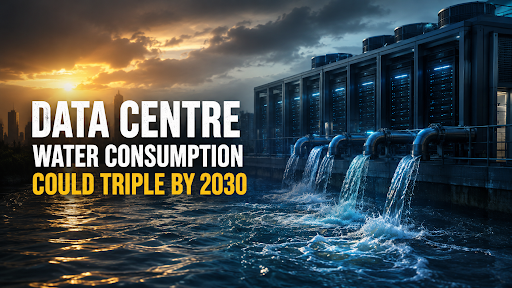
Rystad Energy reports that annual global data centre water consumption could nearly triple from 222 billion litres in 2025 to 644 billion litres by 2030, driven by rapid AI-led expansion and cooling demands.
Key Highlights of the Report
-
Global water consumption: Data centres consumed about 222 billion litres of water in 2025 for direct cooling and could reach 644 billion litres annually by 2030 without major efficiency gains.
-
Water-saving potential: Improved efficiency could reduce 2030 consumption to 543 billion litres under a moderate pathway and 388 billion litres under an aggressive pathway.
-
AI-driven demand: Rapid expansion of AI infrastructure is increasing cooling requirements because AI servers generate substantially more heat.
-
Cooling technology matters: Dry cooling and rack-level liquid cooling can reduce dependence on water-intensive facility-level cooling, though dry cooling can increase electricity consumption.
-
Water-positive targets: AWS, Google, Microsoft and Meta have committed to becoming water positive by 2030 through water replenishment and efficiency projects.
-
Regulatory gap: Regulation is emerging, but disclosure requirements are developing faster than binding water-performance standards.
-
Water-stressed regions: Areas facing high or extremely high water stress could account for 34% of global direct data-centre water consumption by 2030.
-
Potential policy impact: Mandating low-water cooling technologies in highly stressed regions could reduce water consumption by 45%. Jamnagar and Thane in India are among the identified high-exposure areas.
India-specific Highlights
-
AI adoption: 59% of Indian enterprises have adopted AI, while India accounts for nearly 20% of global data generation but only about 3% of global data-centre capacity.
-
Rapid capacity growth: India's data-centre capacity increased fourfold, from around 375 MW in 2020 to nearly 1,500 MW in 2025.
-
India's water footprint: Indian data centres are estimated to consume around 150 billion litres of water annually, with consumption projected to more than double by the end of the decade.
-
Concentration in stressed cities: Mumbai and Chennai together account for roughly 70% of India's data-centre capacity, while Bengaluru is also witnessing rapid expansion despite recurring water stress.
-
Regulatory lacuna: Major state data-centre policies generally do not mandate centralised disclosure of water consumption, creating monitoring and accountability gaps.
The report recommends mandatory water-stress assessments, standardised WUE benchmarks, greater use of recycled/treated wastewater, and robust monitoring, reporting and verification (MRV) systems.

What is a Data Centre?
A Data Centre is a dedicated physical facility that houses enterprise computing infrastructure, networked computers, data storage systems, and power delivery units to process, store, and distribute digital information.
-
Digital Infrastructure Backbone: It forms the physical backbone of the digital economy, powering internet traffic, online banking, digital public infrastructure (DPI), e-commerce, and enterprise applications.
-
Server Systems & Processing Units: It accommodates thousands of rack-mounted servers containing Central Processing Units (CPUs) and Graphics Processing Units (GPUs) operating 24/7.
-
Cloud Computing Platform: It delivers scalable computing power, storage, and software over the internet for public and private cloud providers (e.g., AWS, Microsoft Azure, Google Cloud).
-
Artificial Intelligence Infrastructure: Modern AI data centres deploy specialized ultra-dense accelerator clusters optimized for large-scale machine learning training, neural network processing, and generative AI inference.

What are the Environmental Concerns?
Local Water Stress & Depletion: Data centres draw freshwater from municipal piped networks and local aquifers, accelerating water table declines in drought-prone regions.
Groundwater Over-Extraction: Facilities in water-scarce corridors often rely on private borewells and commercial groundwater tankers, lowering regional water tables.
Direct Competition with Local Communities: High industrial water intake creates severe resource conflicts with domestic drinking water needs and agricultural irrigation during peak summer heatwaves.
Thermal Water Pollution & Chemical Discharge: Water blown down from cooling towers contains concentrated anti-scaling biocides, corrosion inhibitors, and elevated heat, risking local soil and aquatic ecosystems if discharged untreated.
Carbon Footprint & Waste Heat Generation: Massive energy consumption emits greenhouse gases, while uncaptured low-grade waste heat contributes to localized urban heat island (UHI) effects.
What are the Major Challenges for India?
Urban Concentration in Water-Stressed Metros: Over 75% of India's data centre capacity is concentrated in Mumbai/Thane, Chennai, Bengaluru, Hyderabad, and Delhi-NCR/Noida—cities facing acute seasonal water deficits.
Rapid Capacity Expansion: India's data centre capacity is expanding at over 25% CAGR, projected to exceed 2,000 MW by 2027–2030 under digital data localisation policies.
Severe Groundwater Dependence: Over 60% of Indian districts face groundwater over-exploitation or critical water stress, heightening vulnerability to industrial water extraction.
Tropical Climate & Ambient Heat Loads: High summer temperatures exceeding 40°C in India degrade cooling efficiency, forcing cooling towers to consume up to 30% more water per kWh compared to temperate European climates.
Lack of Mandatory Water Reporting: India's environmental clearance norms currently monitor power consumption but lack mandatory Water Usage Effectiveness (WUE) reporting standards.

What India Can Learn from International Successful Models
Singapore Tropical Data Centre Roadmap: Singapore lifted its data centre moratorium by establishing strict standards: mandating a WUE below 2.0 litres/kWh and raising operating server temperatures to 26°C+ to reduce chilling loads.
Nordic Seawater Cooling & District Heating (Finland & Sweden): Google's Hamina facility uses cold seawater from the Gulf of Finland for 100% water-free cooling, while Stockholm data centres pipe waste heat into municipal home-heating networks.
Big Tech "Water Positive by 2030" Pledges: Global cloud providers invest in local watershed restoration, artificial aquifer recharge, and canal irrigation efficiency to recharge more water than their facilities withdraw.
Way Forward
Mandatory Water Usage Effectiveness (WUE) Benchmarks: Integrate mandatory WUE caps (e.g., maximum 1.0 to 1.2 litres/kWh) into the National Data Centre Policy and state industrial approval frameworks. (Source: NITI Aayog)
100% Recycled & Non-Potable Water Mandate: Prohibit the use of treated municipal potable water and groundwater for cooling; mandate the utilization of tertiary-treated municipal wastewater and industrial effluent.
Mandate Zero Liquid Discharge (ZLD) & Rainwater Harvesting: Require all hyperscale data centres exceeding 10 MW capacity to install on-site ZLD plants and rooftop rainwater harvesting reservoirs capable of meeting at least 30 days of cooling needs.
Geographical Decentralisation to Water-Abundant / Coastal Zones: Direct new data centre parks away from water-stressed inland metros toward coastal corridors with access to seawater cooling or regions with surplus recycled water infrastructure.
Incentivise Transition to Immersion and Dry Cooling: Provide capital subsidies and green building tax credits for data centres adopting zero-water immersion cooling and direct-to-chip liquid cooling architectures.
Transparent Water Footprint Audits & Public Disclosures: Mandate annual third-party water audits and public sustainability reporting under the Business Responsibility and Sustainability Reporting (BRSR) framework of SEBI.
Conclusion
Aligning India's AI revolution with environmental sustainability requires decoupling digital growth from freshwater extraction through mandatory water efficiency standards, closed-loop cooling, and recycled wastewater integration.
Source: DOWNTOEARTH
|
PRACTICE QUESTION Q. Which of the following technological solutions can reduce or eliminate freshwater consumption in data centre operations? 1. Direct-to-chip liquid cooling 2. Two-phase immersion cooling 3. Use of tertiary-treated municipal sewage water 4. Integration of renewable solar and wind power Select the correct answer using the code given below: (a) 1 and 2 only (b) 2, 3, and 4 only (c) 1, 3, and 4 only (d) 1, 2, 3, and 4 Answer: (d) 1, 2, 3, and 4 Explanation: 1. Direct-to-chip liquid cooling & 2. Two-phase immersion cooling: Traditional data centers rely heavily on evaporative cooling towers, which consume and evaporate massive amounts of freshwater. Both direct-to-chip and immersion cooling function as closed-loop or waterless systems. Because the engineered fluids or coolants are completely sealed and constantly recirculated without evaporation, they drastically reduce or eliminate on-site freshwater consumption 3. Use of tertiary-treated municipal sewage water: Using alternative, non-potable water sources—such as reclaimed or tertiary-treated municipal wastewater—allows data centers to satisfy their cooling needs without consuming valuable freshwater resources. 4. Integration of renewable solar and wind power: Traditional electricity generation (e.g., coal or nuclear power plants) relies heavily on water for steam production and cooling. By shifting data center operations to solar and wind energy, the indirect freshwater consumption associated with power generation is virtually eliminated. |