Why In News?
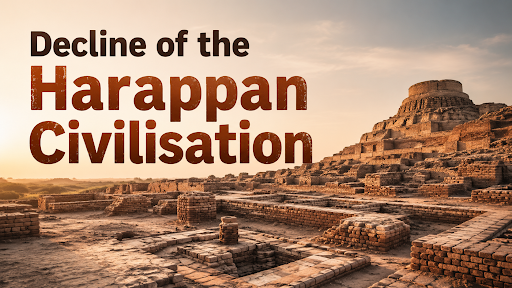
Scientists from the Birbal Sahni Institute of Palaeosciences discovered Garhwal Himalaya pollen records linking a 4,200-year-old mega-drought to the Harappan Civilisation's gradual collapse and migration.
What is Palynology?
Palynology is the scientific study of pollen grains, spores, and other microscopic organic particles preserved in sediments, peat, and rocks. It helps reconstruct ancient vegetation, climate, and human–environment interactions.
Pollen grains act as natural microscopic time capsules because their tough outer wall (sporopollenin) allows them to remain preserved for thousands of years.
-
By identifying pollen assemblages, scientists can reconstruct past vegetation, rainfall, temperature, and monsoon variability.
-
For example, higher oak (Quercus) pollen generally indicates warm and moist conditions, while higher pine (Pinus) pollen reflects relatively cooler and drier environments.
Recent Study about the decline of Harappan Civilisation
Study Site: Scientists extracted a 3.8-metre-long sediment core from Deoria Tal, a high-altitude lake in the Garhwal Himalaya (Uttarakhand), to reconstruct environmental changes over the past several thousand years.
Scientific Method: Researchers used Accelerator Mass Spectrometry (AMS) radiocarbon dating on 10 water chestnut (Trapa) seed samples to establish an accurate chronology. They analysed the Oak–Pine pollen ratio to infer changes in temperature, rainfall, and the strength of the Summer Monsoon (ISM).
What are the Major Findings?
Evidence of the 4.2 ka Climatic Event: The pollen record shows a shift in vegetation around 4,250 years ago, corresponding to the globally recognised 4.2 ka climatic event, a prolonged episode of drought and cooling.
Weakening of the Indian Summer Monsoon: The study indicates a marked decline in the Indian Summer Monsoon (ISM) during this period, likely linked to a southward shift of the Inter-Tropical Convergence Zone (ITCZ), frequent El Niño events, and a negative Indian Ocean Dipole (IOD).
Impact on the Harappan Civilisation: Reduced monsoon rainfall weakened river systems such as the Indus and Ghaggar-Hakra, affecting agriculture and contributing to the gradual eastward migration of Harappan populations towards the more humid Ganga plains, rather than an abrupt collapse.
What is the 4.2 ka Climatic Event?
The 4.2 ka (4,200 years ago) climatic event was a global episode of prolonged drought and cooling that occurred around 2200 BCE.
-
It marks the beginning of the Meghalayan Age, the current stage of the Holocene Epoch, recognised by the International Commission on Stratigraphy (ICS).
The event coincided with widespread environmental stress and societal changes, including the decline of the Akkadian Empire (Mesopotamia), the Old Kingdom of Egypt, and several ancient cultures across Asia, highlighting the far-reaching impacts of abrupt climate change.
Source: PIB
|
PRACTICE QUESTION Q. Evaluate the role of the Indian Summer Monsoon (ISM) in the rise and fall of ancient civilizations in the Indian subcontinent. 150 words |