Why In News?
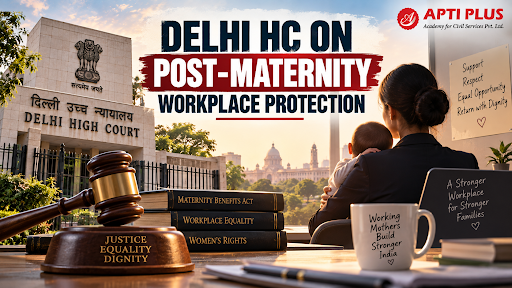
The Delhi High Court in the Rakhi Bisht vs Union of India (2026) case established that women returning from statutory maternity leave in private firms are legally entitled to their previous functional status and managerial responsibilities.
What Did the Delhi High Court Rule?
Right to Resume Previous Post: Woman returning from maternity leave is entitled to resume the exact post she held prior to leave.
Requirement of Genuine Equivalence: If the previous post is unavailable for bona fide reasons, the alternate post must match in pay, status, and authority.
Beyond Mere Salary Retention: Maternity protection cannot be hollowed out by retaining pay while demoting managerial duties to clerical tasks.
Eradicating Workplace Ignominy: Biological maternity cannot be allowed to become a source of professional humiliation or career derailment.
Strict Application to Private Employers: Statutory protections under Section 12 of the Maternity Benefit Act bind private establishments without exception.
Maternity Rights In India
Section 12 of Maternity Benefit Act, 1961: Prohibits dismissal during pregnancy absence and outlaws altering service conditions to a woman's disadvantage.
Maternity Benefit (Amendment) Act, 2017: Mandates 26 weeks paid leave, crèche facilities for 50+ staff, and optional work-from-home provisions.
Code on Social Security, 2020: Integrates maternity entitlements across organized and unorganized gig-economy platforms under Chapter VI.
Constitutional Equality (Articles 14 & 15(3)): Empowers affirmative state actions to eliminate structural economic disadvantages confronting female professionals.
DPSP Directive on Maternity Relief (Article 42): Mandates the State to secure just and humane conditions of work and effective maternity relief.
Right to Dignity under Article 21: Expands the right to life to encompass reproductive autonomy free from corporate career penalization.
Core Issue
Subdued Female Labour Participation: India's Female Labour Force Participation Rate stands at 41.7%, constrained heavily by family caregiving burdens.
Corporate 'Leaky Pipeline' Post-Childbirth: According to an Ashoka University report, 73% of Indian women leave their jobs after childbirth and struggle to return to work. Even among those who do return, nearly 48% exit again within four months of rejoining.
100% Employer-Financing Disincentive: Mandating private employers to fully fund 26 weeks of paid leave creates subconscious hiring biases against young women.
Informal Sector Coverage Exclusions: Working women in agriculture and construction remain outside the effective reach of formal paid maternity leave.
Supreme Court on Maternity Rights
MCD vs Female Workers (Muster Roll) (2000): Extended statutory maternity benefits to daily-wage and temporary contractual women workers under Article 21.
Dr. Kavita Yadav vs Secretary, MoHFW (2023): Ruled that statutory maternity benefit entitlement continues even if the underlying contract expires during the leave period.
Deepika Singh vs Central Administrative Tribunal (2022): Clarified that biological realities and familial choices cannot be weaponized to withhold statutory maternity leave.
State of Punjab vs Rafiq Masih (2014): Reaffirmed that arbitrary administrative recoveries or functional downgrades against vulnerable employees violate natural justice.
Way Forward
Transition to Shared Social Insurance Model: Replicate ILO Convention 183 by funding maternity wages via state social security funds rather than 100% employer liability.
Institutionalize Mandatory Re-Integration Plans: Require corporate human resource departments to file structured post-maternity career resumption blueprints.
Enact Paid Paternity and Parental Leave: Introduce statutory shared parental leave mandates to balance domestic childcare responsibilities between spouses equally.
Enforce On-Site and Clustered Crèche Mandates: Subsidize common industrial crèches in urban business parks to implement Section 11A of the amended Maternity Act.
Deploy Internal Gender Audit Watchdogs: Mandate internal complaints and gender audit committees in firms with 50+ staff to probe disguised post-maternity demotions.
Learn from Successful Global Models
-
Sweden's Shared Parental Leave System (Global Gold Standard): Offers 480 days of state-funded parental leave with 90 days reserved exclusively for each parent, eliminating hiring biases.
-
Singapore's Co-Funded Maternity Leave Model (Global PPP Benchmark): Government co-finances up to 8 weeks of maternity leave wages, shielding private businesses from direct financial burdens.
Conclusion
Safeguarding a returning mother’s functional status and managerial trajectory transforms statutory maternity leave from formal paper compliance into genuine constitutional gender equality at the workplace.
Source: thehindu
|
PRACTICE QUESTION Q. Examine the economic and legislative rationale for shifting India's employer-funded maternity benefit system to a state-supported social insurance model. (10 Marks, 150 Words) |