Why In News?
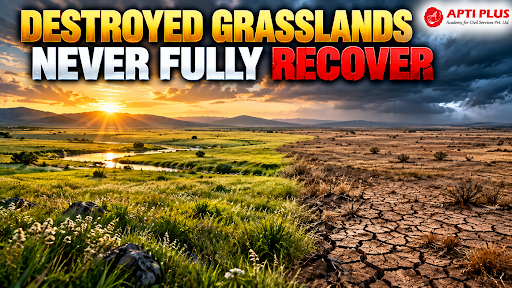
A study by the Indian Institute of Science Education and Research (IISER) revealed that destroyed ancient grasslands may never fully recover their original (Ancient) ecological composition.
What Are Ancient (Old-Growth) Grasslands?
Ancient or "old-growth" grasslands are primary, long-established open grassy biomes shaped over thousands of years by natural evolutionary forces, seasonal drought, grazing megafauna, and low-intensity wildfire regimes.
Slow-Growing Perennial Flora: Dominated by long-lived perennial grasses and forbs characterized by tough, fibrous leaves, high root-to-shoot ratios, and underground bud banks designed to endure extreme climatic stress.
Endemic Biodiversity Sanctuaries: Harbor highly specialized, co-evolved wildlife species, ranging from critically endangered avian fauna to subterranean insects and distinct soil microbiota.

What Are Secondary Grasslands?
Regrowth Following Anthropogenic Clearing: Secondary grasslands are open habitats that recolonize land following severe human intervention, such as agricultural plowing, clear-felling, open-cast mining, or heavy livestock overgrazing.
Altered Plant Composition: Dominated by short-lived, fast-growing annual grasses, opportunistic weeds, and ruderal species that possess rapid seed dispersal mechanisms but lack the ecological resilience of native perennials.
Severed Underground Linkages: Plowing and soil compaction permanently destroy ancient subterranean bud banks, disrupt fungal mycorrhizal networks, and deplete organic carbon stratified over centuries.
Persistent Ecological Divergence: Even after decades or centuries of total agricultural abandonment, secondary grasslands fail to transition back to the botanical diversity of primary grasslands.
Highlights of The IISER-PNAS Study
Comprehensive Global Dataset: Analyzed 742 plant species across temperate and tropical grasslands spanning six continents (Asia, Africa, North America, South America, Europe, and Australia).
Universal Functional Divergence: Ecological gap between old-growth and secondary grasslands is consistent globally: secondary grasslands are universally populated by species with higher specific leaf area and rapid nutrient acquisition, while ancient grasslands preserve stress-tolerant, slow-growing perennials.
Longevity Trap: Native perennial plants in ancient grasslands prioritize survival over rapid growth; once cleared, they cannot outcompete aggressive colonizer species in disturbed soils.
Centuries-Long Deficit: Structural and functional differences persist for centuries, confirming that grassland degradation is functionally irreversible under passive natural recovery.
Ancient (Old-Growth) Grasslands vs Secondary Regenerated Grasslands
|
Why Is Grassland Restoration Difficult?
Exhaustion of Soil Seed & Bud Banks: Deep plowing obliterates the subterranean regenerative organs (tubers, corms, rhizomes) that ancient grasses depend upon for post-disturbance recovery.
Loss of Soil Microbiome and Mycorrhizae: Soil disturbance eradicates specialized arbuscular mycorrhizal fungi (AMF) that native perennial grasses rely on to extract phosphorus and moisture during prolonged droughts.
Invasive Species Encroachment: Fast-growing ruderal weeds rapidly colonize exposed soil, preempting sunlight, water, and space, thereby suppressing the slow germination of native grass seeds.
Altered Hydrology and Soil Chemistry: Agricultural fertilizers leave residual nitrogen and phosphorus spikes that favor non-native annual weeds over nutrient-efficient native perennials.
Why Are Grasslands Critical For Ecological Security?
Climate-Resilient Carbon Storage: Grasslands store approximately 34% of global terrestrial carbon, primarily underground; unlike forests, where fires release canopy carbon directly into the atmosphere, grassland fires leave subterranean root carbon intact.
Water Table Recharge and Soil Conservation: Deep, fibrous root systems facilitate rainwater infiltration, recharge shallow aquifers, reduce flash-flood runoff, and prevent topsoil erosion.
Harboring India's Most Threatened Fauna: Indian grasslands are mandatory habitats for critically endangered species, including the Great Indian Bustard (Ardeotis nigriceps), Lesser Florican, Bengal Florican, Blackbuck, Indian Gazelle (Chinkara), and the Indian Grey Wolf.
Pastoral Economy & Food Security: Sustain millions of livestock in India, supporting the milk, meat, and wool economies of traditional pastoralist communities (e.g., Maldharis, Dhangars, Gujjars, Bakarwals).

What Are The Major Threats To Indian Grasslands?
Misclassification as "Wastelands": Official planning frameworks, including the Wasteland Atlas of India, classify open natural ecosystems (grasslands, scrublands, savannas) as "wastelands" suitable for diversion.
Inappropriate Afforestation Policies: Well-intentioned compensatory afforestation programs frequently plant non-native, water-guzzling tree saplings on natural open grasslands, destroying the ecosystem.
-
Example: Monoculture Tree Plantings in the Shola-Grasslands of the Western Ghats, where exotic eucalyptus, pine, and acacia plantations historically displaced native montane grasses.
Proliferation of Invasive Alien Species: Proliferation of aggressive woody weeds alters soil chemistry and shades out native sun-loving grasses.
-
Example: The Prosopis juliflora (Gando Baval) Invasion in the Banni Grasslands of Kutch, shrinking Asia's finest natural grassland tract and suffocating native fodder varieties.
Fragmentation by Linear Infrastructure: Unplanned canals, power transmission lines, and road networks crisscross grassland habitats, causing direct bird strike mortalities.
-
Example: Overhead High-Voltage Power Lines in Rajasthan and Gujarat, acting as the primary mortality driver for the critically endangered Great Indian Bustard.
Way Forward
De-Notify Grasslands from the "Wasteland" Category: Amend the Wasteland Atlas of India to formally classify grasslands, scrublands, and savannas as Open Natural Ecosystems (ONEs) requiring strict conservation parity with tropical forests.
-
Example: Task Force on Grasslands and Deserts (Planning Commission, 2006), which recommended enacting a National Grassland Policy to halt arbitrary land diversion.
Halt Ill-Conceived Tree Planting in Open Biomes: Prohibit compensatory afforestation (CAMPA) projects from converting natural native grasslands into tree plantations.
-
Example: Madras High Court Directives (2022), ordering the systematic eradication of exotic acacia and eucalyptus from the Nilgiris to restore native Shola grasslands.
Establish Regional Native Seed Banks: Set up dedicated native grass seed multiplication facilities and germplasm banks to supply native perennial seeds (e.g., Dichanthium, Cenchrus, Sehima) for active ecological restoration.
Empower Pastoralist Communities via Community Forest Rights: Recognize community management over pastoral commons under Section 3(1)(i) of the Forest Rights Act (FRA), 2006, integrating traditional rotational grazing systems.
-
Example: Banni Grassland Community Management Plans by the Maldhari Community, successfully restoring native Deshi Baval and perennial grasses through community-led invasive removal.
Institutionalize Long-Term Ecological Monitoring (LTEM): Establish multi-decadal permanent monitoring plots to measure subterranean carbon stocks, hydrological recharge, and vegetative transitions across Indian grasslands.
Conclusion
By proving that destroyed ancient grasslands cannot be rebuilt through passive regrowth, scientific evidence underscores that protecting intact open natural ecosystems is an ecological imperative that post-hoc restoration can never replace.
Source: HINDUSTANTIMES
|
PRACTICE QUESTION Q. With reference to grassland ecosystems, consider the following statements: 1. Unlike tropical forests, the majority of carbon in ancient grassland ecosystems is stored below ground in root systems and soils. 2. Secondary grasslands that regrow after agricultural abandonment quickly regain the exact floristic composition of ancient old-growth grasslands. 3. The Banni grassland in Gujarat is one of the largest natural grasslands in Asia, currently threatened by the invasive Prosopis juliflora. Which of the statements given above are correct? (a) 1 and 2 only (b) 2 and 3 only (c) 1 and 3 only (d) 1, 2 and 3 Answer: (c) Explanation: Statement 1 is correct: In forest ecosystems, the majority of carbon is stored above ground in the leaves, branches, and trunks of trees. In contrast, ancient grassland ecosystems store up to 90% of their carbon below ground in their massive, deep root systems and the surrounding soil. This makes them highly resilient carbon sinks, as underground carbon is less vulnerable to wildfires. Statement 2 is incorrect: Old-growth grasslands are highly complex ecosystems that develop over centuries or millennia. When grasslands are cleared for agriculture and later abandoned, the recovering secondary grasslands do not quickly regain the exact floristic composition of the original ecosystem. Studies show that full recovery of native plant diversity and species composition can take decades, centuries, or may never fully happen due to soil degradation and seed bank loss. Statement 3 is correct: The Banni grassland in the Kachchh District of Gujarat is indeed one of the largest and finest natural grasslands in Asia. It forms a crucial ecosystem for pastoral communities (like the Maldharis) and wildlife. However, it is heavily threatened by Prosopis juliflora (locally known as Gando Baval), an exotic invasive shrub species that suppresses native grasses and alters the landscape. |