Why In News?
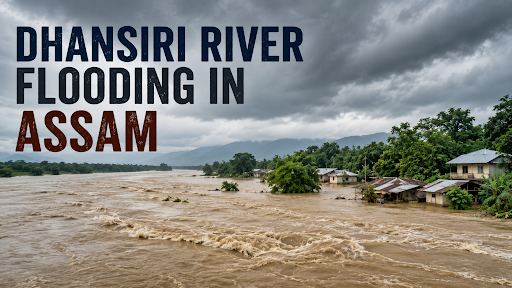
Assam’s flood situation remains highly critical as the Dhansiri River continues flowing above its danger mark.
About Dhansiri River
|
River system |
Part of Brahmaputra River System |
|
Origin |
Nagaland, near Laisang/Laishiang Peak of the Barail mountain region |
|
Direction |
Generally south to north, with changes in course |
|
States |
Nagaland and Assam |
|
Length |
About 350 km |
|
Confluence |
Joins the Brahmaputra near Dhansirimukh, opposite the Majuli region |
|
Important districts |
Dimapur area of Nagaland; Karbi Anglong and Golaghat in Assam |
|
Nature |
Predominantly rain-fed |
|
Major tributaries |
Doyang/Diyung, Diphu, Bhogdoi, Nambar, Doigrung and Kalyani |
Tributaries & Drainage Basin
-
Left-Bank Tributaries: Intaki, Diphu, Moradansiri, Kalioni
-
Right-Bank Tributaries: Doyang (Dayang) — the most important and longest tributary, Bara Monglu, Langlong, Khora, Beopani
Ecological Significance
-
Ecological Corridors: The river flows adjacent to wildlife habitats:
-
Intanki National Park (Nagaland)
-
Dhansiri Reserved Forest (Assam)
-
It skirts parts of the Kaziranga National Park ecosystem near its mouth.
-
Key Biodiversity:
-
The basin holds tropical semi-evergreen and moist deciduous forests rich in commercial timber.
-
It serves as a habitat for endangered aquatic fauna like the Golden Mahseer.
Source: ANINEWS
|
PRACTICE QUESTION Q. With reference to the Dhansiri River, consider the following statements:
Which of the statements given above is/are correct? (a) 1 only (b) 2 only (c) Both 1 and 2 (d) Neither 1 nor 2 Answer: (c) Explanation: Statement 1 is correct: The Dhansiri River originates from the Laisang Peak in Nagaland. It flows from south to north before merging into the southern bank of the Brahmaputra River. Because the Brahmaputra flows from east to west through Assam, any tributary joining it from the south (left side of its flow direction) is classified as a left-bank tributary. Statement 2 is correct: In its initial course, the river cuts through Nagaland and flows directly past the Dimapur district. It subsequently acts as a natural boundary before entering the plains of Assam, where it primarily flows through the Golaghat district until its confluence with the Brahmaputra. |