Why In News?
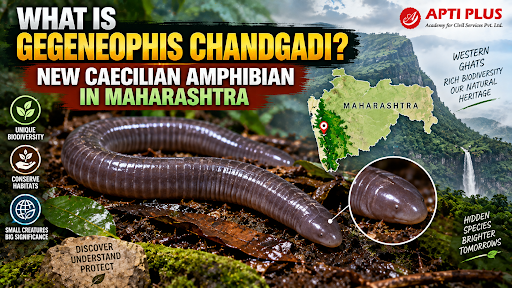
Researchers identified Gegeneophis chandgadi, a rare burrowing caecilian amphibian discovered in Maharashtra.
What is Gegeneophis chandgadi?
Gegeneophis chandgadi is a newly discovered species of subterranean, legless amphibian belonging to the caecilian family Grandisoniidae
-
Named after Chandgad taluka, Maharashtra, where the holotype was collected.
Habitat
-
Found hiding under woodpiles and moist leaf litter in backyard gardens.
-
It is endemic to the northern Western Ghats.
Features
-
Appearance: It has a slender, flesh-colored, worm-like body.
-
Body Rings (Annuli): Like other caecilians, its skin features ring-like folds. Gegeneophis chandgadi is distinct because it features primary rings running along the entire length of its body, but its secondary rings are strictly concentrated on the posterior (back) half.
-
Secretive Nature: Like other members of the Gegeneophis genus, it is a burrowing (fossorial) creature that lives almost entirely underground, completely lacking visible external limbs.
What are Caecilians?Caecilians are a group of limbless, worm-like or snake-like amphibians belonging to the order Gymnophiona.
Key Characteristics
|
Ecological Significance
-
Soil Purity Bio-Indicators: Rapidly vanish from soil contaminated by chemical fertilizers, pesticides, or weedicides.
-
Soil Aeration & Tillage: Dig micro-tunnels that boost water infiltration and stop topsoil compaction.
-
Trophic Regulation: Act as middle predators controlling subterranean termites while feeding burrowing shieldtail snakes (Uropeltidae).
-
Cryptic Biodiversity: Show that unknown vertebrates can persist in human-modified agricultural areas.
Source: RESEARCHMATTERS
|
PRACTICE QUESTION Q. The newly discovered species 'Gegeneophis chandgadi' belongs to which of the following animal groups? (a) Arboreal pit vipers endemic to the Eastern Himalayas (b) Subterranean, legless amphibians endemic to the Western Ghats (c) Freshwater blind cavefish discovered in Meghalaya (d) Nocturnal gliding geckos found in the Andaman and Nicobar Islands Answer: (b) Explanation: Gegeneophis chandgadi is a fossorial, legless caecilian amphibian belonging to the family Grandisoniidae, discovered in Buzawade village, Chandgad, Maharashtra. |