Why In News?
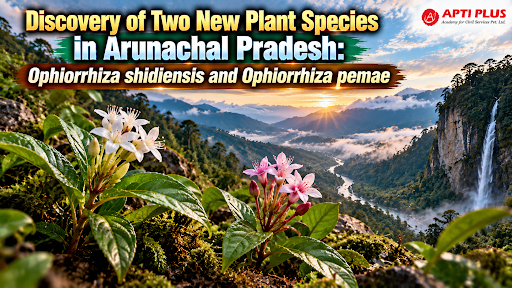
Scientists from the Botanical Survey of India (BSI) discovered two new flowering plant species—Ophiorrhiza shidiensis and Ophiorrhiza pemae—from the Vijoynagar valley in Changlang district, Arunachal Pradesh.
About Ophiorrhiza shidiensis
-
Family: Belongs to the Rubiaceae family (the coffee, madder, or bedstraw family).
-
Naming: Named after "Shidi," the traditional name for Gandhigram used by the Lisu (Yobin) tribal community, reflecting the specific collection locality.
-
Botanical Characteristics:
-
An erect, perennial herb growing up to one meter tall.
-
Features pale green leaves on the underside.
-
Displays tubular flowers that are white at the base, pale pink in the middle, and rose-pink towards the mouth.
-
Occurs in moist, shaded forests between 1,100 and 2,000 meters above sea level.
-
Genus Significance: Plants belonging to the genus Ophiorrhiza are traditionally known to produce camptothecin, a medicinal alkaloid used as a foundation for anti-cancer drugs (such as treatments for colon cancer).
-
Companion Species: Discovered alongside another new species in the same genus, Ophiorrhiza pemae.
About Ophiorrhiza pemae
-
Named After: Arunachal Pradesh Chief Minister Pema Khandu.
-
Family: Belongs to the family Rubiaceae (the coffee, madder, or bedstraw family) and the genus Ophiorrhiza.
-
Morphological Characteristics:
-
Closely related to Ophiorrhiza himadrica.
-
Differs through its taller growth, larger leaves, distinctive leaf margins, and light pink to purplish flowers.
-
Ecological Context: The genus Ophiorrhiza is widely noted in botanical research as a natural source of camptothecin—an important anti-cancer compound.
About Botanical Survey of India (BSI)
The Botanical Survey of India (BSI) is the apex taxonomic and floristic research organization under the Ministry of Environment, Forest and Climate Change (MoEFCC).
-
Origin: Founded in 1890 under Sir George King (Superintendent of the Royal Botanic Garden, Calcutta), and reorganised in 1954 post-independence.
-
Headquarters: Kolkata, West Bengal.
-
Regional Network: Operates via 11 Regional Centres across India and manages the Botanic Garden of Indian Republic in Noida (established in 2002).
Core Mandates and Functions
-
Taxonomic Studies: Conducts systematic studies and inventories of plant resources, including angiosperms, gymnosperms, cryptogams, and microbes.
-
Floristic Documentation: Publishes national, state, and district-level floras (such as Flora of India).
-
Conservation: Evaluates rare, endangered, and threatened species for the Red Data Book of Indian Plants using IUCN-adapted criteria.
-
Herbaria & Gene Banks: Acts as the national custodian of authentic plant specimens in herbaria and maintains germplasm/gene banks.
-
Ethnobotany & Traditional Knowledge: Documents plant-based traditional knowledge and performs phytochemical and molecular profiling.
-
Statutory/Policy Support: Helps implement the Biological Diversity Act, 2002, the Wildlife (Protection) Act, 1972, and India's commitments under the Convention on Biological Diversity (CBD).
Important Periodicals & Publications
-
NELUMBO (formerly Bulletin of the Botanical Survey of India)
-
Vanaspati Vani
-
Parijata
-
Regular release of annual Plant Discoveries reports
Source: MID-DAY
|
PRACTICE QUESTION Q. Consider the following statements regarding the plant biodiversity of Arunachal Pradesh:
Which of the statements given above is/are correct? (a) 1 and 2 only (b) 1 and 3 only (c) 3 only (d) 1, 2, and 3 Answer: (b) Explanation: Statement 1 is correct: Arunachal Pradesh harbors 5,192 angiosperm species (23.52% of India's total) within 2.54% of India's landmass. Statement 2 is incorrect: Ophiorrhiza shidiensis belongs to the Rubiaceae family (not Orchidaceae) and is an erect, photosynthetic perennial herb. Statement 3 is correct: Amentotaxus assamica is an endemic gymnosperm listed as Critically Endangered by the IUCN. |