Why In News?
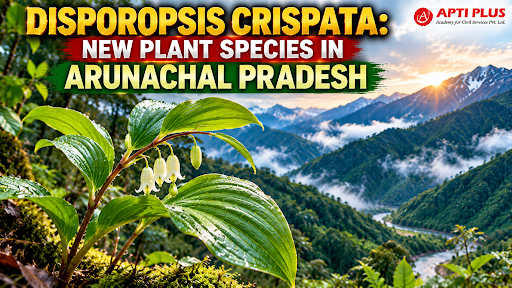
Researchers have discovered a new flowering plant species, Disporopsis crispata, in Arunachal Pradesh.
What Is Disporopsis Crispata?
-
Discovery Site: From Vijoynagar in Changlang district, Arunachal Pradesh. Vijoynagar is a remote area near the Myanmar border.
-
Research Team: Royal Botanic Garden Edinburgh and the Botanical Survey of India.
-
Classification: It belongs to Asparagaceae, subfamily Convallarioideae.
-
Genus Range: The genus Disporopsis has around 12 known species. They were earlier recorded mainly in Myanmar, China, Taiwan, the Philippines and other parts of Southeast Asia.
-
Westernmost Record: The discovery extends the known range of the genus to the west. India is its westernmost known extension.
-
Habitat: Grows on damp slopes in temperate forests of mixed rhododendron and bamboo, at 2,500 to 2,800 metres.
-
Conservation Status: Researchers have proposed classifying it as Data Deficient (DD) under the IUCN framework, as fewer than five individual plants have been located in India so far.
Key Features Of Disporopsis Crispata
-
Distinctive Leaves: Strongly wavy, crinkled leaf margins. The species name crispata refers to these crinkled edges.
-
Stems And Flowers: Reddish stems and white-and-green flowers. Stems grow 30 to 80 cm tall, and lance-shaped leaves measure 5 to 15 cm.
-
Fruits And Season: Bears fleshy white fruits with three to eight seeds. It flowers between May and June.
-
Earlier discovery: A specimen collected in 1962 from the Kachin Hills of Myanmar was misidentified as Polygonatum. It lacked flowers, so identity could not be settled.
Source: INDIATODAYNE
|
PRACTICE QUESTION Q. With reference to Disporopsis crispata, consider the following statements:
How many of the statements given above are correct? (a) Only one (b) Only two (c) Only three (d) All four Answer: (a) Explanation: Statement 1 is incorrect. Researchers discovered Disporopsis crispata in the Vijoynagar area of Changlang district in Arunachal Pradesh, not Tawang district. Statement 2 is incorrect. The plant belongs to the Asparagaceae family (subfamily Convallarioideae), not the grass family Poaceae. Statement 3 is correct. It grows on damp slopes in temperate forests at elevations of 2,500 to 2,800 metres above sea level. Statement 4 is incorrect. The plant bears white-and-green flowers. Its stems are reddish, and its leaves feature strongly wavy, crinkled margins. |