Why In News?
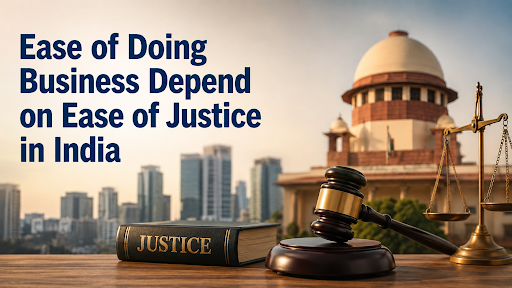
Ease of Doing Business directly depends on Ease of Justice: economic growth and investments rely on a predictable, transparent, and swift legal framework to protect contracts and resolve corporate disputes.
What is Ease of Justice?
Ease of Justice means citizens and businesses can access, afford, and use the legal system without unreasonable delay, cost, or complexity.
-
Access to Courts: Physical and digital reach of courts to every citizen and enterprise, including rural and remote areas.
-
Affordable Justice: Litigation costs that do not deter genuine claimants or small businesses from seeking redress.
-
Timely Justice: Disposal of cases within a reasonable, predictable timeframe.
-
Understandable Legal Processes: Procedures simple enough for a layperson or small entrepreneur to navigate without excessive dependence on expensive legal counsel.
Why is Ease of Justice Important for Businesses?
-
Enforcing Contracts: Businesses need courts to make agreements binding in practice, not just on paper.
-
Protecting Property Rights: Secure property and IP rights encourage long-term investment rather than short-term extraction.
-
Resolving Commercial Disputes: Fast resolution of disputes over payments, supply chains, and joint ventures keeps business relationships functional.
-
Reducing Business Uncertainty: Predictable timelines let firms plan budgets and litigation reserves accurately.
-
Improving Investor Confidence: A credible judiciary signals to foreign and domestic investors that their capital is legally protected.
What are the Major Judicial Challenges?
Large Case Pendency: As of July 2026, over 96000 cases are pending in the Supreme Court and over 64.7 lakh cases in the High Courts. (Source: National Judicial Data Grid).
Infrastructure Gaps: Many district and taluka courts still lack adequate courtrooms, digital connectivity, and case-management systems.
Shortage of Judicial Resources: As of February 2026, district and subordinate courts had 22,712 court halls and 20,052 residential units, but infrastructure remains uneven across States.
Complex Legal Procedures: Multiple layers of appeal and procedural technicalities extend case life well beyond original estimates.
High Litigation Costs: Legal fees and procedural costs discourage small businesses and individuals from pursuing legitimate claims.
What is the Link Between Justice and Investment?
-
Contract Enforcement: Directly determines whether a business can recover dues or damages through legal means.
-
Investor Confidence: A judiciary that resolves disputes fairly and fast reduces the "risk premium" investors attach to a market.
-
Business Predictability: Firms plan expansion more confidently when they know disputes won't drag for years.
-
Protection of Investments: Legal certainty shields both domestic and foreign capital from arbitrary loss.
-
Reduction in Transaction Costs: Fewer resources spent on legal contingencies free up capital for productive investment.
-
Long-term Capital Formation: Countries with credible courts tend to attract patient, long-horizon capital rather than speculative flows.
Significance for the Economy
|
What are India's Major Judicial Reforms?
-
Commercial Courts Act, 2015: Creates dedicated commercial courts and commercial divisions in High Courts to fast-track high-value commercial disputes.
-
Mediation Act, 2023: Institutionalises mediation as a formal, legally recognised mode of dispute resolution to reduce court burden.
-
e-Courts Mission Mode Project: Digitises court records, enables e-filing, and builds the backbone for the National Judicial Data Grid.
-
Tele-Law: Delivers free pre-litigation legal advice through Common Service Centres and Village Level Entrepreneurs across 784 districts in 36 States/UTs.
-
Nyaya Bandhu: Connects citizens with pro-bono advocates; the earlier DISHA scheme (2021-26) registered 10,681 pro-bono advocates.
-
DISHA 2.0: A restructured Central Sector Scheme (2026-31) with an outlay of ₹255 crore, aimed at 3 crore beneficiaries by 2031. (Source: PIB)
Way Forward
-
Fill Judicial Vacancies: Expedite appointments across the Supreme Court, High Courts, and district judiciary.
-
Strengthen Court Infrastructure: Scale up digital and physical infrastructure, especially in district and taluka courts.
-
Expand Commercial Courts: Widen the reach of the Commercial Courts Act, 2015 beyond metro cities.
-
Promote Mediation: Operationalise the Mediation Act, 2023 to divert more disputes away from litigation.
-
Improve Digital Justice: Scale platforms like VIDHI-Sanjeevani and Nyaya Setu for real-time, AI-assisted service delivery.
-
Simplify Legal Procedures: Cut procedural redundancy to make justice understandable for non-experts.
-
Strengthen Contract Enforcement: Continue Department of Justice-led reforms tied directly to the Enforcing Contracts indicator.
Conclusion
Ease of justice is not a separate goal from ease of doing business — it is the legal infrastructure that makes economic growth enforceable.
Source: INDIANEXPRESS
|
PRACTICE QUESTION Q. "Ease of doing business in India cannot be achieved without ease of justice." Critically analyse (250 words) |