Why In News?
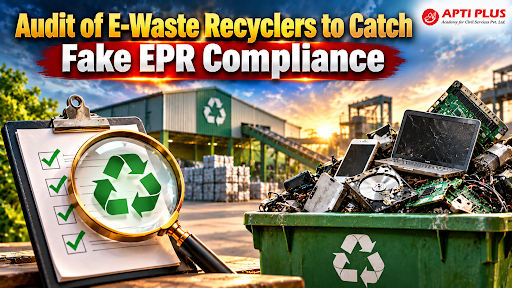
The Central Pollution Control Board (CPCB) has ordered States to audit more than 2,000 recyclers, including 309 e-waste recycling units, to stop inflated processing claims and forged compliance documents.
What Does The Audit Order Say?
|
Feature |
Details |
|
Issued by |
CPCB Chairman. |
|
Coverage |
2,000+ recyclers, including 309 e-waste units |
|
Concentration |
About one-third of e-waste recyclers are in Uttar Pradesh |
|
What will be checked |
Machinery, plant operations, electricity consumption and production records |
|
Penalty for forgery |
Treated as a "major violation"; the unit is blocked from generating EPR certificates |
-
Industry Impact: The issue has raised alarm in India's $95 billion consumer electronics market, prompting companies to review their recycling supply chains.
How Does E-Waste EPR Work In India?
Extended Producer Responsibility (EPR)
-
Principle: "Polluter pays": producers of electronics are responsible for ensuring their products are recycled at end of life.
-
Targets: Under the E-Waste (Management) Rules, 2022, producers must meet collection-cum-recycling targets starting at 60% of the e-waste generated, rising to 80% by 2027–28.
Certificate Mechanism
|
Step |
What Happens |
|
1. Recycling |
A CPCB-registered recycler processes e-waste; discarded, broken, or obsolete electrical and electronic devices. |
|
2. Certificate |
The recycler generates EPR certificates on the CPCB portal for the quantity recycled |
|
3. Purchase |
Producers buy these certificates to show they met their targets |
|
4. Penalty |
Non-compliant producers pay Environmental Compensation |
-
Floor Price: A 2024 amendment fixed a minimum price, such as ₹22 per kg for general e-waste, that producers must pay recyclers for certificates.
Where Fraud Happens
-
Paper Recycling: Some units generate certificates for waste they never processed, selling "paper compliance" to producers.
-
Early Warning: A January 2026 report by a government think tank had flagged recyclers issuing fraudulent certificates.
-
Similar Plastic Scam: In 2023, a CPCB audit in Karnataka found a plastic recycling unit had issued certificates for 3.48 lakh tonnes while it was not even operational.
How Big Is India's E-Waste Problem?
-
Third Largest Generator: India is the world's third-largest e-waste generator after China and the United States, according to the Global E-waste Monitor 2024.
-
Volume: India generated about 17.5 lakh tonnes of e-waste in 2023–24.
-
Global Context: The world generated about 62 million tonnes of e-waste in 2022, of which only about 22% was formally recycled. (Source: ITU)
-
Informal Hubs: Much of India's e-waste is still handled informally in clusters such as Seelampur (Delhi) and Moradabad (UP), using open burning and acid baths.
Initiatives Taken By Government For Strengthening E-Waste Management In India
E-Waste (Management) Rules, 2022
-
Coverage: In force from 1 April 2023, covering 106 types of electrical and electronic equipment.
-
Shift In Model: Replaced the earlier "producer responsibility organisation" system with tradable EPR certificates generated by registered recyclers.
-
Targets: Collection-cum-recycling targets rise from 60% to 80% over the years.
Centralised EPR Portal
-
Digital Registration: All producers, refurbishers, and recyclers must register on a centralized online portal managed by the Central Pollution ControlBoard (CPCB), where compliance tracking, certificate generation, and trading occur.
-
Crackdown on Loopholes: The CPCB has tightened verification and revoked registrations or penalized entities found generating fraudulent or fake certificates.
EPR Floor Price (2024)
-
Minimum Payment Rules: Introduced a floor pricing structure for EPR certificates to ensure genuine recyclers receive a fair minimum value, preventing sub-standard or fraudulent operators from undercutting legitimate recycling standards.
Battery Waste Management Rules, 2022
-
Battery EPR: Extended the certificate-based EPR framework specifically to battery waste, covering industrial, automotive, and portable lithium-ion batteries derived from electronics and electric vehicles.
Critical Mineral Recycling Incentive Scheme (2025)
-
Funding: A ₹1,500 crore incentive scheme designed to scale up domestic industrial capacity for extracting and recovering valuable critical and rare-earth minerals from e-waste and spent batteries.
Ban On Black Mass Exports (2026)
-
Keeping Feedstock At Home: In November 2026, India prohibited the export of lithium-ion battery black mass, so that battery waste is recycled within the country.
What Are The Key Challenges In Ensuring Genuine E-Waste Recycling In India?
Fake Certificates Undermining EPR
-
Paper Compliance: Certificates can be generated without real processing, letting producers meet targets on paper while waste goes to informal yards.
-
Producer Blind Spots: Large firms such as Haier and Godrej & Boyce failed to detect forged documents, showing weak due diligence.
-
Repeated Pattern: The 2023 Karnataka plastic case shows fraud is not limited to e-waste.
Weak Verification Capacity
-
Few Inspectors: State Pollution Control Boards lack staff to physically verify output at hundreds of units.
-
Concentrated Risk: With about a third of e-waste recyclers in Uttar Pradesh, a single State's enforcement capacity matters greatly.
Dominance Of Informal Sector
-
Cheap And Toxic: Informal recyclers extract metals through open burning and acid leaching, harming workers' health and polluting soil and water.
-
Leakage From Formal Chain: Waste collected by formal channels can still leak to informal yards.
Gap Between Collection And Real Recycling
-
Data Doubts: Official recovery rates have risen sharply, but fraud cases raise questions about how much of it reflects actual recycling.
Inconsistent State Rules
-
Fragmented Implementation: Some States insist on local recycling while central rules allow inter-State movement, creating confusion for compliant firms.
Low Consumer Participation
-
Hoarding And Informal Sale: Consumers often store old devices or sell them to scrap dealers, so they never reach registered recyclers.
Low Recovery Of Valuable Materials
-
Value Lost: Without advanced refining, precious and critical metals in e-waste, such as gold, copper and rare earths, are lost.
What Is The Way Forward For Ending Fake Compliance In E-Waste Recycling?
Data-Based Verification
-
Mass Balance Checks: Cross-check certificates against input weights, electricity use and output sales of each plant, as the audit procedure now requires.
-
Real-Time Monitoring: Install CCTV, digital weighbridges and power meters linked to the CPCB portal.
Strict Penalties And Producer Liability
-
Deterrent Action: Cancel registrations and impose heavy environmental compensation on fraudulent recyclers.
-
Shared Responsibility: Hold producers accountable for due diligence on their recycling partners.
Independent Third-Party Audits
-
Accredited Auditors: Use certified auditors for regular, unannounced inspections, reducing dependence on overstretched State boards.
Formalise The Informal Sector
-
Integration: Train and register informal collectors and dismantlers as suppliers to authorised recyclers.
Consumer Take-Back Systems
-
Easy Returns: Mandate take-back counters at retailers and offer refunds for returned devices.
-
Learn From Global Models: The EU's WEEE Directive sets a collection target of 65% of equipment sold, and Switzerland has long funded recycling through an advance recycling fee paid at purchase.
Invest In Advanced Recycling
-
Refining Capacity: Use the Critical Mineral Recycling Incentive Scheme to build plants that recover critical and precious metals.
Harmonise Rules Across States
-
Uniform Standards: Issue clear national guidelines on inter-State movement and audits to reduce confusion.
Conclusion
The nationwide audit targets a basic weakness in India's EPR system: certificates that exist on paper without real recycling. Strong data checks, penalties, independent audits and formalisation of the informal sector are needed to make EPR deliver genuine recycling.
Source: REUTERS
|
PRACTICE QUESTION Q. India's e-waste rules are strong on paper but weak on the ground. Examine. (10 Marks, 150 Words) |