Why In News?
Australian catchment research disproved long-standing afforestation assumptions, showing eucalyptus is no cure for salinity.
About Eucalyptus Trees
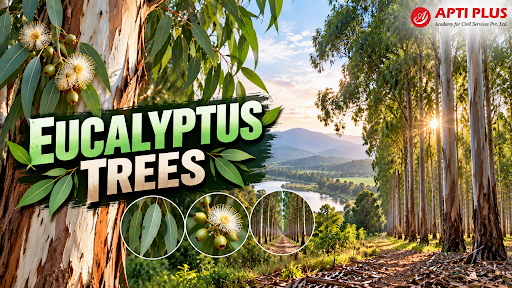
Eucalyptus trees (commonly known as nilgiri or gum trees) are fast-growing evergreen trees native to Australia that feature aromatic leaves and peeling bark.
Key Characteristics
-
Height: Can grow very tall, ranging from 30 feet in managed or container settings up to over 100 feet in the wild.
-
Leaves: Lance-shaped or varying shapes containing eucalyptol oil, which gives off a strong, refreshing, mint-like scent.
-
Bark: Often peels away in long strips, leaving a smooth or colorful trunk.
Uses and Benefits
-
Medicinal: The extracted essential oil is widely used in aromatherapy and traditional remedies to help clear nasal passages and support the respiratory system.
-
Wildlife: Leaves serve as the primary food source for koalas.
-
Biomass Production: High yields support regional rural fuel needs and industrial biomass briquettes.
-
Pole Timber: Provides durable, straight poles for construction, scaffolding, and transmission lines.
-
Pulp Industry: Supplies the paper and packaging sectors, creating downstream jobs.
-
Carbon Sequestration: Rapid early growth assists in expanding national carbon sinks for Paris Agreement targets.
-
Farm Income: Serves as a "tree-bank" asset for smallholders to fund agricultural needs and emergencies.
-
Land Reclamation: Bio-drains waterlogged canal-command zones, restoring access to land.
Australian Eucalyptus Study
A study published in Agricultural Water Management revealed that planting deep-rooted eucalyptus trees to combat soil salinity altered groundwater levels over 15 years but failed to stop saline seeps.
Key Findings of the Study
-
Started in 1976: Researchers set up a mixed eucalyptus plantation over a salty patch of land in south-western Australia to see how the trees handled groundwater and salt movement.
-
Higher Water Use: The eucalyptus trees consumed more water than nearby crops and pasturelands, changing underground water conditions over time.
-
No Salinity Fix: Despite using large amounts of water, the trees did not reverse or stop the saline seep as scientists originally hoped.
-
Broader Lesson: The research shows that underground water systems are complex, meaning simple tree-planting fixes cannot always solve deep environmental problems.

Eucalyptus Trees In India
-
Colonial & Post-Independence Adoption: Introduced in 1790 by Tipu Sultan and promoted in the 1970s via World Bank social forestry loans to generate industrial pulpwood.
-
Severe Groundwater Exhaustion: A mature eucalyptus tree transpires up to 100 liters of water daily, desiccating tube-wells across semi-arid belts of Karnataka and Punjab.
-
Chemical Allelopathy Hazards: Leaves release phytotoxic volatile terpenes and phenolic compounds that chemically inhibit the seed germination of native grasses and crops.
-
Severe Nutrient Siphoning: Rapid vegetative rotation strips soils of potassium, phosphorus, and nitrogen without returning nourishing organic humus to topsoils.
-
Heightened Wildfire Hazard: Highly flammable essential oils contained in canopy foliage dramatically increase forest fire ignition risks during dry summer spells.
Exotic Monoculture vs Native Multi-Tier Forest
|
Legal, Policy & Judicial Responses in India
-
Karnataka Statewide Cultivation Ban (2017): Prohibited planting Eucalyptus and Acacia species across public and private lands following critical groundwater collapses.
-
National Green Tribunal (NGT) Directives: Restrained state forest departments from utilizing Compensatory Afforestation Fund (CAMPA) funds to establish exotic monocultures.
-
National Forest Policy Alignment: Mandates that afforestation programs prioritize indigenous indigenous mixed species that enhance local biodiversity and soil water retention.
-
Bonn Challenge Commitment: Enforces native ecological restoration targets to reclaim 26 million hectares of degraded and desertified land by 2030.
Sustainable Afforestation Strategy
-
Strictly Enforce Monoculture Restrictions: Prohibit the deployment of exotic fast-growing species in water-stressed arid and semi-arid agro-ecological zones.
-
Institutionalize Native Agroforestry Subsidies: Incentivize farmers to cultivate indigenous species like Neem, Khejri, Jamun, and Mahua under the National Agroforestry Policy.
-
Promote Hydrogeologically Informed Afforestation: Require Central Ground Water Board clearance and aquifer mapping before approving large-scale commercial tree plantations.
-
Transition from Bio-Drainage to Watershed Management: Combat soil salinity through check dams, laser land-leveling, sub-surface gypsum drainage, and rainwater harvesting.
-
Reform CAMPA Fund Guidelines: Legally restrict compensatory afforestation outlays to native ecological restoration, penalizing commercial monoculture planting.
Source: TIMESOFINDIA
|
PRACTICE QUESTION Q. Which of the following environmental impacts is/are commonly associated with large-scale commercial plantations of Eucalyptus in semi-arid regions? 1. Depletion of the groundwater table due to high transpiration rates. 2. Chemical suppression of undergrowth vegetation through allelopathy. 3. Rapid replenishment of soil nitrogen and organic humus. Select the correct answer using the code given below: (a) 1 and 2 only (b) 2 and 3 only (c) 1 and 3 only (d) 1, 2, and 3 Answer: (a) Explanation: Statement 1 is correct: Eucalyptus trees are known for their fast growth and high transpiration rates, which require large amounts of water. In semi-arid regions, planting them on a large commercial scale often leads to the depletion of the groundwater table and the drying up of nearby water bodies. Statement 2 is correct: Eucalyptus leaves and roots release certain biochemicals into the soil that inhibit the growth of nearby plants. This biological phenomenon is known as allelopathy, and it leads to the chemical suppression of undergrowth vegetation, reducing local biodiversity. Statement 3 is incorrect: Eucalyptus plantations are notorious for depleting soil nutrients rather than replenishing them. They consume nutrients rapidly and their leaf litter decomposes very slowly, which prevents the quick formation of organic humus. They do not fix nitrogen like leguminous plants do. |