Why In News?
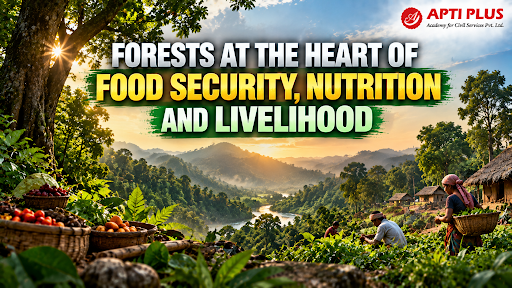
The report, Forests for food: Nourishing people, sustaining the planet, by the Food and Agriculture Organization (FAO), highlights the importance of forests in reducing hunger and poverty and calls on countries to include them into agrifood system policies.
FAO Report Highlights the Food and Nutrition Role of Forests
Global Dependence: More than 5 billion people worldwide rely on forests and trees to some extent for their livelihoods, dietary needs, fuel, and income.
Global Hunger: Around 645 million people experiencing chronic hunger in 2025, while global forest cover continues to shrink by an average of 10.9 million hectares per year.
Ecosystem Contributions: Forests provide direct dietary foods while simultaneously offering indirect agricultural support through soil fertility protection, watershed regulation, pest control, and pollination.
|
Food and Agriculture Organization (FAO) It is a specialized agency of the United Nations that leads international efforts to defeat hunger and improve nutrition.
|
What is the Role of Forests in Food Security?
Forest foods form a vital component of diets for rural and food-insecure communities, adding diversity, essential micronutrients, and macro-nutrients to staple-heavy diets.
Worldwide, more than 50,000 wild species are used for food and medicine, including at least 10,000 species consumed directly as food.
Fruits, Nuts and Tubers
-
Nutritional Density: Wild forest fruits, nuts, and tubers supply essential calories, proteins, healthy fats, and key micronutrients.
-
In regions like Gabon, young people consuming 200 grams of five specific forest fruits fulfill up to 100% of their daily requirements for several essential nutrients.
-
Commercial and Subsistence Value: Wild nuts, such as Brazil nuts and acai berries in the Amazon, support both household subsistence and significant commercial trade.
Mushrooms and Edible Insects
-
Mushrooms: Wild edible fungi are rich in micronutrients such as selenium, potassium, and essential vitamins. The global market for edible mushrooms is estimated at USD 42 billion per year.
-
Edible Insects: Over 1,900 insect species are consumed as food globally, serving as energy-dense sources of protein and fats.
Wild Meat and Other Forest Products
-
Protein and Essential Micronutrients: Wild meat (bushmeat) is a major source of protein, iron, and zinc for rural forest communities where domestic livestock is limited.
-
In parts of Africa, wild meat supplies up to 80% of daily protein intake, while in the Amazon and Congo basins, it delivers 60% to 80% of daily protein needs.
-
Inland Fisheries: In the Amazon basin, aquatic forest foods (fish from floodplain forests) account for 44% of total food consumed by weight.
Support for the Four Pillars of Food Security
-
Availability: Forests supply wild plant and animal foods directly, as well as livestock fodder (browse and feed) that supports milk and meat production.
-
Access: Non-timber forest products (NTFPs) contribute up to 20% of rural household income in developing regions, enabling poor families to purchase food.
-
Utilization: Woodfuel is used by 2.4 billion people (one-third of humanity) for cooking and food preservation, and by 1 billion people for boiling drinking water. Additionally, over 1 billion people rely on forest medicinal plants for primary healthcare.
-
Stability: Forest resources serve as essential safety nets during agricultural lean seasons, droughts, crop failures, and economic crises.
Challenges
Forest Degradation: Over 100 million hectares of forests are adversely impacted by wildfires, pest outbreaks, diseases, invasive species, and extreme weather.
Loss of Biodiversity: The global forest-specialist index declined by 53% between 1970 and 2014, indicating significant drops in forest wildlife populations.
Unsustainable Resource Extraction: Overhunting and illegal timber logging deplete local resource bases and disrupt crucial forest ecological processes like natural regeneration and seed dispersal.
Weak Recognition in Statistics: Forest food harvest and informal NTFP trade are rarely captured in official national statistics or agrifood accounting systems.
Pressure from Agriculture and Infrastructure: Commercial agriculture (cattle ranching, soy, oil palm) causes 40% of tropical deforestation, local subsistence farming accounts for 33%, and infrastructure and urban expansion account for 20%.
Climate Change: Rising temperatures, drought stress, and changing weather patterns reduce forest resilience, increasing tree diebacks and fire frequency.
|
International Initiatives For Sustainable Forestry
|
Way Forward
Integrate Forests into Food Policies: Cross-sectoral alignment is needed to bring forestry, agriculture, and national nutrition policies closer together.
Strengthen Community Forest Governance: Legal tenure rights should be secured to empower Indigenous Peoples and local communities in forest management.
Promote Sustainable Harvesting & Agroforestry: Expand agroforestry systems, support sustainable wild food harvesting, and enforce zero-deforestation commodity supply chains.
Improve Forest-Food Data: Build disaggregated data systems to record forest food consumption, wild meat reliance, and economic contributions.
Protect Forest Biodiversity: Apply landscape-scale management, reduce illegal wildlife trade, and integrate the One Health framework to balance human, animal, and ecosystem health.
Support Forest-Dependent Communities: Increase public investments, foster small forest enterprises (particularly for rural women), and establish transparent benefit-sharing frameworks.
Conclusion
Forests must shift from isolated conservation assets to integrated components of national food security frameworks, ensuring environmental protection strengthens human rights, gender equity, and resilient agrifood systems.
Source: DOWNTOEARTH
|
PRACTICE QUESTION Q. Forests are not only ecological assets but also important sources of food, nutrition and livelihoods. Discuss. 150 words |