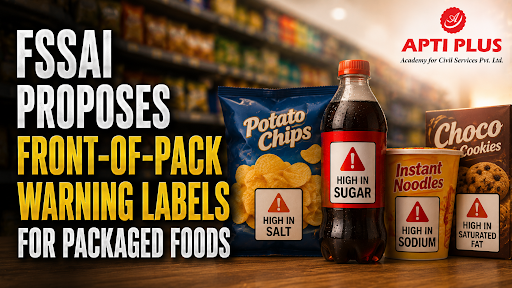
Why In News?
Following Supreme Court intervention, the FSSAI proposed red hexagonal front-of-pack warning labels for packaged foods high in sugar, salt, and saturated fat.
What is Front-of-Pack Labelling (FOPL)?
It is a simplified nutritional labeling system placed on the front of food packages to help consumers quickly identify and compare the nutritional quality or healthfulness of products.
Key Objectives
-
Inform Consumers: Give shoppers fast, easy-to-understand data about critical nutrients like sugars, sodium, saturated fats, and trans fats.
-
Prevent Disease: Help reduce rates of non-communicable diseases like diabetes, obesity, and heart conditions by discouraging unhealthy choices.
-
Encourage Reformulation: Motivate food manufacturers to improve recipes and lower unhealthy ingredients in packaged goods.
Common Types of FOPL Systems
-
Warning Labels: Bold graphic seals (like black stop signs) that indicate if a product is "High In" specific nutrients of concern.
-
Traffic Light Labels: Color-coded indicators (red, amber, green) showing high, medium, or low levels of key nutrients.
-
Graded / Scale Labels: Letter or star scores (such as Nutri-Score or Health Star Ratings) evaluating overall nutritional value.
-
Endorsement Symbols: Simple checkmarks or logos showing a product meets general healthy-diet standards.
Highlights of FSSAI Proposal on Front-of-Pack Labelling
Shift Towards Warning Labels: The FSSAI abandoned the earlier controversial Indian Nutrition Rating (INR) system—which assigned positive 1/2 to 5 stars to foods—and proposed bold front-of-pack warning symbols for products high in saturated fats, added sugar, and sodium.
Thresholds for HFSS Categorization: Sets maximum allowable percentage limits for added sugars (more than 10% of total energy), saturated fats (more than 8% of energy), and sodium (more than 1 mg per kcal).
The "Per-Serve" Metric Controversy: The draft proposal allows manufacturers to declare nutrient values per recommended "serving size" rather than a standardized per-100-gram or per-100-milliliter base.
Mandatory Size and Contrast Rules: Requires front-facing warning marks to occupy at least 15% to 20% of the front principal display panel in high-contrast red or black coloring.
FSSAI has suggested a red hexagonal warning symbol carrying declarations such as:
-
High Sugar
-
High Salt
-
High Fat
-
Highly Sweetened Beverage
They are linked to the Dietary Guidelines for Indians, 2024, developed by the ICMR-National Institute of Nutrition (ICMR-NIN).
What is FSSAI?
The Food Safety and Standards Authority of India (FSSAI) is an autonomous statutory body responsible for protecting and promoting public health through the regulation and supervision of food safety across the country.
Established under the Food Safety and Standards Act, 2006, FSSAI consolidated multiple historical food laws and orders into a single, unified line of command.
It operates under the administrative control of the Ministry of Health and Family Welfare.
Core Functions of FSSAI
-
Setting Food Standards: Formulates science-based rules, limits, and regulations for food items, additives, contaminants, and packaging.
-
Mandatory Licensing & Registration: Issues a unique 14-digit FSSAI number and license to all Food Business Operators (FBOs)—including manufacturers, wholesalers, restaurants, and retailers.
-
Enforcing Compliance: Conducts periodic inspections, data collection, and food safety audits to keep food businesses accountable.
-
Lab Network & Testing: Accredits nationwide food testing laboratories to detect adulteration and ensure product safety.
-
Monitoring Imports: Assesses the safety of food articles imported into India before they reach local markets.
-
Public Awareness: Launches consumer welfare initiatives like the Eat Right India and Save Food, Share Food campaigns.
Source: THEHINDU
|
PRACTICE QUESTION Q. Discuss the statutory role of the Food Safety and Standards Authority of India (FSSAI) in safeguarding public health under Article 21 of the Constitution. (10 Marks, 150 Words) |