Why In News?
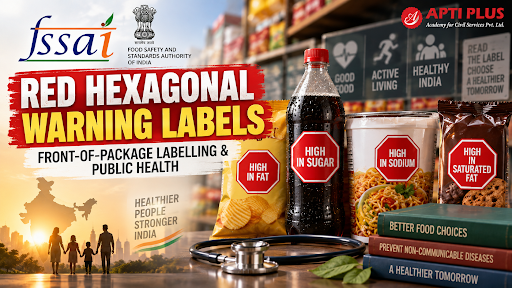
The Food Safety and Standards Authority of India proposed mandatory red hexagonal front-of-pack warning labels on packaged foods exceeding sugar, salt, and saturated fat limits.
What is Front-of-Package Labelling (FOPL)?
Front-of-Package Labelling (FOPL) is a simplified nutrition information system placed on the front of food packaging to help consumers quickly identify the healthfulness of a product.
Regulatory Shift: Replaces tiny, complex back-of-pack numerical nutrition tables with intuitive front-facing color-coded indicators.
Departure from Star-Rating Model: Abandons the Indian Nutrition Rating 5-star system that allowed manufacturers to mask excessive sugar by adding synthetic fiber.
Enforcement Under FSS Act, 2006: Formulated under the Food Safety and Standards (Labelling and Display) Regulations to curb deceptive marketing.
How the Proposed Red Hexagonal System Will Work
Distinctive Stop-Sign Geometry: Features an eye-catching red hexagonal symbol positioned prominently on the top-front surface of packaged food wrappers.
Specific Hazard Warnings: Displays explicit text labels inside the hexagon stating "High in Sugar", "High in Saturated Fat", or "High in Salt".
Standardized per 100g/100ml Thresholds: Evaluates nutrient concentrations against strict cut-offs per 100 grams of solids or 100 milliliters of liquids.
Proportional Area Coverage: Mandates that warning symbols occupy a minimum designated percentage of the package's front face to ensure immediate visibility.
Broad Product Coverage: Applies mandatorily across ultra-processed foods including carbonated colas, fruit beverages, potato chips, biscuits, and instant noodles.
Exclusion of Whole Staples: Completely exempts raw single-ingredient commodities such as fresh milk, whole foodgrains, raw fruits, table sugar, and cooking oils.
Phased Industry Compliance Window: Provides a structured multi-year transition period for food companies to exhaust old packaging and reformulate recipes.
Public Health Significance: Addressing India's NCD Crisis
Staggering Diabetes Burden: The ICMR-INDIAB study revealed that over 101 million Indians suffer from diabetes and 136 million live with pre-diabetes.
Surging Hypertension and Heart Disease: Over 315 million citizens suffer from hypertension, directly exacerbated by high sodium content in packaged snacks. (Source: ICMR)
Explosion of Pediatric Obesity: Sales of ultra-processed food and beverages in India grew at an alarming 13.4% compound annual growth rate over the last decade. (Source: WHO)
Overcoming Low Nutritional Literacy: Delivers an instant visual warning that protects semi-literate consumers and school children from deceptive corporate advertising.
Source: thehindu
|
PRACTICE QUESTION |