Why In News?
The United Nations Environment Programme (UNEP) recognized Ganges River Dolphin (Platanista gangetica) species recovery program for its sustained ecological impact.
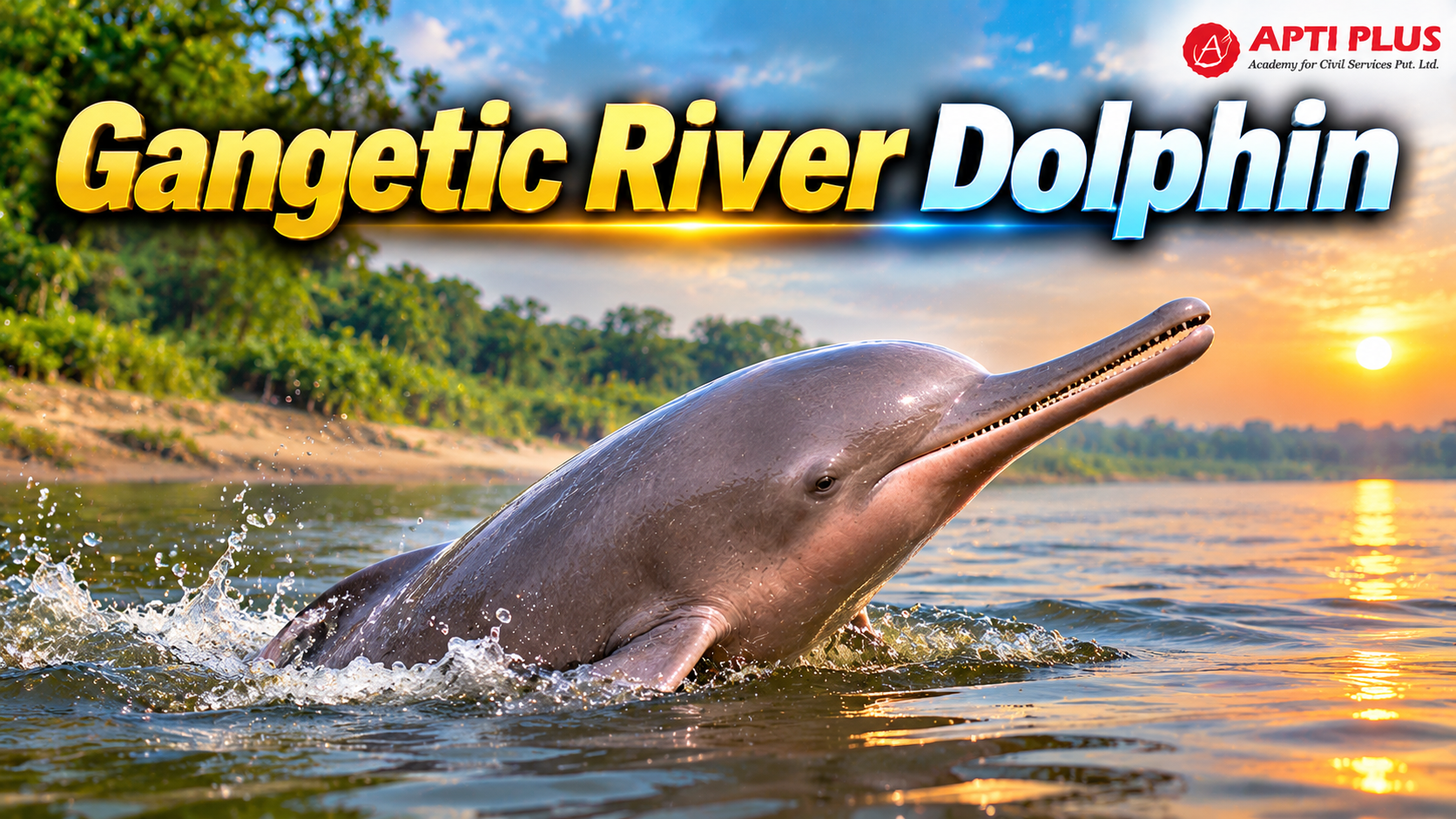
About Gangetic River Dolphin
● Scientific Name: Platanista gangetica (subspecies P. g. gangetica)
● National Aquatic Animal: Declared on October 5, 2009 (celebrated annually as National Dolphin Day).
● Local Name: Popularly called Susu because of the sound it makes when surfacing to breathe (every 30 to 120 seconds). Also known as the "Blind Dolphin" or "Tiger of the Ganges".
● Physical & Biological Features:
● Functionally Blind: Their eyes lack a crystalline lens, rendering them blind; they rely entirely on a sophisticated echolocation (bio-sonar) system to navigate and hunt in murky river waters.
● Anatomy: Side-swimming behavior (often swims on one side), long thin snout, stocky body, and prominent flippers. Females are generally larger than males.
● Habitat & Distribution:
● Found in the freshwater river systems of the Ganges-Brahmaputra-Meghna and Karnaphuli-Sangu basins across India, Nepal, and Bangladesh.
● In India, they span across states like Uttar Pradesh, Bihar, West Bengal, Assam, Madhya Pradesh, Rajasthan, and Jharkhand. Uttar Pradesh and Bihar record the highest populations.
● Population Status: India's comprehensive river dolphin survey (coordinated by the Wildlife Institute of India under Project Dolphin) estimated 6,324 Gangetic dolphins in India, representing roughly 90% of the global population.
Conservation Status
● IUCN Red List: Endangered
● Wildlife (Protection) Act, 1972: Schedule I (highest level of legal protection in India)
● CITES: Appendix I
● CMS (Convention on Migratory Species): Appendix II
Key Government & Conservation Initiatives
● Project Dolphin: Launched by the Government of India to protect and conserve both riverine and marine dolphin species while improving river ecosystem health.
● Vikramshila Gangetic Dolphin Sanctuary: Located in a 60-km stretch of the Ganges River in Bhagalpur district, Bihar; it is India's first and only dedicated sanctuary for Gangetic dolphins.
● National Dolphin Research Centre (NDRC): Inaugurated in Patna, Bihar, as India's premier research hub for river dolphin studies.
Major Threats
● Infrastructure: Construction of dams, barrages, and embankments that fragment river habitats and alter water flow and sediment loads.
● Bycatch: Accidental entanglement in commercial and local fishing nets.
● Pollution: Industrial heavy metals, agricultural chemical/fertilizer runoff, and domestic sewage.
● Poaching: Killed illegally for dolphin oil and fat, which is used as fish bait or traditional liniments.
Source: NEWINDIANEXPRESS
|
PRACTICE QUESTION Q. With reference to the Gangetic River Dolphin (Platanista gangetica), consider the following statements:
Which of the statements given above are correct? (a) 1 and 2 only (b) 2 and 3 only (c) 1 and 3 only (d) 1, 2, and 3 Answer: (c) Explanation: Statement 1 is correct: The Gangetic River Dolphin (Platanista gangetica) is an exclusive freshwater mammal. It is natively distributed across the Ganges-Brahmaputra-Meghna and Karnaphuli-Sangu river systems of India, Nepal, and Bangladesh. Statement 2 is incorrect: The Gangetic River Dolphin is functionally blind. Living in muddy, murky waters, its eyes lack a lens, and it cannot form clear visual images. It relies entirely on echolocation (sonar) to navigate and hunt for prey in deep river trenches. Statement 3 is correct: Being a mammal, it cannot breathe underwater and must surface every 30 to 120 seconds to breathe atmospheric air. Because of the sound it makes while breathing, it is also locally known as Susu. |