Why In News?
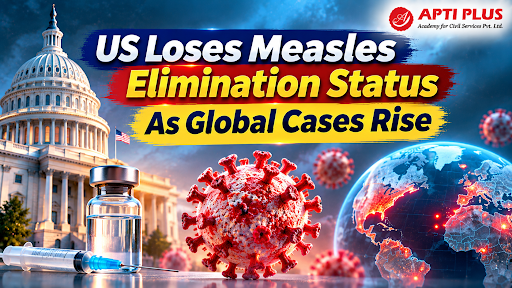
The Pan American Health Organization (PAHO) announced that the United States has lost its measles elimination status, held since 2000, after the commission found that endemic transmission had been re-established.
What Is Measles?
Measles (also called rubeola or morbilli) is a highly contagious airborne viral disease that primarily infects the respiratory tract and immune system before spreading throughout the body.
Pathogen and Transmission
-
Causative Agent: Measles virus (MV), a single-stranded, negative-sense RNA virus of the genus Morbillivirus (family Paramyxoviridae). It is strictly a human pathogen with no known animal reservoir.
-
Mode of Spread: Transmitted via respiratory droplets and airborne aerosols when an infected person coughs, sneezes, or breathes. The virus can remain active in the air or on surfaces for up to two hours.
-
High Contagiousness: About 90% of unvaccinated, non-immune close contacts exposed to the virus become infected. People can spread it from roughly 4 days before to 4 days after the rash appears.
Symptoms and Complications
-
Incubation & Early Phase: Symptoms start 10–14 days after exposure with high fever, cough, runny nose (coryza), and red/watery eyes (conjunctivitis). Koplik spots (tiny white spots inside the mouth/cheeks) often appear before or alongside the rash.
-
Rash Phase: A red, blotchy rash usually begins on the face/hairline and spreads downward to the rest of the body, typically lasting around 5–6 days.
-
Complications: Can cause pneumonia, severe diarrhea, ear infections, blindness, or encephalitis (brain swelling). It can also temporarily suppress immunity and, rarely years later, lead to subacute sclerosing panencephalitis (SSPE). Unvaccinated young children, malnourished individuals, and pregnant people face higher risks.
Treatment and Prevention
-
No Specific Antiviral Cure: Care focuses on hydration, nutrition, fever/symptom relief, and Vitamin A supplementation to reduce severe complications and eye damage.
-
Vaccination: Protected via two doses of measles-containing vaccines—such as Measles-Rubella (MR), MMR, or MMRV. Achieving high herd immunity (around 95% coverage) is key to stopping outbreaks.
Source: SCIENTIST
|
PRACTICE QUESTION Q. Consider the following statements regarding Measles:
Which of the statements given above is/are correct? (a) 1 and 2 only (b) 2 and 3 only (c) 1 and 3 only (d) 1, 2 and 3 Answer: a Explanation: Statement 1 is correct: Measles is a highly contagious airborne viral disease caused by the measles virus (Morbillivirus hominis), which has a single-stranded, negative-sense RNA genome and belongs to the Paramyxoviridae family. Statement 2 is correct: Humans are the only known natural hosts of the measles virus, with no known animal or environmental reservoirs. Statement 3 is incorrect: Measles can theoretically be eradicated globally—much like smallpox and its close relative rinderpest—because humans are its sole host, there is only one serotype, and an effective vaccine exists. Survivors develop lifelong immunity rather than lifelong infectious latency (though a rare, non-contagious, delayed neurological complication called SSPE can occur years later, it does not sustain transmission). |