Why In News?
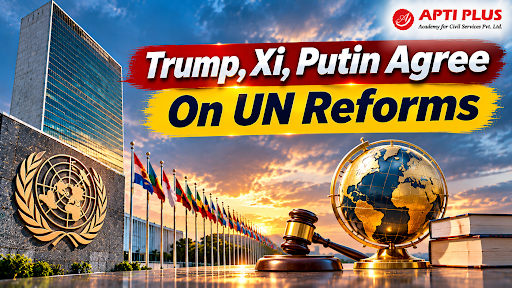
The United States, China and Russia, in a joint declaration after their first trilateral summit in Shenzhen, committed to reforming the United Nations, but did not mention expansion of the UN Security Council (UNSC) or India's bid for a permanent seat.
What Did The Shenzhen Declaration Say On UN Reform?
The leaders of the three countries met on the sidelines of the Asia-Pacific Economic Cooperation (APEC). It was the first time Donald Trump, Xi Jinping and Vladimir Putin met as a trio.
-
Declaration Towards Peace: The four-point declaration covers UN reform, higher supply of refined petroleum products, talks on nuclear risks, and state immunity against the jurisdiction of the International Criminal Court (ICC).
-
UN Reform Commitment: The three permanent members committed to reform the UN so that it can respond more effectively to global challenges. They said the organisation must adapt to present-day realities.
-
What Was Missing: The text does not mention the expansion of the Security Council, India, or the wars in Ukraine and Iran.
How Is The UN Security Council Structured And Why It Must Be Reformed?
The UN Security Council (UNSC) has 15 members—5 permanent members with veto power and 10 non-permanent members elected for two-year terms—and needs reform because its 1945 post-WWII structure no longer reflects modern global geopolitics or prevents veto gridlock.
How the UN Security Council Is Structured
-
Permanent Members (P5): China, France, Russia, the United Kingdom, and the United States hold permanent seats established after World War II.
-
Non-Permanent Members: 10 seats rotate on two-year terms, elected by the UN General Assembly with geographic distribution (expanded from 6 seats in 1965).
-
Voting and Veto Power: Passing a substantive resolution requires at least 9 of 15 votes with no veto cast by any of the five permanent members.
-
Mandate and Presidency: The Council holds primary responsibility for international peace and security, can issue legally binding decisions on member states (such as sanctions or peacekeeping mandates), meets continuously in New York, and rotates its presidency monthly.
Why It Must Be Reformed
-
Outdated 1945 Representation: The structure reflects post-WWII power dynamics rather than today's 193 UN member states and multipolar realities.
-
Underrepresentation of Key Regions: Africa, Latin America, and major parts of Asia lack permanent seats, even though much of the Council's conflict agenda focuses on regions like Africa.
-
Veto Paralysis: Any single P5 member can block resolutions—often when its own strategic interests or allies are involved—stalling action on major crises.
-
Evolving Global Threats: Modern security challenges, including cross-border terrorism and climate-related instability, test a body designed around traditional state-on-state conflict.
Reform is difficult because amending the UN Charter requires a two-thirds vote in the General Assembly and ratification by two-thirds of member states, including all five permanent members.
|
United Nations Security Council (UNSC)
|
What Does The Declaration Mean For India's Permanent Seat Bid?
-
Reform Without Expansion: The declaration speaks of making the UN more effective and is silent on enlarging the Council. A commitment on effectiveness does not by itself add any new permanent seat.
-
Russia And China: The BRICS New Delhi Declaration of September 2026 records that China and Russia support the aspirations of Brazil and India to play a greater role in the UN. The wording does not name a permanent seat.
-
United States: In September 2026, a State Department spokesperson declined to say whether Council reform should include a permanent seat for India. He described the partnership with India across the UN, the Quad and bilateral channels as strong.
-
Veto Question: India has said that new permanent seats without the veto would create second-class members and leave the existing five in control. A P5-led reform that keeps the veto exclusive would therefore not meet India's demand.
-
Charter Amendment: Any change in Council membership needs an amendment under Article 108 of the UN Charter. It requires a two-thirds vote in the General Assembly and ratification by two-thirds of members, including all five permanent members.
Initiatives Taken By India For Reform Of The UN Security Council
Intergovernmental Negotiations (IGN): India stands that expansion limited to the non-permanent category would be grossly inadequate and would not change the P5's decision-making power. It presses for expansion in both categories.
G4 Framework: India works with Brazil, Germany and Japan, which together form the G4, for new permanent and non-permanent seats. The G4 holds that new permanent members should have the same responsibilities and obligations as current ones.
Flexibility On The Veto: In May 2026, the G4 proposed that new permanent members would not exercise the veto during a review period. This was offered to foster constructive negotiations.
Support For The African Model: India and the G4 fully backed the African model presented at the IGN on 20 April 2026. It seeks permanent African representation in an expanded Council.
L.69 And IBSA: India engages the L.69 group of developing countries from Africa, Latin America, the Caribbean and the Asia-Pacific. In September 2026, India, Brazil and South Africa demanded formal text-based negotiations within a fixed timeframe.
BRICS Chairship: The BRICS New Delhi Declaration reiterated support for comprehensive UN reform, including the Security Council, to make it more democratic, representative, effective and efficient. It also recognised the aspirations of African countries under the Ezulwini Consensus and the Sirte Declaration.
Pact For The Future: India uses the Pact for the Future, adopted by the General Assembly in 2024, as the basis to demand a consolidated reform model. The Pact reaffirms the commitment to reform the Council.
What Are The Key Challenges In India's Bid For A Permanent UNSC Seat?
P5 Control Over The Reform Process
-
Disguised Veto: In October 2026, India decried the disguised, de facto veto that is preventing the Council reform process from advancing.
-
Ratification Power: Each permanent member can block ratification, so no reform moves against the interest of any one of the five. This gives the P5 control over both the pace and the content of change.
Disagreement Over Categories Of Membership And The Veto
-
Opposition To Permanent Seats: The Uniting for Consensus group favours longer-term elected seats instead of new permanent seats.
-
Veto Objection: Some delegations argue that the veto concern remains even if new permanent members agree not to use it before a review. This weakens the G4's interim offer.
Procedural Paralysis In The Negotiations
-
Process Deadlock: The IBSA foreign ministers expressed deep concern at the persistent paralysis within the IGN in September 2026.
-
Mandate Dispute: The G4 wants the co-chairs' Elements Paper revised with attribution of positions. Other delegations caution against reading the Pact for the Future as a formal mandate for the IGN.
Incomplete Consensus Among The P5
-
Expansion Not Endorsed: The Trump administration seeks sweeping changes at the UN but has not linked them to Council composition.
-
Absent Members: France and the United Kingdom, which have supported the G4 position, were not part of the Shenzhen declaration. P5 consensus on expansion therefore remains incomplete.
Weak Credibility Of The Council
-
Declining Confidence: In July 2026, India warned that people's confidence in the UN is declining because the Council has not been reformed and global conflicts remain unaddressed.
-
Conflict Response: Dr S. Jaishankar has said that the Council's inability to address ongoing conflicts and threats underlines the urgency of reform.
Working Methods That Sideline Affected Countries
-
Troop-Contributing Countries: In April 2026, India welcomed the recommendation to strengthen the Council's relationship with troop-contributing countries. This points to a present gap in consultation with the countries that serve in the field.
-
National Agendas: India also welcomed the call for Council members to avoid using the Council to pursue national political agendas.
What Is The Way Forward For Reform Of The UN Security Council And India's Bid?
Set A Time-Bound, Text-Based Process
-
Negotiating Text: The General Assembly's 81st session should move the IGN from restating positions to negotiating a single text. A fixed timeframe prevents another year of open-ended discussion.
-
Action 39: Action 39 of the Pact for the Future sets parameters and interim measures on Council reform. These can anchor the text.
Bridge Differences On The Veto And Categories
-
Review Clause: A review after a fixed period, combined with non-use of the veto by new members meanwhile, can reconcile the G4 and African positions with sceptics.
-
Package Approach: Seats for Africa, Latin America and Asia should be negotiated as one package. This avoids pitting regional claims against each other.
Convert Declared Support Into Written Commitments
-
China And Russia: India should seek explicit mention of a permanent seat, in place of the wider phrase on a greater role in the UN, in bilateral and BRICS texts.
-
Western Permanent Members: India should seek written endorsement from the United States, France and the United Kingdom in joint statements.
Widen The General Assembly Majority
-
Existing Backing: In June 2025, the G4 listed the African Group, the Arab Group, CARICOM, the L.69 Group, the Nordic Group and the Benelux countries as part of the majority position for expansion.
-
European Support: Poland's ambassador said on 20 October 2026 that India's permanent bid is an obvious element of global governance reform. Such statements should be built on with other European members.
Use The Authority Of The General Assembly
-
Collective Voice: The IBSA ministers emphasised strengthening the General Assembly's authority so that Council inaction does not paralyse UN efforts.
-
Uniting For Peace: Resolution 377 of 1950 allows the General Assembly to act when the Council is deadlocked by a veto. It offers a precedent for a larger Assembly role.
Improve Working Methods Without Waiting For Charter Change
-
Collaborative Spirit: India has stressed that the Council and the General Assembly must work together, as the African model proposes.
-
Interim Steps: The Council can adopt notes on consultation with troop-contributing countries and wider participation in drafting. These raise legitimacy while the larger reform is negotiated.
Conclusion
The Shenzhen declaration shows that the P5 are willing to talk about UN reform, but only in terms of effectiveness, not expansion. India must turn broad support into written commitments and push for a text-based process.
Source: TIMESOFINDIA
|
PRACTICE QUESTION Q. Evaluate India's case for permanent membership of the UNSC and the main obstacles it faces. (10 Marks, 150 Words) |