Why In News?
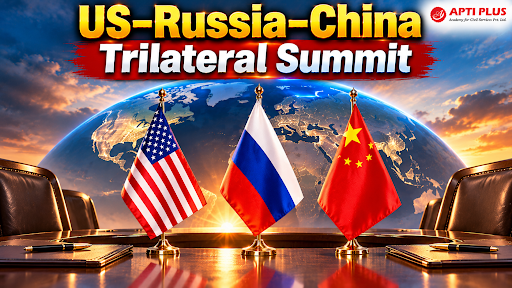
The leaders of the United States, Russia and China held their first-ever trilateral summit in Shenzhen on the sidelines of the Asia-Pacific Economic Cooperation (APEC) summit, and issued a four-point joint declaration on UN reform, energy supply, international law and nuclear risk.
What Happened At The Shenzhen Trilateral Summit?
-
First-ever format: The leaders of the United States, China and Russia held their first-ever trilateral summit in Shenzhen to discuss key international security issues. Xi Jinping hosted Donald Trump and Vladimir Putin.
-
Context: The summit came as key Russia–US nuclear treaties have expired. Trump had said he hoped to include China in nuclear arms control talks.
-
Concrete outcome: The leaders announced no concrete agreement beyond a pledge to pursue dialogue on reducing risks.
-
Other issues: The agenda was reported to include the Iran war and Ukraine. The declaration itself carried no joint initiative on either conflict.
|
Asia-Pacific Economic Cooperation (APEC)
|
Highlights of the Joint Declaration
-
UN reform: China, Russia and the US, as permanent Security Council members, committed to reforming the UN so it can respond more effectively to global challenges. The statement does not name any aspirant countries.
-
Energy security: The three plan to increase production and supply of refined petroleum products and reaffirmed the importance of stable energy flows. They agreed to "jointly maintain stable and unimpeded energy industrial and supply chains".
-
International law and the ICC: They stated that state consent and immunities for state officials are of "paramount importance" and that the International Criminal Court (ICC) must not abuse its jurisdiction.
-
Nuclear risk: They reaffirmed that a nuclear war cannot be won and must never be fought, and pledged to conduct a dialogue on reducing nuclear risks and preventing proliferation.
Significance of The Summit
-
Energy markets: The pledge on refined petroleum products could ease pressure on energy markets after repeated disruption to shipping through the Strait of Hormuz. The pledge has no stated timeline or mechanism.
-
Arms control vacuum: With New START expired, no treaty limits US and Russian strategic arsenals. China's inclusion in dialogue marks the first step towards three-way talks.
-
Challenge to institutions: The ICC clause signals pushback against international criminal jurisdiction. None of the three is a party to the Rome Statute.
-
Perception of a "new Yalta": Commentators have asked whether great powers may decide global rules among themselves. The declaration's UN reform pledge shows the three accept the UN as the forum.
What Are The Key Challenges And Implications Of The Shenzhen Summit?
Absence of binding commitments
-
No treaty or timeline: The declaration has no timeline, scope or treaty commitment for nuclear reductions. Dialogue can continue without cuts.
-
Energy pledge without mechanism: There are no details on how output will rise. Prices may not fall without actual supply changes.
Divergent strategic interests
-
Different stockpile sizes: China's arsenal is much smaller than those of the US and Russia. Beijing has resisted joining numerical limits.
-
Ukraine and sanctions: The US and Russia remain divided on Ukraine and on sanctions. Officials had said Ukraine would not be raised at the summit.
Risk of a great-power directorate
-
Exclusion of others: Europe, India, Japan and others were not at the table. Decisions among three powers may affect countries outside the room.
-
Weakening of the UN: If the format becomes a regular event, it could sideline the Security Council's wider membership.
Stress on international criminal justice
-
ICC legitimacy: The statement stresses immunity of state officials. This may weaken accountability under the Rome Statute.
-
Impact on warrants: Russia's leader faces an ICC arrest warrant. Critics see the clause as shielding sitting leaders.
Domestic political limits
-
US term limits: The current US President's term ends in January 2029. A successor might not continue the format.
-
Congressional and allied resistance: US hawks and European allies are likely to oppose any institutionalisation.
Implications for India
-
UN reform: The declaration's UN reform pledge could help India's bid for a permanent seat. The statement does not name India.
-
Strategic autonomy: India must watch for a US–China–Russia understanding on Asia. It also must keep balanced ties with Washington, Moscow and Beijing.
What Is The Way Forward For India And The World?
Shaping UN reform
-
Coordinate with the G4 and the African Union: India should push for text-based negotiations at the IGN. Support from all three permanent members in Shenzhen should be turned into concrete commitments.
-
Seek explicit mention: India should seek public backing from each of the three powers for permanent membership.
Making arms control inclusive
-
Phased approach: Start with transparency, notifications and crisis hotlines, then move to limits. A realistic path may be parallel bilateral talks with a focus on risk reduction.
-
Multilateral forums: Disarmament should also be taken up at the Conference on Disarmament and the UN First Committee. India should champion a non-discriminatory approach.
Securing energy supply
-
Diversifying sources: India should diversify oil imports, expand strategic petroleum reserves and invest in renewables and biofuels. This reduces exposure to Strait of Hormuz disruption.
-
Stable refining and shipping: India can work with the International Energy Agency and the Gulf States on shipping security.
Protecting strategic autonomy
-
Multi-alignment: India should deepen ties with the US through the Quad and trade talks, with Russia on energy and defence, and with China on border stability. Each track should be kept separate.
-
Use of plurilateral forums: BRICS, SCO and the G20 let India engage all three powers. India can promote Global South priorities there.
Defending international law
-
Rule-based approach: India should call for accountability norms and a rule-based order while respecting sovereign immunity. A balanced stance helps India avoid taking sides on the ICC.
-
Support for UN mediation: Peacekeeping and mediation under the UN Charter should be strengthened for conflicts such as Ukraine and West Asia.
Institutionalising dialogue
-
Include middle powers: A wider consultation format with other nuclear powers and aspirants can reduce the risk of a directorate.
-
Track-II diplomacy: Think tanks and scientists can prepare technical proposals on verification and risk reduction.
Conclusion
The Shenzhen summit is a symbolic first for great-power diplomacy, but its declaration carries no binding commitments. Its value depends on whether nuclear risk reduction, energy supply and UN reform move from words to action. India should engage all sides to protect its strategic autonomy and its claim to a place in a reformed global order.
Source: THE HINDU
|
PRACTICE QUESTION Q. Examine the significance of the Shenzhen trilateral summit for global nuclear arms control and the multilateral order. (15 Marks, 250 Words) |