Why In News?
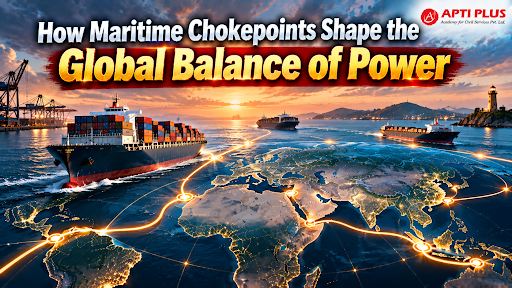
Experts argues that conflicts over strategic maritime chokepoints—from the 1956 Suez Crisis to the 2026 blockades in the Strait of Hormuz and Bab-el-Mandeb—trigger major shifts in the global balance of power and create an opportunity for India to lead the emergence of a new world order.
What Are Maritime Chokepoints?
-
Definition: Narrow sea passages through which a large share of global trade or energy must pass, making them vulnerable to blockade, piracy or attack.
-
Key Global Chokepoints: The Strait of Hormuz, Strait of Malacca, Suez Canal, Bab el-Mandeb, Panama Canal, Bosphorus, Strait of Gibraltar and the Cape of Good Hope route.
Major Chokepoints
|
Chokepoint |
Connects |
Bordering Countries |
Significance |
|
Strait of Hormuz |
Persian Gulf and Gulf of Oman |
Iran, Oman |
About 20% of world oil, around 21 million barrels/day, plus large LNG volumes |
|
Bab el-Mandeb |
Red Sea and Gulf of Aden |
Yemen, Djibouti, Eritrea |
Gateway to the Suez route |
|
Suez Canal |
Red Sea and Mediterranean Sea |
Egypt |
Shortest Asia–Europe sea route |
|
Strait of Malacca |
Indian Ocean and South China Sea |
Malaysia, Indonesia, Singapore |
Main route for East Asian energy imports |
Asian Dependence: In 2024, about 84% of crude and condensate shipped through Hormuz went to Asian markets.
How Have Chokepoints Shaped History?
The Suez Crisis (1956)
-
Nationalisation: Egypt’s Gamal Abdel Nasser nationalised the Suez Canal in 1956, prompting an invasion by Britain, France and Israel.
-
Power Shift: Pressure from the United States and the Soviet Union forced their withdrawal, marking the end of Britain’s imperial dominance and the rise of the superpowers.
Closure After The Six-Day War
-
Eight-Year Shutdown: The Suez Canal stayed closed from 1967 to 1975, forcing ships around Africa and spurring the building of larger supertankers.
The Tanker War (1980–88)
-
Attacks On Shipping: During the Iran–Iraq War, hundreds of vessels were attacked, yet Hormuz was never fully closed, as Iran itself depended on it for exports.
-
US Escorts: The US reflagged and escorted Kuwaiti tankers in Operation Earnest Will (1987–88).
Modern Disruptions
-
Ever Given (2021): A container ship blocked the Suez Canal for six days in 2021, holding up global trade.
-
Houthi Attacks (2023 onwards): Attacks in the Red Sea cut oil transit through Bab el-Mandeb from 9.3 to 4.1 million barrels a day.
What Happened In The 2026 Chokepoint Crisis?
Timeline
|
Date |
Event |
|
28 February 2026 |
US–Israeli strikes on Iran; Hormuz effectively shut |
|
2 March 2026 |
IRGC says the strait is closed to “unfriendly nations”, allowing only Iran-approved ships |
|
March 2026 |
Coordinated 400-million-barrel emergency stock release, covering about 25% of the supply gap |
|
13 April 2026 |
US naval blockade of Iranian ports begins |
|
4–6 May 2026 |
US “Project Freedom” operation to reopen the strait |
|
17–18 June 2026 |
US–Iran memorandum of understanding, mediated by Pakistan, to end the war and reopen the strait |
|
20 July 2026 |
Houthis declare a blockade of Saudi-linked shipping at Bab el-Mandeb |
|
October 2026 |
Highest number of shipping incidents since the war began |
Impact
-
Simultaneous Failures: By July 2026, three of eight key oil chokepoints, Hormuz, Bab el-Mandeb and the drought-hit Panama Canal, faced disruption at once, unprecedented in modern trade.
-
Insurance Shock: War-risk insurance in Hormuz rose to about 10% of a ship’s hull value.
-
Price Spike: Brent crude rose towards $118 a barrel.
-
Wider Supply Chains: The closure disrupted oil, LNG and fertiliser supplies together.
-
Toll Ambitions: Iran sought to assert control over the strait and collect fees on passing ships even after the June MoU.
-
Unequal Pain: UNCTAD found developing economies paid the heaviest price at the fuel pump.
Impact on The Balance Of Power
-
Leverage For Weaker States: Iran and the Houthis, though militarily weaker than the US, have used chokepoints to impose global costs.
-
Naval Power Projection: Control of sea lanes, as argued by strategist Alfred Thayer Mahan, remains central to great-power status.
-
China’s “Malacca Dilemma”: China’s fear of a blockade at Malacca, voiced by Hu Jintao in 2003, drives its pipelines, ports and its naval base in Djibouti (2017).
-
Rising Navies: Growing naval capabilities of China and India are reshaping security around chokepoints.
Why Is India Especially Vulnerable?
-
Import Dependence: India imports about 88% of its crude oil, and much of its LPG and LNG passes through Hormuz.
-
Limited Buffers: India’s strategic petroleum reserves of about 5.33 million tonnes at Visakhapatnam, Mangaluru and Padur cover only about 9–10 days of demand.
-
Trade Routes: Most of India’s trade with Europe passes through Bab el-Mandeb and Suez.
-
Diaspora Safety: Millions of Indians live and work in the Gulf, exposed to conflict.
-
Limited Relief: Some Iran-approved tankers bound for India and China passed Hormuz during the conflict.
Initiatives Taken By Government For Protecting India’s Maritime And Energy Security
Strategic Petroleum Reserves
-
Phase I: Underground caverns at Visakhapatnam, Mangaluru and Padur store 5.33 MT of crude.
-
Phase II: Plans for new reserves at Chandikhol (Odisha) and expansion at Padur to raise storage.
Operation Sankalp
-
Escorting Ships: Launched in 2019 after attacks on tankers in the Gulf, the Navy escorts Indian-flagged ships through the region.
Red Sea And Arabian Sea Deployments
-
Anti-Piracy And Escort: Since 2023–24, the Indian Navy has deployed warships in the Arabian Sea and Gulf of Aden, rescuing vessels from piracy and drone attacks.
Information Fusion Centre–Indian Ocean Region
-
Maritime Awareness: The Gurugram-based centre, set up in 2018, tracks shipping and shares data with partners.
Diversified Energy Sources
-
More Suppliers: India increased crude imports from Russia, the US and Africa to reduce reliance on Gulf supplies passing Hormuz.
Connectivity Corridors
-
INSTC And Chabahar: The International North–South Transport Corridor and India’s 10-year contract for Chabahar port (2024) offer routes to Central Asia and Russia.
-
IMEC: The India–Middle East–Europe Economic Corridor (2023) offers a rail-and-sea alternative to the Suez route.
Access To Strategic Ports
-
Partner Ports: Access arrangements at Duqm (Oman), Sabang (Indonesia) and Sittwe (Myanmar) extend the Navy’s reach.
Energy Transition
-
Cutting Oil Dependence: Achieving 20% ethanol blending in 2025 and targeting 500 GW of non-fossil power capacity by 2030 reduce long-term exposure to oil shocks.
What Are The Key Challenges In Securing India Against Chokepoint Disruptions?
Thin Strategic Reserves
-
Short Cover: Reserves cover only about 9–10 days, far below the 90 days of net imports required of International Energy Agency (IEA) members.
-
Limits Of Releases: Even the coordinated 400-million-barrel release met only about a quarter of the global supply gap in 2026.
No Alternative Route For Gulf Energy
-
Geographic Lock: Gulf exporters have few pipelines bypassing Hormuz, and the Red Sea route from Yanbu must still pass the Houthi-threatened Bab el-Mandeb.
LPG And LNG Exposure
-
Household Fuel Risk: India depends heavily on Gulf LPG for cooking gas, which is harder to replace quickly than crude.
Naval Capacity Limits
-
Stretched Fleet: Protecting shipping across the vast Indian Ocean strains the Navy’s ships and aircraft.
-
China’s Presence: China’s bases and port access, such as Djibouti and Gwadar, compete with India’s influence near key chokepoints.
Economic Costs
-
Inflation And Deficit: Higher oil prices, freight and insurance push up inflation, subsidy bills and the trade deficit.
Stalled Corridors
-
Slow Progress: IMEC and Chabahar face delays from conflict and sanctions.
Rising Non-State Threats
-
Drones And Missiles: Groups like the Houthis use cheap drones and missiles to disrupt shipping, which is hard to deter.
What Is The Way Forward For Reducing India’s Chokepoint Vulnerability?
Expand Strategic Reserves
-
More Storage: Complete Phase II reserves quickly and lease space to oil-exporting countries, as done with the UAE’s ADNOC at Mangaluru.
-
Commercial Stocks: Require refiners to hold minimum stocks, raising total cover.
Diversify Energy Imports
-
Wider Sourcing: Expand long-term contracts with suppliers in the Americas and Africa that do not depend on Hormuz.
Build Alternate Corridors
-
Revive IMEC And INSTC: Push these corridors to reduce dependence on Suez and Bab el-Mandeb.
Strengthen Naval Presence
-
Blue-Water Navy: Add ships, submarines and maritime surveillance aircraft to secure sea lanes.
-
Andaman And Nicobar Command: Develop the islands, near the Malacca Strait, as a strategic base.
Maritime Diplomacy
-
Freedom Of Navigation: Work with partners and the UN to uphold freedom of navigation under UNCLOS, which India ratified in 1995.
-
Engage Gulf States And Iran: Maintain balanced ties to secure safe passage for Indian vessels.
Accelerate Energy Transition
-
Less Oil Dependence: Expand electric vehicles, green hydrogen and renewables to reduce exposure to oil shocks.
Strengthen Indian Shipping
-
Own Fleet: Expand Indian-flagged shipping and domestic marine insurance to reduce reliance on foreign carriers during crises.
Conclusion
From Suez in 1956 to Hormuz in 2026, control of narrow sea passages has repeatedly shifted power and shaken economies. For an import-dependent India, larger reserves, diversified energy, alternate corridors, a stronger navy and faster energy transition are the best insurance against chokepoint shocks.
Source: INDIANEXPRESS
|
PRACTICE QUESTION Q. Examine India’s vulnerability to disruptions at maritime chokepoints and suggest a strategy to strengthen its energy and maritime security. (15 Marks, 250 Words) |