Why In News?
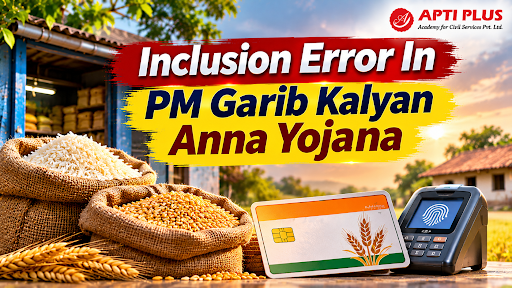
A concurrent evaluation study commissioned by the Department of Food and Public Distribution (DFPD) has found a 13.2% inclusion error in the Pradhan Mantri Garib Kalyan Anna Yojana (PMGKAY), with ineligible households including car owners and government employees.
What Did The Concurrent Evaluation Study On PMGKAY Found?
-
Study Design: The DFPD study was conducted in 2025-26 and covered over 50 thousands beneficiary households, rural and urban, across all 36 States and Union Territories.
-
National Inclusion Error: An estimated 13.2% of beneficiaries did not meet the eligibility criteria prescribed by their own States but still received free foodgrains. Applied to the 78.63 crore beneficiaries covered in October 2026, this indicates about 10.4 crore people.
-
Rural And Urban Gap: The inclusion error was 12.5% in rural areas and 15.6% in urban areas.
-
Category-Wise Error: The error was 12.2% among Antyodaya Anna Yojana (AAY) households and 13.4% among Priority Households (PHH). Urban Priority Households recorded 15.7%.
-
Recommended Remedies: The study suggests stronger beneficiary identification, periodic validation of databases, updated eligibility records, Aadhaar seeding and regular reviews of beneficiary lists.
Which States Have The Highest And Lowest Inclusion Error Under PMGKAY?
-
Highest Error: West Bengal recorded 39.5% and Tamil Nadu 38.7%. Bihar followed at 25.5%, Odisha at 22.9%, Punjab at 20.6% and Maharashtra at 20.3%.
-
Lowest Error: Madhya Pradesh recorded 0.5% and Rajasthan 1.8%. Uttar Pradesh, with the largest beneficiary base of 14.73 crore, recorded 6%.
-
Scale Of Variation: West Bengal's error is nearly 79 times that of Madhya Pradesh. This shows that the problem lies in State-level identification and verification, not in the national design.
Which Types Of Ineligible Households Were Found Receiving Free Foodgrains?
-
Asset Markers: The study flagged households owning cars or air conditioners and those living in houses with three or more rooms.
-
Employment Marker: It also flagged families with members in government jobs.
-
Basis Of Eligibility: States set their own criteria, which generally consider income, assets, landholding, employment status and tax records. The 13.2% error is measured against each State's own rules, not a uniform national test.
|
What Are Inclusion Error And Exclusion Error In Welfare Targeting?
|
What Is The National Food Security Act, 2013?
The National Food Security Act, 2013 (NFSA) shifts food security from a welfare benefit to a legal right. Enacted on July 5, 2013, it guarantees food and nutritional support to eligible citizens across India.
Key Coverage and Entitlements
-
Population coverage: Covers up to 75% of the rural population and 50% of the urban population (about two-thirds of India's population, capped at 81.35 crore people based on the 2011 Census).
-
Priority households: Entitled to 5 kg of foodgrains per person per month through the Targeted Public Distribution System (TPDS).
-
Antyodaya Anna Yojana (AAY): The poorest households receive 35 kg of foodgrains per household per month.
-
Pricing: Originally set at ₹3/kg for rice, ₹2/kg for wheat, and ₹1/kg for coarse grains, foodgrains under NFSA are provided free of cost to beneficiaries.
-
Women's leadership: The eldest woman (aged 18 or above) in an eligible household is designated as the head of the household for issuing ration cards.
Nutritional and Welfare Provisions
-
Life-cycle nutrition: Extends legal entitlements to meals and nutritional support for pregnant women, lactating mothers, and children through schemes such as the Integrated Child Development Services (ICDS) and Mid-Day Meal (PM POSHAN).
-
Accountability: Establishes grievance redressal mechanisms and State Food Commissions to monitor implementation.
What Is The Pradhan Mantri Garib Kalyan Anna Yojana?
It is a food security welfare scheme that provides free food grains through the Public Distribution System (PDS) to eligible low-income households.
Originally launched in March 2020 to support vulnerable families during the COVID-19 pandemic, the scheme was extended for five years starting January 1, 2024, covering roughly 81.35 crore beneficiaries nationwide.
Key Entitlements and Eligibility
-
Priority Households (PHH): Eligible members receive 5 kg of free food grains per person per month.
-
Antyodaya Anna Yojana (AAY) Households: The poorest families receive 35 kg of free food grains per household per month.
-
Grains & Fortification: Distribution is managed by the Department of Food and Public Distribution (under the Ministry of Consumer Affairs, Food and Public Distribution), providing wheat or rice—with fortified rice rolled out across government schemes.
-
How Beneficiaries Access It: Eligible ration card holders under the National Food Security Act (NFSA), 2013 collect their free entitlement at Fair Price Shops (ration shops), including across state lines via One Nation One Ration Card.
Evolution
-
COVID-19 Phase (2020–2022): Initially provided extra free grains on top of regular subsidized NFSA rations to cushion households against pandemic-related economic shocks.
-
Zero-Cost NFSA Continuation (2023 onward): Starting January 1, 2023, the government made regular NFSA food grains free of cost to beneficiaries rather than charging nominal subsidized rates (such as ₹2–₹3 per kg), and extended the free-grain commitment for five years from January 1, 2024, with an estimated five-year food subsidy outlay of about ₹11.80 lakh crore.
Initiatives Taken By Government To Improve Targeting In The Public Distribution System
-
Digitisation And Aadhaar Seeding: All ration cards have been digitised. Of 20.51 crore ration cards, 98.8% (20.27 crore) are Aadhaar-seeded, and 76.97 crore beneficiaries are linked with Aadhaar.
-
Aadhaar-Based e-KYC: Electronic Know Your Customer verification was completed for 71.52 crore beneficiaries, or 91%, by September 2026. It removes duplicate and non-existent entries from beneficiary lists.
-
Electronic Point Of Sale Devices: Of 5.51 lakh Fair Price Shops, 5.50 lakh (99.8%) operate with e-PoS devices. Distribution is authenticated at the shop counter.
-
Removal Of Fake Cards: The Ministry reported that 5.8 crore fake ration cards were eliminated through digitisation.
-
One Nation One Ration Card: The plan, launched in 2019, lets beneficiaries draw foodgrains from any e-PoS-enabled shop. More than 201 crore portability transactions had been recorded by February 2026.
-
SMART-PDS And SARTHAK-PDS: The Scheme for Modernization and Reforms through Technology in Public Distribution System (SMART-PDS) funds computerisation. The SARTHAK-PDS framework strengthens national portability and supports the margin of Fair Price Shop dealers.
-
Mera Ration App: Beneficiaries can check monthly entitlements, view past transactions, verify Aadhaar-seeding status and locate nearby shops using GPS.
What Is The Way Forward For Improving Targeting Under PMGKAY?
Verify Eligibility Through Linked Government Databases
-
Data Matching: Ration card lists can be matched with vehicle registration, income-tax, employment and company records using Aadhaar as the key. Delhi's survey found its ineligible cases through such matching.
-
Periodic Validation: The DFPD study itself recommends periodic validation of databases and regular reviews. These should become annual and State-wise.
Set Time-Bound Clean-Up Targets For High-Error States
-
Targeted Audits: States with errors above 20% should get verification drives with fixed deadlines. Madhya Pradesh and Rajasthan, with errors below 2%, can share their identification practices.
-
Single Registry Model: Brazil's Cadastro Único uses one social registry and requires families to update records at least every two years. A similar periodic recertification can be piloted.
Create Voluntary Exit And Graduation Routes
-
Give It Up Precedent: The 2015 Give It Up campaign for LPG subsidy led over 1 crore households to surrender the subsidy voluntarily. A similar option can be offered to ration card holders who have moved up economically.
-
Cash Transfer Pilots: Direct benefit transfer pilots were run under the Act in Chandigarh and Puducherry. Their outcomes can inform where cash is better than grain.
Safeguard Eligible Families Against Wrongful Exclusion
-
Alternative Authentication: Offline or alternative identity proof must remain available where biometrics fail, in line with the Supreme Court's 2018 Aadhaar judgment. No eligible family should lose grain for a technical failure.
-
Doorstep e-KYC: The Department of Posts has offered doorstep e-KYC in Gujarat. This can reach the 9% of beneficiaries who are yet to complete verification.
Update The Coverage Base And Urban Criteria
-
Census Update: The coverage ceiling should be recalculated once the next Census data is available, in line with the Supreme Court's concern over old population figures.
-
Urban Criteria: Urban eligibility can use housing, vehicle and employment markers that the study found most often in ineligible households. This directly addresses the higher urban error.
Strengthen Community Monitoring And Social Audit
-
Social Audit Model: Andhra Pradesh's social audit system for rural employment guarantee works shows that audits run by village-level auditors can expose ghost beneficiaries. A similar model can verify ration lists.
-
Open Lists: Chhattisgarh's reformed PDS puts beneficiary lists and shop-wise distribution data in public view. Display of lists at every Fair Price Shop allows neighbours to flag ineligible entries.
Publish Independent Audits And Public Dashboards
-
Annual Concurrent Evaluation: The DFPD should repeat the study every year with State-wise results made public. This creates accountability for high-error States.
-
Independent Scrutiny: A performance audit by the Comptroller and Auditor General can verify whether removed beneficiaries were truly ineligible.
Conclusion
A 13.2% inclusion error shows that PMGKAY's problem is verification, not design. Linked databases, periodic recertification and safeguards against wrongful exclusion can protect both the fiscal base and the right to food.
Source: INDIANEXPRESS
|
PRACTICE QUESTION Q. Consider the following statements regarding the National Food Security Act, 2013:
Which of the statements given above are correct? (a) 1 only (b) 2 and 3 only (c) 1 and 2 only (d) 1, 2 and 3 Answer: (c) Explanation: Statement 1 is correct: Under the National Food Security Act (NFSA), 2013, coverage extends to up to 75% of the rural population and up to 50% of the urban population. Statement 2 is correct: Antyodaya Anna Yojana (AAY) households are entitled to 35 kg of foodgrains per household per month. Statement 3 is incorrect: Priority Households (PHH) are entitled to 5 kg of foodgrains per person per month, not 10 kg. |