Why In News?
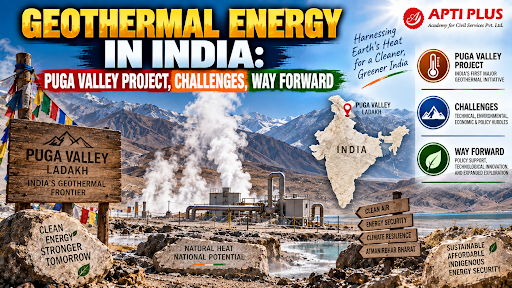
India’s geothermal push gained momentum following the National Policy on Geothermal Energy, 2025 and the commissioning of its first two geothermal wells at Puga Valley, Ladakh.
What is Geothermal Energy?
Geothermal energy is clean, renewable energy derived from the Earth’s internal thermal reservoir, generated by primordial heat retained from planetary accretion and continuous radioactive decay of isotopes (uranium-238, thorium-232, and potassium-40) in the Earth's crust and mantle.
-
Subsurface Reservoirs: Tectonic fractures let groundwater reach magma, heating it above 150°C–250°C under high pressure.
-
Power Generation: Deep wells send high-pressure steam or brine to spin turbines, using binary cycles for medium heat.
-
Closed-Loop System: Cooled fluids are reinjected into reservoirs to maintain pressure and protect groundwater.

What is India’s Geothermal Energy Resource Potential?
The Geological Survey of India (GSI) has mapped 381 thermal hot springs across the country, cataloguing geochemical and subsurface thermal gradients.
-
Theoretical Power Potential: India possesses an estimated theoretical geothermal power capacity of 10.6 GW (10,600 MW).
-
Priority Drillable Prospects: GSI has demarcated 42 promising sites viable for commercial power generation and direct-heat industrial applications.
-
Non-Volcanic Hydrothermal Character: Unlike volcanic ring-of-fire regions (e.g., Iceland, Philippines), most Indian geothermal resources are non-volcanic, fracture-dominated, medium-to-high enthalpy hydrothermal systems located along major fault sutures.
Major Geothermal Provinces in India
|
Geothermal Province |
Tectonic & Geological Setting |
Prominent Geothermal Sites |
|
Himalayan Province |
Continental-collision suture zone between the Indian and Eurasian plates; high heat flow. |
Puga and Chumathang (Ladakh), Manikaran (Himachal Pradesh). |
|
SONATA Province |
Deep-seated intracontinental rift fault running through Son-Narmada-Tapi lineament. |
Tatapani (Chhattisgarh), Bakreshwar (West Bengal). |
|
Cambay Graben |
Post-rift graben structure with tertiary sediments and high volcanic intrusive heat. |
Tuwa and Dholera (Gujarat). |
|
West Coast Province |
Continental margin rift-fracture zone running parallel to the Western Ghats. |
Unhavre and Rajapur (Maharashtra). |
|
Godavari & Mahanadi |
Gondwana sedimentary grabens with deep thermal water circulation. |
Manuguru (Telangana), Athamallik (Odisha). |
|
Andaman & Nicobar |
Active volcanic island arc system in the Andaman Sea. |
Barren Island and Narcondam Island. |
How Can Geothermal Energy Strengthen India’s Renewable Energy Transition?
True 24x7 Baseload Power: Operates with a Capacity Utilization Factor (CUF) exceeding 85–90%, providing continuous electricity that resolves the intermittent, duck-curve limitations of solar PV and wind turbines.
Zero Combustion & Minimal Land Footprint: Requires less surface land area per megawatt-hour generated than solar farms or wind parks, without producing air pollutants or greenhouse gases.
Direct-Heat Utilization: Geothermal brine discharge can be utilized for:
-
High-Altitude Agriculture: Heating sub-zero poly-greenhouses to grow vegetables year-round in Ladakh and Himachal Pradesh.
-
Cold-Chain Logistics & Drying: Geothermal space heating for wool processing and fruit dehydration.
-
Geothermal Heat Pumps (GHPs): Replacing power-hungry air conditioning and space heating systems in commercial buildings.
Green Hydrogen Feedstock: Co-locating water electrolyzers with continuous geothermal power plants enables 24x7 green hydrogen production without expensive battery storage.
What are the Major Operational and Technical Challenges?
Subsurface Exploration Uncertainty and Upfront Capital Risks: High financial risks associated with exploratory drilling, where dry holes or lower-than-anticipated reservoir flow rates can result in sunk exploration capital.
Severe Mineral Scaling, Silica Precipitation, and Casing Corrosion: Geothermal brines carry heavy dissolved mineral solids, silica, and hydrogen sulfide that rapidly choke well casings, valves, and heat exchangers.
High Capital Expenditure (CAPEX) Compared to Solar and Wind: Geothermal drilling requires deep-rig mobilisation, blowout preventers, and heat-resistant alloys, requiring $4,000–$5,000 per kW installed compared to $600 per kW for utility-scale solar PV.
Fragile High-Altitude Himalayan Ecology and Tectonic Vulnerabilities: Exploitation in sensitive zones like Ladakh or Himachal Pradesh risks disrupting fragile permafrost layers, local hot spring geysers, and wildlife habitats.
Absence of a Dedicated Feed-in Tariff and Regulatory Framework: Unlike solar tariffs discovered through SECI competitive bidding, State Electricity Regulatory Commissions (SERCs) lack standardized long-term levelized feed-in tariffs for geothermal energy.
Deficit of Indigenous High-Temperature Drilling Technology: India relies on foreign expertise for deep high-temperature drilling tools, high-temperature downhole logging sensors, and specialized binary turbine equipment.
Way Forward
Subsurface Deep Geothermal Resource Mapping: Direct the Geological Survey of India (GSI) under the National Mineral Exploration Policy to conduct magnetotelluric (MT) and seismic surveys across all 42 identified geothermal sites to create bankable resource atlases.
De-Risking Exploratory Drilling Capital: Formulate a targeted Viability Gap Funding (VGF) window under the National Clean Energy and Environment Fund (NCEF) to absorb up to 50% of the financial risk of exploratory dry holes incurred by project developers.
Repurposing Depleted Oil and Gas Wells: Amend the Hydrocarbon Exploration and Licensing Policy (HELP) to allow oil companies to convert depleted, high-temperature petroleum wells into geothermal power and heat generation assets.
Commercial Deployment of Enhanced Geothermal Systems: Invest in Enhanced Geothermal Systems (EGS) and Advanced Geothermal Systems (AGS) under the global Mission Innovation Track, hydraulic-fracturing deep hot dry rocks (HDR) to extract heat independent of natural hydrothermal aquifers.
Direct-Heat Utilization in Agro-Horticulture: Converge geothermal brine discharge with the Mission for Integrated Development of Horticulture (MIDH) to build climate-controlled greenhouse clusters, cold storages, and wool-processing units across remote Himalayan valleys.
Bilateral Technology Transfer Partnerships: Institutionalize government-to-government bilateral pacts with global geothermal leaders (Iceland, New Zealand, and Japan) for technical training in high-enthalpy drilling, directional mud engineering, and turbine manufacturing.
Institutionalizing Geothermal Renewable Purchase Obligations: Introduce a dedicated Geothermal Renewable Purchase Obligation (Geothermal-RPO) or include it under the "Other-RPO" category under the Electricity (Renewable Purchase Obligation and Energy Storage Obligation) Order to guarantee off-take by state DISCOMs.
Public-Private Partnership Joint Ventures: Encourage equity joint ventures between public sector energy giants (NTPC, ONGC, Coal India) and private infrastructure developers to pool capital and specialized mining-drilling equipment for deep drilling.
Conclusion
Geothermal energy offers an unexploited baseload renewable resource that can provide clean, uninterrupted power to India's strategic border areas while diversifying the national energy basket toward net-zero 2070.
Source: PIB
|
PRACTICE QUESTION Q. Consider the following statements regarding the geological generation of Geothermal Energy:
Which of the statements given above are correct? (a) 1 and 2 only (b) 2 and 3 only (c) 1 and 3 only (d) 1, 2, and 3 Answer: (a) 1 and 2 only Explanation: Statement 1 is correct: Earth's internal thermal energy is primarily sustained by the radiogenic decay of long-lived radioactive isotopes—mainly Uranium, Thorium, and Potassium —along with primordial heat remaining from the planet's initial accretion. Statement 2 is correct: Unlike intermittent renewable sources like solar and wind, geothermal power plants operate continuously regardless of weather or daylight conditions, delivering firm baseload electricity with very high capacity factors (typically between 70% and 95%+). Statement 3 is incorrect: The Geological Survey of India (GSI) has mapped hundreds of thermal hot springs across multiple geothermal provinces outside the Himalayan belt. These include prominent regions such as the Son-Narmada-Tapi (SONATA) lineament (e.g., Tattapani in Chhattisgarh), the West Coast (e.g., Unhavre in Maharashtra), the Cambay Graben (Gujarat), the Godavari and Mahanadi basins, and the Bakreshwar region in West Bengal. |