Why In News?
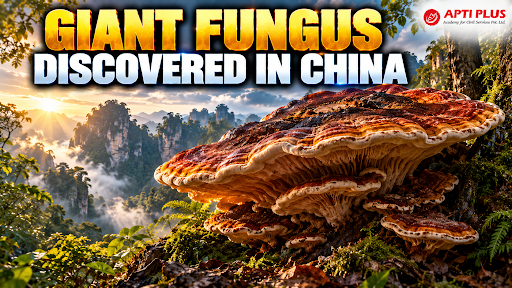
Mycologists from the Kunming Institute of Botany at the Chinese Academy of Sciences discovered a giant fungus species—named Dianjunus rex—in the forests of Yunnan province, China.
What Is Dianjunus rex?
It is a recently discovered giant fungus species that produces the largest known fruiting bodies in the Ascomycota phylum. It can grow up to 50 cm tall and weigh up to 2.2 kg.
-
Scientific Classification: It represents an entirely new species, genus, and family named Dianjunaceae within the order Xylariales.
-
Evolutionary Significance: A "molecular clock" DNA analysis reveals that its lineage dates back 65 million years. It emerged roughly 1 million years after the Cretaceous-Paleogene (K-Pg) mass extinction event that wiped out the dinosaurs.
-
Ecological Role: It is a wood-decomposing fungus. Scientists hypothesize that the massive environmental destruction and sudden abundance of dead plant material after the dinosaur extinction created unique ecological opportunities for this lineage to flourish.
-
Etymology: The name Dianjunus references the ancient Dian Kingdom of Yunnan and the Chinese word for fungus (jun). Rex means king in Latin, denoting its massive size.
What Is A Fungus?
A fungus (plural: fungi) is a member of a distinct biological kingdom of eukaryotic, heterotrophic organisms that include yeasts, molds, and mushrooms.
Core Characteristics
-
Cell Structure: Eukaryotic cells containing a true nucleus and membrane-bound organelles.
-
Cell Wall Composition: Unlike plants (which use cellulose) or bacteria (peptidoglycan), fungal cell walls are made of chitin.
-
Nutritional Mode (Absorptive Heterotrophy): They lack chlorophyll and cannot perform photosynthesis. Instead, they secrete digestive enzymes externally to break down complex organic matter and absorb the simpler nutrients.
-
Body Form: Most are multicellular and filamentous (composed of thread-like structures called hyphae that form a network called mycelium), while some are unicellular (such as yeast).
-
Reproduction: Reproduce via vegetative methods (budding, fission, fragmentation), asexual spores, and sexual reproduction.
-
Study: The scientific discipline dedicated to studying fungi is called Mycology.
Ecological and Economic Significance
-
Decomposers & Recyclers: They break down dead plant and animal matter, playing a primary role in nutrient cycling and soil fertility.
-
Symbiotic Relationships:
-
Mycorrhizae: Association between fungi and plant roots (helps plants absorb water and minerals like phosphorus).
-
Lichens: Symbiotic association between algae (or cyanobacteria) and fungi.
-
Industrial & Medical Uses:
-
Antibiotics (e.g., Penicillin from the mold Penicillium).
-
Food production (e.g., Saccharomyces cerevisiae or baker's yeast for baking and brewing, mushrooms, truffles, and Gucchi in India).
-
Pathogens & Toxins:
-
Causes plant and animal diseases (e.g., Mucormycosis or "Black Fungus" caused by Mucor and Rhizopus, ringworm/tinea by dermatophytes, and rusts/smuts in crops).
-
Produces lethal mycotoxins like Aflatoxins (from Aspergillus species) which are potent natural carcinogens found in poorly stored grains and groundnuts.
Source: THEHINDU
|
PRACTICE QUESTION Q. With reference to the newly discovered giant fungus "Dianjunus rex", consider the following statements:
Which of the statements given above are correct? (a) 1 and 2 only (b) 2 and 3 only (c) 1 and 3 only (d) 1, 2, and 3 Answer: (a) Explanation: Statement 1 is correct: Dianjunus rex (nicknamed "D-rex"), discovered in Yunnan Province, China, produces massive stromata reaching up to 50 cm in height and weighing up to 2.2 kg. According to researchers publishing in Frontiers in Fungal Biology, it represents the largest known fruiting bodies documented within the phylum Ascomycota. Statement 2 is correct: Multilocus phylogenomic and divergence-time analyses place the origin of its family (Dianjunaceae, order Xylariales) in the early Paleocene, approximately 65 million years ago, shortly after the Cretaceous–Paleogene (K–Pg) mass extinction event. Statement 3 is incorrect: Like all true fungi, Dianjunus rex lacks chlorophyll and is strictly heterotrophic (non-photosynthetic). It obtains nutrients by decomposing organic plant matter (growing on host tree roots/dead wood) rather than synthesizing its own food via photosynthesis. |