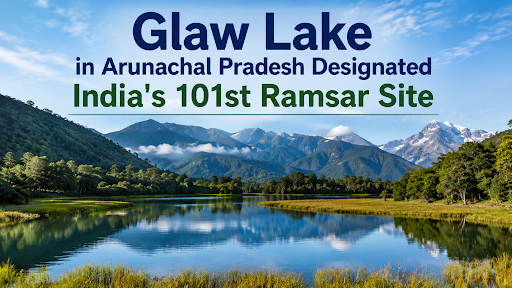
Why In News?
The Union Minister for Environment, Forest and Climate Change officially designated Glaw Lake in Arunachal Pradesh as India’s 101st Ramsar Site.
About Glaw Lake
Location: Within the Kamlang Tiger Reserve and Wildlife Sanctuary, Lohit District, Arunachal Pradesh.
Wetland Type: A high-altitude, pristine, natural freshwater lake in the Eastern Himalayas.
Hydrological Features:
-
Fed by perennial glaciated Himalayan streams, it forms the primary headwaters of the perennial Kamlang River.
-
Tectonic activity and land-block warping in the Eastern Himalayan fold belt created this natural depression storing alpine run-off.
Bioluminescence:
-
The lake displays a natural nocturnal glow caused by dinoflagellates, a type of light-emitting microalgae.
-
The lake water's unique chemical composition, featuring high concentrations of phosphates and nitrates, provides the perfect environment for these organisms to thrive.
Biodiversity Richness
-
Flora: Catchment supports over 150 tree species (Hollong, Canarium, Rhododendron) and 49 recorded wild orchid species.
-
Four Big Cats: Rare Himalayan habitat supporting four major species: Bengal Tiger (Panthera tigris), Indian Leopard (Panthera pardus), Clouded Leopard (Neofelis nebulosa), and Snow Leopard (Panthera uncia).
-
Rare Primates and Mammals: Forest corridor supports endangered species, including Hoolock Gibbon, Slow Loris, Capped Langur, Red Panda, and Mishmi Takin.
-
Avifauna: Wintering grounds for water birds, including critically endangered white-bellied heron (Ardea insignis) and over 20 species of reptiles and amphibians.
Ramsar Convention
-
Origin: Established on February 2, 1971, in Ramsar, Iran. India joined in 1982.
-
Objective: Prevents global wetland loss and promotes the "wise use" of wetlands to sustain biological diversity.
-
Global Reach: Includes over 2,531 sites covering 2.6 million square kilometers
-
Designation Criteria: Sites must support vulnerable or endangered species, maintain regional biological diversity, and provide critical hydrological services like groundwater recharge and flood prevention.

India’s Ramsar Network Status
-
Global Standing: India ranks first in Asia and third globally for the number of protected wetlands, trailing only the UK and Mexico.
-
First Sites: Chilika Lake (Odisha) and Keoladeo National Park (Rajasthan)
-
Largest Site: Sunderban Wetland (West Bengal) at 423,000 hectares.
-
Smallest Sites: Renuka Wetland (Himachal Pradesh) and Vembannur Wetland Complex (Tamil Nadu) at 20 hectares each.
-
State Leader: Tamil Nadu holds the highest count with 20 sites.
-
Unique Sites: Lonar Lake (Maharashtra) (meteorite-impact crater) and Loktak Lake (Manipur) (world’s only floating park).

Source: PIB
|
PRACTICE QUESTION Q. Consider the following statements regarding Glaw Lake, which was recently designated as a Ramsar Site:
Which of the statements given above are correct? (a) 1 and 2 only (b) 1 and 3 only (c) 2 and 3 only (d) 1, 2, and 3 Answer: (b) Explanation: Statement 1 is correct: Glaw Lake is designated as Arunachal Pradesh's first Ramsar Site. Statement 2 is incorrect: Although it is bounded by Namdapha National Park to the south, the lake itself lies deep within the Kamlang Tiger Reserve and Wildlife Sanctuary. Statement 3 is correct: The lake serves as the primary headwater origin and source for the perennial Kamlang River. |