Why In News?
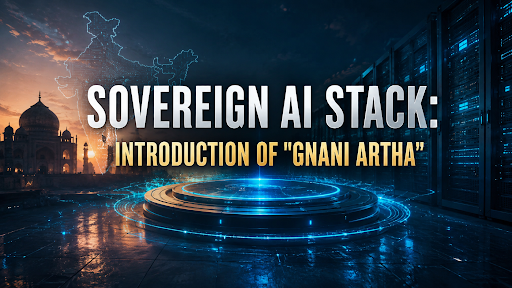
The Vice President Shri C. P. Radhakrishnan launched 'Gnani Artha', a sovereign AI stack comprising Evon 3.3 and Plexus, developed by GNANI AI.
What is Gnani Artha?
Gnani Artha is an end-to-end, indigenous sovereign artificial intelligence (AI) stack launched for Indian enterprises and public institutions.
-
Developed by the Bengaluru-based voice AI startup Gnani.ai.
Core Components
-
Evon v3.3: An open-weight, 30-billion-parameter foundation LLM natively fine-tuned for 11 Indian languages and localized deployment on minimal hardware.
-
Plexus: An agentic AI orchestration platform enabling autonomous workflows for sectors like banking, telecom, and insurance.
Key Benefits
-
Data Sovereignty: Enables self-hosting in local data centers or VPCs to protect sensitive information.
-
Cost Efficiency: Lowers the computational burden for Indic languages while exceeding performance benchmarks of larger global models.
What is Sovereign AI?
Sovereign AI is a country's or an organization's capacity to independently develop, deploy, and govern artificial intelligence using its own local infrastructure, data, models, and talent.
Key Components of Sovereign AI
-
Infrastructure Sovereignty: Running AI workloads on domestic data centers, private clouds, or on-premise hardware rather than foreign hyperscalers.
-
Data Sovereignty: Ensuring training datasets and real-time inputs remain stored and processed within local borders, complying with regional privacy laws.
-
Model Sovereignty: Using custom or open-weights models trained on local languages, culture, and context rather than depending on imported, generalized models.
-
Operational Autonomy: Retaining the power to manage, audit, and switch off systems independently, protecting against foreign interference or service cutoffs.

What are the Major Components of India’s Sovereign AI Ecosystem?
Indigenous Foundation Models & LLMs: Large-scale neural networks trained on diverse Indian linguistic, scientific, and cultural corpora (e.g., BharatGen, Sarvam-1, Evon 3.3).
High-Performance AI Compute Infrastructure: State-backed high-density Graphics Processing Unit (GPU) clusters and supercomputing centres (e.g., C-DAC's AIRAWAT and Param Siddhi).
Curated Indian Datasets Platform: Centralized, anonymized, non-personal public data repositories managed under the IndiaAI Datasets Platform to feed training pipelines.
Domestic Semiconductor Capability: Fabricating AI accelerators, edge processors, and indigenous microprocessors under the India Semiconductor Mission (ISM).
AI Research & Academia-Industry Hubs: Centers of Excellence (CoEs) established at premier IITs, IISc, and IIITs dedicated to foundational AI research.
Dynamic AI Startup & Innovation Ecosystem: Incubating deep-tech AI startups with venture seed capital, subsidized compute vouchers, and public procurement contracts.
Digital Public Infrastructure (DPI) Integration: Layering sovereign AI agents onto established DPI rails like Aadhaar, UPI, DigiLocker, and ONDC.
What is the IndiaAI Mission?
The Union Cabinet approved the comprehensive IndiaAI Mission with a budget of ₹10,371.92 crore over five years.
Key Mission Pillars:
-
IndiaAI Compute Capacity: Creating a public-private partnership (PPP) shared compute infrastructure of 10,000+ high-end GPUs, offering subsidized compute access to startups and researchers.
-
IndiaAI Innovation Centre (IAIC): Dedicated national facility to develop and deploy indigenous foundational models (multimodal and Indic language models).
-
IndiaAI Datasets Platform: A one-stop platform for high-quality, sanitized datasets across government ministries.
-
IndiaAI Application Development Initiative: Sponsoring critical AI solutions in agriculture, healthcare, climate change, and education.
-
IndiaAI FutureSkills: Expanding undergraduate and postgraduate AI education, fellowships, and vocational skilling.
-
IndiaAI Startup Financing: Direct equity and grant support to streamline deep-tech AI commercialization.
-
Safe & Trusted AI: Formulating indigenous AI governance frameworks, red-teaming protocols, and watermarking tools against deepfakes.
What Progress Has India Made in Sovereign AI?
BharatGen Initiative: India's first government-funded multimodal generative AI initiative led by IIT Bombay under the National Mission on Interdisciplinary Cyber-Physical Systems (NM-ICPS).
Sarvam AI & Indic Foundation Models: Release of optimized 2-billion and 7-billion parameter language models trained natively on Indian linguistic scripts.
Gnani Artha (Evon 3.3 + Plexus): Commercial deployment of a 30-billion parameter MoE foundational model integrated with enterprise agentic automation.
AI Supercomputing Leadership: Deployment of the AIRAWAT AI Supercomputer at C-DAC Pune (ranked among the world's most powerful AI supercomputers with 13.17 Petaflops peak compute).
Project Bhashini: National Language Translation Mission delivering real-time voice and text translation across 22 Indian languages to break digital language barriers.
What are the Major Challenges in Building Sovereign AI?
Exorbitant AI Compute Costs & GPU Shortages: Global scarcity of advanced semiconductor chips (Nvidia H100/B200) and immense capital costs required to train 100B+ parameter frontier models.
Heavy Semiconductor Hardware Import Dependence: India lacks domestic commercial fabrication facilities for advanced 3nm/5nm AI microchips, remaining dependent on Taiwan, the US, and South Korea.
Scarcity of High-Quality Digital Indic Training Data: Indian languages suffer from severe digital data deficits ("low-resource languages") compared to English and Mandarin, leading to hallucination risks.
Severe AI Talent Shortage & Global Brain Drain: Top Indian AI researchers and machine learning engineers often migrate to Silicon Valley (USA) due to wage disparities.
Massive Energy & Water Footprint: AI data centers consume vast amounts of electricity and cooling water, posing sustainability challenges for India's clean energy grid.
AI Safety & Misinformation Risks: Rapid proliferation of deepfakes, synthetic voice clones, and algorithmic bias requiring stringent oversight.
Way Forward
Rapidly Expand Domestic Shared AI Compute Capacity: Operationalize the 10,000+ GPU public compute grid under the IndiaAI Mission with transparent, subsidized voucher access for startups and academic labs.
Accelerate the India Semiconductor Mission (ISM) for AI Silicon: Provide specialized capital incentives for domestic fabrication of dedicated AI edge processors and custom Neural Processing Units (NPUs).
Build Scalable National Linguistic Data Repositories: Expand Bhasha Daan initiatives across all 22 Scheduled languages to curate clean, diverse, and representative Indic token datasets.
Promote Open-Weight and Open-Source AI Foundational Ecosystems: Adopt an open-source development architecture to enable collaborative, decentralized model fine-tuning across thousands of Indian MSMEs and developers.
Establish the IndiaAI Safety Institute (IAISI): Create a national statutory body dedicated to AI red-teaming, watermarking standards, algorithmic transparency, and bias audits.
Offer Competitive Sovereign AI Research Fellowships: Launch high-paying national research grants and computational resources to retain top-tier Indian machine learning talent within the country.
Incentivize Green AI Data Centers: Mandate that new hyperscale AI data centers integrate captive solar-wind renewable power and closed-loop liquid cooling systems under the National Green Hydrogen & Clean Energy missions.
Conclusion
Building an indigenous Sovereign AI stack like Gnani Artha ensures that India transitions from a technological consumer into a global sovereign architect of safe, culturally grounded, and inclusive artificial intelligence.
Source: PIB
|
PRACTICE QUESTION Q. With reference to Artificial Intelligence initiatives in India, consider the following statements: 1. 'Gnani Artha' is India's indigenous sovereign AI stack comprising the Evon 3.3 Indic foundation model and the Plexus agentic AI platform. 2. The IndiaAI Mission has an approved financial outlay of over ₹10,000 crore to build shared GPU compute infrastructure and support indigenous foundation models. 3. AIRAWAT is an indigenous earth-observation satellite launched by ISRO for agricultural monitoring. Which of the statements given above are correct? (a) 1 and 2 only (b) 2 and 3 only (c) 1 and 3 only (d) 1, 2, and 3 Answer: (a) 1 and 2 only Explanation: Statement 1 is correct: Gnani Artha is an indigenous sovereign AI stack launched in India. It brings together Evon 3.3 (an open-weight, 30-billion-parameter Indic foundation large language model) and Plexus (an enterprise-grade agentic AI orchestration platform). Statement 2 is correct: The Union Cabinet approved the IndiaAI Mission with an outlay of ₹10,372 crore (over ₹10,300 crore) to establish a comprehensive AI ecosystem, which includes building public-private shared GPU compute infrastructure (democratizing compute capacity) and supporting indigenous foundation models and startups. Statement 3 is incorrect: AIRAWAT (AI Research, Analytics and Knowledge Dissemination Platform) is not an earth-observation satellite. It is India’s high-performance AI cloud supercomputer, installed at the Centre for Development of Advanced Computing (C-DAC), Pune, under the National Program on AI. |