Why In News?
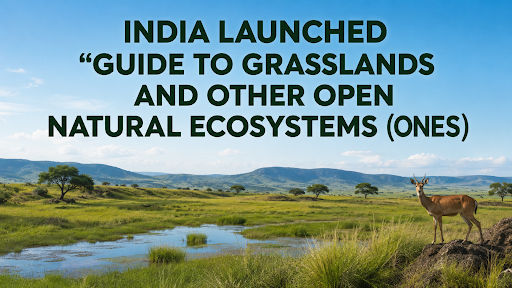
India launched first-ever Guide to Grasslands and Other Open Natural Ecosystems (ONEs) at UNCCD COP17 in Ulaanbaatar, Mongolia, urging science-based conservation of grasslands alongside forests.
What are Open Natural Ecosystems (ONEs)?
ONEs are naturally treeless or sparsely-treed landscapes, including grasslands, savannas, scrublands, deserts, and rocky and saline landscapes.
India's ONEs include the Himalayan and Terai grasslands, Thar and Banni landscapes, Deccan savannas, rocky plateaus, ravines, scrublands, coastal ecosystems and deserts.
ONEs cover approximately 320,000 sq. km, or about 10% of India's geographical area, concentrated in the dry sub-humid and semi-arid zones, with Rajasthan alone accounting for nearly 30% of total ONE area.
The Banni Grassland in Kutch, Gujarat, is Asia's largest grassland.
Ecologically Significance of Grasslands
Biodiversity: Grasslands support specialised species and genetic diversity.
Livelihoods: Grasslands sustain pastoralism, livestock production and rural economies; globally, rangelands support around 2 billion people. (Source: UNCCD)
Food Security: Rangelands provide livestock-based meat, milk and fibre, while pastoral systems convert grass biomass into human food in otherwise marginal lands.
Climate Regulation: Grasslands store carbon in vegetation and especially soils, making them important natural carbon reservoirs and climate-resilience ecosystems.
Water Security: Healthy grasslands improve water infiltration, soil moisture retention and hydrological regulation, reducing runoff and erosion.
Soil Conservation: Dense perennial grass cover protects soil from wind and water erosion, while extensive root systems improve soil structure and resilience to drought.
Desertification Control: Sustainable grazing maintains vegetation cover and reduces bare ground, helping break the degradation → erosion → drought vulnerability cycle.
Pastoral Culture: Grasslands sustain pastoral communities whose traditional mobility and grazing knowledge contribute to ecosystem resilience and cultural heritage.
Climate Resilience: Deep-rooted perennial vegetation allows healthy rangelands to retain water and withstand drought better, strengthening livelihood and ecosystem resilience.
Economic Value: Rangelands support livestock value chains while providing food, fibre, water regulation, carbon storage and tourism/recreational services, creating multiple economic benefits.
Global Significance: Rangelands cover over 54% of terrestrial land, making their conservation central to global food security, biodiversity, climate action and Land Degradation Neutrality.
What are the Major Threats?
Wasteland Misclassification: A large share of India’s grasslands and savannas remains classified as “wasteland”, facilitating conversion despite ONEs covering >10% of India’s geographical area and supporting pastoral livelihoods. (Source: ATREE)
Afforestation Pressure: Tree-centric restoration can replace native grassland ecology; the 2025 Revised Green India Mission Guidelines now emphasise eco-restoration and native species, strengthening the case for ecosystem-specific restoration.
Historical Loss: India lost around 20 million ha of grasslands between 1880–2010, alongside 26 million ha of forest, showing the historically neglected scale of grassland conversion. (Source: ATREE)
Infrastructure & Mining: Roads, urbanisation, mining, agriculture and renewable-energy infrastructure fragment ONEs, reducing habitat connectivity and threatening grassland-dependent species.
Protection Gap: <5% of India’s ONEs fall within the protected-area network, leaving most grasslands and savannas outside formal conservation regimes. (Source: ATREE)
Habitat Fragmentation: Fragmentation restricts species movement and genetic exchange, increasing long-term vulnerability of species such as the Lesser Florican and Great Indian Bustard.
Overgrazing & Invasive Species: Overgrazing and invasive shrubs such as Prosopis juliflora can alter grassland structure, reducing suitable habitat for specialised grassland fauna.
Way Forward
Ecosystem-Specific Restoration: Shift from blanket tree planting to grassland-specific restoration, using native grasses, controlled grazing and ecological fire regimes where scientifically appropriate.
Scientific Classification: Replace the generic “wasteland” approach with ecological mapping that identifies grasslands, savannas, shrublands and deserts as distinct ecosystems.
Community Conservation: Scale community-led models where local livelihoods align with conservation; 13 Phasepardhi villages have developed community monitoring and protection networks for the Lesser Florican.
Phaase Pardhi Model: In Wadala, community grassland management has linked fodder security with Lesser Florican conservation, demonstrating a livelihood–biodiversity co-benefit model.
Traditional Knowledge: Integrate pastoral grazing practices and indigenous ecological knowledge into management plans; Phasepardhi communities have contributed traditional knowledge on florican habitats and monitoring.
Climate Policy: Recognise ONEs explicitly within climate, biodiversity and land-restoration strategies because they provide carbon storage, biodiversity and livelihood services despite lacking forest cover.
Protected-Area Expansion: Move beyond forest-dominated conservation by creating community reserves, conservation reserves and other landscape-level mechanisms for ecologically important grasslands.
Livelihood Security: Link restoration with fodder, pastoral incomes and sustainable commons management, making conservation economically viable for agro-pastoral communities.
Conclusion
India needs a shift from “forest-centric conservation” to “ecosystem-centric conservation”, where a grassland is protected because of its ecological function, not converted because it lacks trees.
Source: HINDUSTANTIMES
PRACTICE QUESTIONQ. Consider the following statements regarding India's Open Natural Ecosystems (ONEs):
Which of the statements given above is/are correct? (a) 1 and 3 only (b) 2 only (c) 1, 2 and 3 (d) 3 only Answer: (a) Explanation: Statement 1 is correct: Open Natural Ecosystems (ONEs)—which include various types of non-forested habitats like grasslands, shrublands, and deserts—cover approximately 300,000 to 320,000 square kilometers, amounting to roughly 10% of India's total geographical area. Statement 2 is incorrect: A scientific assessment mapping India's ONEs revealed that they are severely under-protected. Less than 5% of India's Open Natural Ecosystems fall within the existing protected-area network, not more than 20%. Because a vast portion (around 68%) is legally categorized as "wastelands," they frequently face land conversion for industrial development and renewable energy projects. Statement 3 is correct: The Great Indian Bustard (Ardeotis nigriceps) and the lesser florican (Sypheotides indicus) are critically endangered, open-habitat specialist birds that rely heavily on the health and preservation of these grassland and shrubland ONEs for their survival and breeding. |