Why In News?
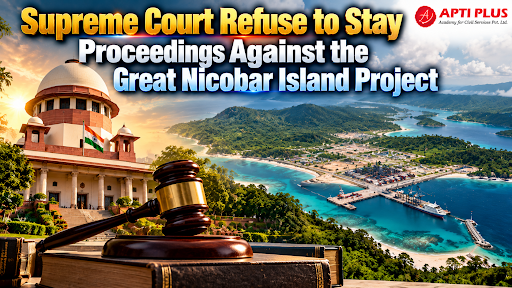
The Supreme Court refused to stay Calcutta High Court proceedings challenging the Great Nicobar Island Project, emphasizing that the preservation of indigenous tribal culture is a constitutionally protected fundamental right.
What Is The Great Nicobar Island Infrastructure Project?
International Container Transshipment Terminal At Galathea Bay
Transshipment Capacity & Footprint: Conceived by NITI Aayog, the Galathea Bay International Container Transshipment Terminal (ICTT) is designed for an ultimate capacity of 16 million TEUs (twenty-foot equivalent units), with Phase-I handling 4 million TEUs by 2028.
Geographic and Nautical Advantages: Located along the eastern side of Galathea Bay, the port features a natural water depth exceeding 20 metres and sits just 40 nautical miles from the primary international East-West shipping channel.
Greenfield International Airport And Township Development
Civil-Military Dual-Use Facility: Great Nicobar International Airport at Chingen is designed with a peak capacity of 4,000 passengers per hour and projected annual traffic expanding from 1 million to 10 million passengers under Indian Navy operational control.
Greenfield Smart Cities & Demographics: The master plan allocates 16,610 hectares to construct two greenfield coastal smart cities spanning seven revenue villages to house 650,000 permanent residents, increasing the island's current population by nearly 8,000 percent.
450 MVA Gas-Solar Power Generation Facility
Hybrid Energy Infrastructure: The project integrates a 450 MVA Gas and Solar Power Plant coupled with a 5 MW solar project paired with a Battery Energy Storage System (BESS) executed by NTPC over 16,610 hectares to power industrial and port operations.
Supporting Utilities: Water supply infrastructure includes Sea Water Reverse Osmosis (SWRO) desalination plants and a proposed check-dam along the Galathea River to meet urban and commercial freshwater demands.
Why Is Great Nicobar Island Strategically Important For India?
Location Near The East-West International Shipping Route
-
Proximity to Global Maritime Trade: Great Nicobar commands the main shipping artery connecting Europe, the Middle East, and East Asia, sitting within 40 nautical miles of the busiest transpacific and Indian Ocean sea lanes.
Proximity To The Malacca Strait And Indo-Pacific Sea Lanes
-
Maritime Choke Point Control: Located 150 km (or 80 nautical miles) north of Indonesia's Rondo Island (Sabang) and the entry to the Strait of Malacca, the island provides real-time surveillance over a choke point carrying over 30 percent of global maritime commerce.
Strengthening India’s Maritime Security And Surveillance
-
Forward Defense Operating Base: Upgrading facilities under the tri-service Andaman and Nicobar Command (ANC)—complementing INS Baaz at Campbell Bay—bolsters power projection, anti-submarine warfare, and maritime domain awareness across the Bay of Bengal.
Reducing Dependence On Foreign Transshipment Hubs
-
Logistics Sovereignty: Over 75 percent of India's transshipment cargo is currently handled at foreign ports such as Colombo, Singapore, and Port Klang.
-
Establishing a deep-water hub at Galathea Bay retains transshipment revenue and cuts feeder shipping delays for Indian exporters.
Strengthening India’s Presence In The Bay Of Bengal
-
Countering Regional Strategic Expansion: The infrastructure responds to expanding foreign naval footprints and port acquisitions in the Indian Ocean region, embedding India as the primary net security provider in the Indo-Pacific.
What Are The Major Concerns Associated With The Great Nicobar Project?
Large-Scale Forest Diversion And Habitat Loss
-
Rainforest Loss & Tree Felling: The project mandates diverting 130.75 sq km of tropical rainforest land. Official ministry estimates state 964,000 trees will be felled, while independent ecological studies estimate total tree loss could exceed several millions.
-
In-Principle Forest Approval Status: The Ministry of Environment, Forest and Climate Change granted Stage-I in-principle approval under the Van (Sanrakshan Evam Samvardhan) Adhiniyam, 1980, but Stage-II final clearance remains pending subject to judicial review.
Threat To Endemic Island Biodiversity
-
Risks to Endemic Species: Deforestation threatens specialized endemic fauna, including the Nicobar Macaque, the Nicobar Megapode, the newly discovered wolf snake Lycodon irwini (2025), and the Great Nicobar Crake.
Impact On Coral Reefs And Coastal Ecosystems
-
Coral Reef Degradation & Mapping Alterations: The Zoological Survey of India (ZSI) noted that extensive coral colonies in Galathea Bay require mechanical translocation. Updated coastal zone maps produced by the National Centre for Sustainable Coastal Management (NCSCM) in 2021 reduced CRZ-IA protected designations compared to 2020 baseline maps.
Risks To Leatherback Turtle Nesting Habitat
-
Disruption of Nesting Sites: Galathea Bay is the primary nesting site in the South Asian region for the giant Leatherback Sea Turtle (Dermochelys coriacea). Port dredging, breakwater construction, and artificial lighting threaten these critical nesting beaches.
Ecological Fragility Of The Great Nicobar Biosphere Region
-
High Seismic and Tsunami Risk: Located on an active seismic fault line, Great Nicobar experienced a 15-foot coastal subsidence during the 2004 Indian Ocean Earthquake and Tsunami. High-density infrastructure expansion increases exposure to natural disasters and volcanic activity in the Andaman Sea.
What Are The Tribal And Indigenous Rights Issues In The Great Nicobar Project?
Protection Of The Shompen Particularly Vulnerable Tribal Group
-
Vulnerability of Uncontacted Tribes: The Shompen are a hunter-gatherer Particularly Vulnerable Tribal Group (PVTG) numbering approximately 300 individuals (or 229 in the 2011 Census) living in semi-nomadic isolation within the interior rainforests.
-
Pathogen & Demographic Extinction Risks: Global human rights organizations and 39 genocide experts warned that introducing 650,000 settlers exposes the immunologically naive Shompen to fatal disease epidemics, cultural collapse, and demographic extinction.
Rights And Traditional Livelihoods Of The Nicobarese Community
-
Displacement of Coastal Tribes: Approximately 1,200 Nicobarese indigenous inhabitants relocated to Campbell Bay after the 2004 Tsunami face ancestral land alienation and loss of traditional coconut and maritime livelihoods.
Compliance With The Forest Rights Act, 2006
-
Statutory Violation of Habitat Rights: The Forest Rights Act, 2006 (FRA) mandates Gram Sabha Consent and the settlement of Community Forest Rights (CFR) and Habitat Rights under Section 2(h) and Section 3(1)(e) before forest land diversion.
-
Contested NOCs & Consent Withdrawal: In November 2022, the Nicobar Tribal Council formally withdrew its previously signed No Objection Certificate (NOC), alleging the administration used misleading maps that hid the overlap with designated tribal reserves.
Protection Of Indigenous Culture And Community Rights
-
Constitutional Duty of Cultural Protection: The Supreme Court affirmed that preserving indigenous cultural identity is a fundamental right under Article 21 that cannot be sacrificed for commercial ventures.
Requirement Of Meaningful Tribal Consultation
-
Violation of FPIC Standards: Proceeding without obtaining Free, Prior, and Informed Consent (FPIC) violates the UN Declaration on the Rights of Indigenous Peoples (UNDRIP) and the International Convention on the Elimination of All Forms of Racial Discrimination (CERD).
Way Forward
Balance Strategic Development With Ecological Conservation
-
Spatial Redesign and Buffer Zones: Restructure port and smart city layouts to keep construction strictly outside the Galathea National Park and sacred tribal foraging corridors.
Ensure Full Compliance With The Forest Rights Act
-
Binding Gram Sabha Consent Protocol: Operationalize genuine, transparent consent mechanisms under Section 3(1)(e) of the Forest Rights Act, 2006 before granting final Stage-II forest clearance.
-
Example: Niyamgiri Gram Sabha Consent Model, replicating the Supreme Court mandated 2013 Niyamgiri referendum framework under the Forest Rights Act, 2006, where binding Gram Sabha approval was required prior to clearing forest land.
Protect Indigenous Communities And Cultural Heritage
-
Inviolable Biocultural Reserves: Establish strict perimeter buffer zones around Shompen habitats to enforce the 2015 Shompen Policy of minimal interference and prevent pathogen exposure.
-
Example: UNDRIP Biocultural Reserve Protocol, establishing an inviolable Statutory Tribal Biosphere Reserve across the interior forests of Great Nicobar with zero non-tribal access to safeguard isolated PVTGs.
Strengthen Independent Environmental Monitoring
-
Real-Time Judicial and Ecological Oversight: Replace internal executive committees with independent judicial-scientific monitoring bodies.
Adopt Ecosystem-Sensitive Infrastructure Planning
-
Sustainable Construction Alternatives: Enforce elevated stilt expressways, zero-emission mass transit rail, modular SWRO desalination, and run-of-the-river water structures to preserve fragile island hydrology.
Conclusion
The long-term success of the Great Nicobar Project depends on protecting the irreplaceable biocultural heritage of the Shompen PVTG while maintaining full judicial accountability.
Source: THEHINDU
|
PRACTICE QUESTION Q. Examine the socio-ecological vulnerabilities of Particularly Vulnerable Tribal Groups (PVTGs) when mega-infrastructure projects alter coastal and forest ecosystems in island territories. 150 words |