Why In News?
The Union Government has moved the Supreme Court to stay ongoing legal proceedings before the Calcutta High Court regarding the Great Nicobar Island (GNI) Project.
What Is The Great Nicobar Project?
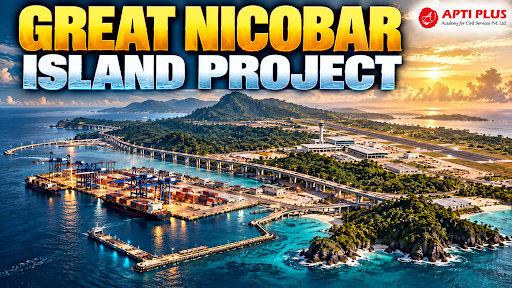
Mega Integrated Development Plan: Conceived by NITI Aayog and executed through the Andaman and Nicobar Islands Integrated Development Corporation (ANIIDCO) to transform Great Nicobar into an international transshipment and strategic economic hub.
Four Interlinked Infrastructure Components:
-
International Container Transshipment Terminal (ICTT): Deep-draft transshipment port at Galathea Bay designed to handle mega-container vessels.
-
Greenfield International Airport: Dual-use military and civilian airport capable of handling long-range commercial and naval surveillance aircraft.
-
Gas and Solar-Based Power Plant: A 450 MVA integrated power plant to supply uninterrupted electricity to the complex.
-
Greenfield Smart City and Township: A modern urban township, commercial maritime zone, and tourism complex spread over 130 square kilometers.
Geographical Scope: Involves the diversion of 130.75 square kilometers (13,075 hectares) of land, including extensive swathes of pristine tropical rainforest.

Strategic Significance of Great Nicobar
Maritime Chokepoint: Great Nicobar occupies an unmatched geopolitical position at the southern tip of the Bay of Bengal, lying within 40 nautical miles of the Malacca Strait—one of the world's busiest maritime transit corridors for global petroleum and trade.
Power Projection & Indo-Pacific Security: Enables the Indian Navy to maintain round-the-clock maritime domain awareness, anti-submarine warfare (ASW) patrols, and counter the expanding presence of China's People's Liberation Army Navy (PLAN) in the eastern Indian Ocean.
UNESCO Man and the Biosphere (MAB) Reserve: Designated as the Great Nicobar Biosphere Reserve in 2013, home to rare tropical wet evergreen forests, extensive coral reefs, and complex mangrove estuaries.
High Endemism: Harbors critical populations of endemic flora and fauna found nowhere else on Earth, operating as a biological speciation hotspot.

What Are The Major Concerns?
Massive Deforestation & Habitat Fragmentation: Entails the felling of an estimated 8.5 to 9.6 lakh mature rainforest trees, threatening irreplaceable ancient equatorial rainforest cover.
Destruction of Coral Reefs and Seagrass Beds: Port dredging and land reclamation at Galathea Bay threaten pristine coral colonies; while coral translocation has been proposed, global survivability rates for translocated corals remain critically low.
Threat to the Giant Leatherback Sea Turtle: Galathea Bay is one of the world's most significant nesting sites for the globally vulnerable Giant Leatherback Sea Turtle (Dermochelys coriacea), where port berths, artificial lighting, and breakwaters risk destroying critical nesting beaches.
Endangered Endemic Wildlife: Directly impacts the habitats of the Nicobar Megapode (a mound-building bird nesting along coastal shores), the Nicobar Tree Shrew, the Nicobar Macaque, and the Saltwater Crocodile.
Tectonic and Seismic Vulnerability: Great Nicobar lies in Seismic Zone V along the highly active Sunda Trench subduction zone; the 2004 Indian Ocean Tsunami caused the island’s coastline to subside by up to 3–4 meters, posing long-term hazards to rigid coastal concrete infrastructure.
Indigenous And Tribal Rights Concerns
Shompen Community
-
A Particularly Vulnerable Tribal Group (PVTG) of nomadic hunter-gatherers numbering between 200 and 300 individuals living in deep forest isolation.
-
Because of their limited immunological resistance, exposure to outside populations, construction workers, and urban sprawl poses severe biological and cultural existential risks.
Great Nicobarese Community
-
An indigenous coastal tribe displaced from ancestral seaside villages (including Chingen and Pulo Bhabhi) following the 2004 tsunami.
-
The community has persistently demanded resettlement back to their ancestral coastal lands, which overlap directly with proposed port and township zones.
Violation of the Forest Rights Act (FRA), 2006
-
Allegations that forest clearances were granted without recognizing Community Forest Rights (CFR) or obtaining genuine, informed consent from the traditional tribal councils.
-
In 2022, the local Tribal Council of Great Nicobar withdrew its earlier "No Objection Certificate," alleging that crucial details regarding the scale of tribal land acquisition were withheld.
Erosion of Tribal Protections: Circumvents protections under the Andaman and Nicobar Islands (Protection of Aboriginal Tribes) Regulation, 1956 (ANPATR) and the National Policy on Shompen (2015), which mandate that tribal habitats must not be diverted for commercial infrastructure.
Strategic Maritime Imperatives vs Ecological & Tribal Vulnerabilities
|
Way Forward
Institute Independent Cumulative Impact Assessments: Conduct multi-season, peer-reviewed scientific studies assessing the combined impact of port dredging, oil bunkering, aviation noise, and urban influx on island ecology.
Enforce Genuine Free, Prior, and Informed Consent (FPIC): Re-engage with the Great Nicobarese and Shompen communities in full compliance with the Forest Rights Act and international indigenous rights conventions (UNDRIP).
-
Example: Anthropological Buffer Demarcations to ensure zero non-tribal access within traditional Shompen foraging reserves.
Explore Alternative Port Geographies: Evaluate shifting the transshipment container berths from ecologically critical Galathea Bay turtle nesting shores to less sensitive, pre-existing port anchorages within the archipelago.
-
Example: Alternative Deep-Draft Feasibility Studies, assessing Campbell Bay or Car Nicobar for naval and commercial expansion.
Adhere to Transparent Judicial Review: Respect the jurisdiction of environmental tribunals and constitutional courts, addressing statutory procedural deficits rather than seeking pre-emptive litigation stays.
-
Example: Supreme Court Precedents in T.N. Godavarman Thirumulpad and Lafarge Umiam Mining, upholding that economic and strategic utility cannot supersede constitutional compliance with environmental statutes.
Conclusion
Balancing India’s maritime security and transshipment ambitions with Shompen tribal rights and Great Nicobar’s biosphere requires strict ecological safeguards, legal compliance, and genuine indigenous consultation.
Source: THEHINDU
|
PRACTICE QUESTION Q. Discuss the challenges of balancing strategic infrastructure development with ecological and tribal concerns in the Great Nicobar Island region. 150 words |