Why In News?
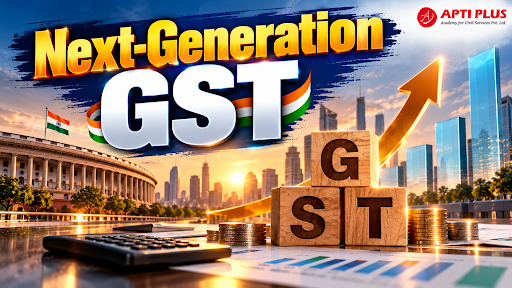
The Union Finance Minister highlighted that Next-Gen GST (GST 2.0) rate rationalization, implemented on 22 September 2025 following the 56th GST Council meeting, has expanded economic activity without eroding public revenues.
What Is GST 2.0?
Introduced on 1 July 2017 under the Constitution (One Hundred and First Amendment) Act, 2016, the Goods and Services Tax (GST) subsumed 17 indirect taxes and 13 cesses to construct a unified national market. However, structural friction from multi-tier rates (5%, 12%, 18%, and 28%) necessitated the next evolution.
GST 2.0 approved during the 56th GST Council session, shifted to a two-slab framework of 5% (merit rate) and 18% (standard rate), alongside a 40% demerit slab for luxury and sin items.
-
Objectives: lower living costs, unlock working capital for Micro, Small and Medium Enterprises, enhance consumption elasticity, and eliminate distorted inverted duty structures.
-
Performance: Central Board of Indirect Taxes and Customs data validates that gross GST collections escalated from ₹7.41 lakh crore in FY 2017–18 to ₹22.08 lakh crore in FY 2024–25, with average monthly collections reaching ₹2.04 lakh crore compared to ₹82,000 crore at inception.
What Are The Key Features Of GST 2.0?
Consumer Relief On Everyday Essentials: Essential food items like pre-packaged paneer, bread, and UHT milk attract 0% tax, while daily hygiene goods, bicycles, and packaged foods dropped to 5%. Life-saving healthcare formulations and 33 critical drugs moved to 0%–5%.
Stimulus To Durables And Automobiles: Small automobiles, two-wheelers (350cc), construction materials like cement, and electronic consumer durables (air conditioners, televisions) were reduced from 28% to 18%.
Decriminalization And Civil Dispute Resolution: Section 69 CGST Act powers of arbitrary arrest are slated for replacement with statutory civil penalties and automated risk profiling. Criminal prosecution thresholds are being elevated from ₹1 crore to ₹5 crore.
Digitized Administration And Automated Refunds: Incorporating Artificial Intelligence, automated invoice reconciliation through the Goods and Services Tax Network, and e-invoicing has automated 90% of low-risk refund claims without paper submissions.

What Are The Impacts Of GST 2.0?
Growth Acceleration: Total reported taxable supplies expanded by 25.8% and business-to-consumer sales grew by 26.7% within ten months of rate rationalization.
-
Real Gross Domestic Product growth reached 8.3% while the fiscal deficit contracted to 3.2% of Gross Domestic Product.
Fiscal Federalism: Former Reserve Bank of India Governor Duvvuri Subbarao conceptualized India's fiscal federalism across three epochs: 'Docile Federalism' (1947–1970s), 'Cooperative Federalism' (1970s–mid-1990s), and 'Combative Federalism' (mid-1990s–present).
-
While Article 279A institutionalizes cooperative governance via the Goods and Services Tax Council, the Centre's one-third weighted voting share often creates leverage concerns for subnational units.
State Autonomy: In the judgment Union of India vs Mohit Minerals Pvt. Ltd. (2022), the Supreme Court ruled that recommendations of the Goods and Services Tax Council carry persuasive, non-binding value, thereby safeguarding constitutional fiscal autonomy under Article 246 and the Seventh Schedule.
Shrinkage Of The Divisible Tax Pool: The Centre's expanded imposition of cesses and surcharges caused the divisible tax pool under Article 270 to contract from 88.6% in FY 2011–12 to 78.9% in FY 2021–22.
Feature |
GST 1.0 (2017–2025 Architecture) |
GST 2.0 (Next-Gen Reform Era) |
|
Tax Rate Architecture |
• Complex four-tier slab structure (5%, 12%, 18%, 28%) alongside multiple cesses. • Inverted duty structures causing severe working capital blockage for manufacturers. |
• Simplified primary two-slab structure (5% and 18%) with a dedicated 40% sin/luxury rate. • Standardized rate alignment resolving duty inversion across textiles and fertilizers. |
|
Compliance & Governance |
• Frequent return filings (GSTR-1, GSTR-3B, GSTR-9) generating high administrative costs. • Statutory powers of arrest under Section 69 of the Central Goods and Services Tax Act, 2017. |
• Single annual tax return with quarterly payment systems for firms up to ₹5 crore turnover. • Decriminalization replacing routine arrests with civil monetary fines and elevated prosecution thresholds. |
|
Federal Relations & Autonomy |
• Centralized voting structure (one-third Union share) curbing state tax autonomy. • Friction over 5-year Goods and Services Tax revenue compensation delays during economic shocks. |
• Reinforcement of collaborative decision-making under Article 279A. • 16% surge in aggregate State Goods and Services Tax receipts post-rationalization. |
Challenges In GST Structure
Shrinking Divisible Pool And Surging Cesses: The Union Government's reliance on cesses and surcharges—excluded from vertical devolution under Article 270—erodes subnational fiscal space.
-
Example: Fifteenth Finance Commission Report, divisible pool of central taxes dropped from 88.6% in FY 2011–12 to 78.9% in FY 2021–22, diminishing State revenue shares.
Restrictive Borrowing Ceilings On States: Unilateral enforcement of the Net Borrowing Ceiling under Article 293 restricts subnational capital expenditure and disaster response capability.
-
Example: State of Kerala vs Union of India (2024), suit filed in Supreme Court challenging Centre's borrowing caps under Fiscal Responsibility and Budget Management Act, 2003 as an unconstitutional encroachment on State fiscal autonomy.
Enforced Statutory Distortions And Compliance Costs: Persistent delays in Input Tax Credit verification and inverted duty structure refunds disproportionately impact small manufacturing units.
-
Example: Ministry of Micro, Small and Medium Enterprises Annual Report 2024, over 99% of registered firms are micro/small units facing severe cash-flow blockage from delayed refunds and high compliance costs.
Adjudicatory Delays In Tax Dispute Redressal: The delayed operationalization of national and state benches of the Goods and Services Tax Appellate Tribunal has locked up massive corporate capital in pending litigation.
-
Example: Central Board of Indirect Taxes and Customs Litigation Docket 2026, thousands of corporate appeals remain unresolved due to functional vacancies across appellate tribunals.
Way Forward
Harmonizing Finance Commission And GST Council Directives: Institutionalize a joint consultative mechanism between the Sixteenth Finance Commission under Article 280 and the Goods and Services Tax Council under Article 279A to align revenue projection models and prevent horizontal state imbalances.
-
Example: Y.V. Reddy Committee Recommendations, proposed formal statutory liaison bridge between Finance Commission and GST Council to harmonize tax devolution with indirect tax rate adjustments.
Complete Decriminalization And Administrative Risk Profiling: Transition fully from punitive criminal enforcement to automated, data-driven civil penalty frameworks.
-
Example: Central Board of Indirect Taxes and Customs Smart Enforcement Framework, AI-driven automated reconciliation approving 90% of low-risk refund claims within 3 business days.
Expanding The Tax Base To Energy And Real Estate: Establish a time-bound roadmap to integrate petroleum crude, high-speed diesel, petrol, aviation turbine fuel, natural gas, and electricity within the Goods and Services Tax framework to eliminate embedded tax cascading.
-
Example: Chief Economic Adviser Energy Inclusion Roadmap, proposed capped 18% rate on natural gas and aviation turbine fuel with full Input Tax Credit flow across manufacturing sectors.
Ecosystem Integration For MSME Credit Access: Interlink Goods and Services Tax Network transaction data with national digital public infrastructure to expand cash-flow-based collateral-free lending.
-
Example: Integrated GST 2.0 Policy Framework (IGF–MSME), seamless API integration between Goods and Services Tax Network, Udyam Registration Portal, Government e-Marketplace, and Reserve Bank of India Account Aggregator Framework.
Conclusion
GST 2.0 transforms India's indirect tax system from a revenue-collection tool into a growth-enabling governance architecture, balancing consumer relief with federal revenue buoyancy and economic formalization.
Source: INDIANEXPRESS
|
PRACTICE QUESTION Q. Consider the following statements regarding the Goods and Services Tax (GST) Council in India:
Which of the statements given above is/are correct? (a) 1 and 2 only (b) 2 only (c) 2 and 3 only (d) 1, 2, and 3 Answer: (b) Explanation: Statement 1 is incorrect: The Goods and Services Tax (GST) Council is a constitutional body, not a statutory one. It was established under Article 279A of the Constitution of India via the 101st Constitutional Amendment Act, 2016. Statement 2 is correct: According to Article 279A(9) of the Constitution, every decision of the GST Council requires a three-fourths (75%) majority of the weighted votes of the members present and voting. The Central Government holds a weightage of one-third (33.33%) of the total votes cast, while all State Governments combined hold a weightage of two-thirds (66.67%). Statement 3 is incorrect: In the landmark Union of India vs Mohit Minerals Pvt. Ltd. (2022) case, the Supreme Court ruled that the recommendations of the GST Council are not constitutionally binding on the Union or the States. The court held that the recommendations only have persuasive value, highlighting that both the Parliament and State legislatures possess simultaneous and equal powers to legislate on GST under Article 246A. |