Why In News?
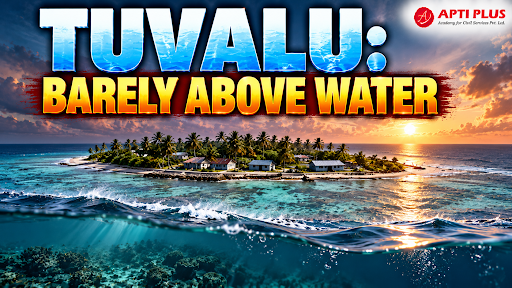
A severe marine heatwave has eradicated 99.9% of the coral foundational to Tuvalu, leaving the low-lying Pacific nation vulnerable to becoming uninhabitable by the end of the century due to rising sea levels.
About Tuvalu
-
Location: Tuvalu is a small island country in the west-central Pacific Ocean, consisting of nine coral islands spread across about 676 km.
-
Capital: Vaiaku, located on Fongafale Islet of Funafuti Atoll
-
Independence: Tuvalu was earlier part of the Gilbert and Ellice Islands Colony with present-day Kiribati and became an independent country in 1978.
-
Physical Features: The country includes both atolls and reef islands. Most islands rise only 4–5 metres above sea level, making Tuvalu highly low-lying.
-
Freshwater: Tuvalu has no rivers. People depend mainly on rainwater collection and wells for freshwater.
-
People: Tuvaluans are mainly Polynesian, and the Tuvaluan language is closely related to Samoan. English is taught in schools and widely used.
-
Population Distribution: Around one-third of the population lives in Funafuti, the country's administrative and commercial centre.
-
Economy: Tuvalu relies heavily on subsistence farming, overseas remittances, fishing fees, copra exports and foreign aid. It imports most of its food, fuel and manufactured goods.
-
Government: Tuvalu is a constitutional monarchy and parliamentary democracy within the Commonwealth.
-
Geographical Significance: Tuvalu is the fourth-smallest country in the world and consists of extremely low-lying islands. Pasted markdown

Why is Tuvalu Vulnerable to Submergence?
Decline of Coral Reef Formation
-
Biogenic Foundation: Tuvalu’s atolls are biogenic landforms, built over long periods from calcium-carbonate material produced mainly by reef-building corals and calcareous algae.
-
Marine Heat Stress: Rising ocean temperatures can cause mass coral bleaching. Prolonged exposure to temperatures beyond coral tolerance levels can result in large-scale coral mortality.
-
Weakened Coastal Protection: Healthy coral reefs act as natural barriers that reduce incoming wave energy. When reefs degrade, stronger waves reach Tuvalu’s fragile coral-rubble coastlines, increasing erosion and shoreline retreat.
Rising Sea Levels and Ocean Expansion
-
Thermal Expansion and Ice Loss: Ocean warming causes seawater to expand, while melting land ice, including the Greenland and West Antarctic ice sheets, adds more water to the oceans. Together, these processes contribute to rising sea levels.
-
Increasing Tidal Flooding: King Tides, associated with exceptionally high seasonal tides, can inundate low-lying parts of Tuvalu, including roads, causeways, homes and other infrastructure, even without a cyclone or major storm.
-
Compounding Risk: The combination of coral reef degradation, coastal erosion and rising sea levels increases Tuvalu’s exposure to recurrent flooding and long-term land-loss risks.
Continental Coasts vs Coral Atolls
|
|
Continental Coastlines |
Coral Atolls |
|
Examples |
India’s eastern coast |
Tuvalu, Kiribati, Maldives |
|
Land Base |
Backed by a large continental hinterland |
No continental hinterland; land occurs as narrow island strips |
|
Sedimentation |
Major river deltas continuously add sediments |
Limited sediment supply; islands mainly consist of calcium-carbonate material |
|
Land Width |
Generally broad coastal plains |
Often very narrow, sometimes less than 50–100 m wide |
|
Elevation |
Coastal areas can have varied and relatively higher terrain |
Usually very low-lying, with average elevation often below 2 m |
|
Substrate |
Diverse sediments and rock formations |
Highly porous calcium-carbonate substrate |
|
Response to Sea-Level Rise |
Greater scope for managed inland retreat |
Very limited space for horizontal retreat |
|
Natural Protection |
Can support mangroves and other ecological buffers |
Relies heavily on coral reefs and limited island landforms |
|
Seawall Effectiveness |
Can provide protection where suitable |
Less effective as water can also move through the porous island substrate, creating groundwater and inland flooding risks |
Source: THEHINDU
|
PRACTICE QUESTION Q. Consider the following statements about Tuvalu:
Which of the statements given above is/are correct? A. 1 and 2 only B. 2 and 3 only C. 1 and 3 only D. 1, 2 and 3 Answer: D Explanation: Statement 1 is correct: Tuvalu is a small island nation entirely surrounded by water, located in the Pacific Ocean. Statement 2 is correct: It is specifically positioned in the western-central part of the Pacific Ocean, about midway between Hawaii and Australia. Statement 3 is correct: The country is a Polynesian archipelago composed of nine small coral islands (comprising five true coral atolls and four reef islands) spread out in a chain. |