Why In News?
A study published in Nature magazine warned that 219 unstable hanging glaciers perched in Uttarakhand's Alaknanda Basin hold 0.74 cubic kilometers of hanging ice that could trigger catastrophic avalanches and flash floods.
What is a Hanging Glacier?
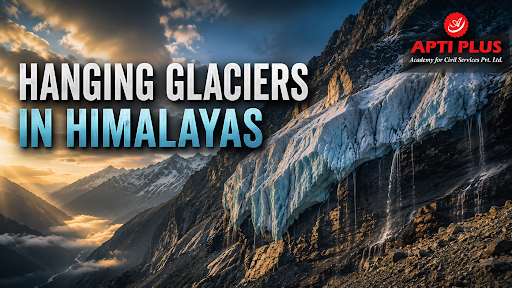
A hanging glacier (or perched glacier) is a mass of ice that clings to a steep mountain slope, cliff face, or hanging valley wall, ending abruptly at a sharp precipice without reaching the main valley floor below.
-
Unstable Ice Dynamics: Unlike valley glaciers that flow smoothly along gentle valley bottoms, hanging glaciers sit on extreme slopes (often exceeding 30° to 45°), making their ice mass physically precarious.
-
Limited Contact with Valley Floor: Because the ice tongue terminates on a cliff edge, it loses basal support as it moves downhill under gravity.
-
Potential Ice Break-Off (Calving): Tensile stress along crevasses causes massive blocks of ice (seracs) to fracture, detach, and plunge thousands of vertical meters down mountain faces.
-
Avalanche Formation: Falling ice masses pulverize into high-velocity powdered snow and rock avalanches, compressing air ahead of them to create destructive blast waves.

Where are Hanging Glaciers Found in India?
Central Himalaya & Garhwal Region: Concentrated heavily in the high-altitude cirques and peaks of the Garhwal Himalaya in Uttarakhand.
Upper Alaknanda Basin: Prominently located across sub-basins surrounding famous Himalayan peaks, including Nanda Devi, Kamet, Trishul, Chaukhamba, Nilkantha, and Ronti Peak.
Trans-Himalayan & Karakoram Ranges: Also distributed along steep rock faces in Ladakh (Zanskar and Nubra valleys), Himachal Pradesh (Spiti and Chenab basins), and North Sikkim (Kanchenjunga massif).
Why are Hanging Glaciers Dangerous?
Sudden, Unpredictable Ice Break-Offs: Unlike rising river levels that give hours of warning, hanging glaciers can detach instantaneously without prior visible signs, releasing millions of tonnes of ice.
Multi-Hazard Cascades & Flash Floods: Falling ice and boulders crash into narrow river gorges, creating temporary debris dams; when these dams burst, they unleash devastating flash floods downstream (as seen in the 2021 Chamoli disaster).
Triggering Glacial Lake Outburst Floods (GLOFs): If an ice avalanche falls into a high-altitude glacial lake, it creates displacement waves (tsunami-like surges) that breach the natural moraine dam.
Rapid Mass Movements: The mixture of ice, pulverized rock, meltwater, and glacial moraine transforms into dense, high-velocity debris flows that travel tens of kilometers downriver.
Catastrophic Infrastructure Destruction: Sweeps away bridges, tunnels, roads, and concrete barrage structures in mountainous valleys.
What Factors Increase Glacier Instability?
Rapid Himalayan Warming (Elevation-Dependent Warming): The Hindu Kush Himalaya is warming at nearly twice the global average rate, causing accelerated surface melting and thinning of perched ice masses.
Basal Lubrication & Thermal Softening: Meltwater penetrates deep into crevasses, reaching the glacier bed and lubricating the contact surface between ice and bedrock, reducing frictional grip.
Permafrost Thawing & Bedrock Fracturing: Rising sub-surface temperatures thaw frozen rock faces (permafrost), triggering structural rockfalls that pull attached glaciers down with them.
Extreme Weather Events & Rain-on-Snow Episodes: Heavy, unseasonal rainfall on high-altitude snowfields adds immense fluid weight and hydrostatic pressure to already strained hanging glaciers.
High Seismic Activity: The Garhwal Himalaya lies in active Seismic Zones IV and V along the Main Central Thrust (MCT), where even minor tremors can trigger sudden slope failures.

Source: INDIANEXPRESS
|
PRACTICE QUESTION Q. Hanging glaciers in the Central Himalayas represent an unseen, ticking disaster risk amplified by climate warming and unchecked infrastructure development in narrow river valleys. Discuss (10 Marks, 150 Words) |