Why In News?
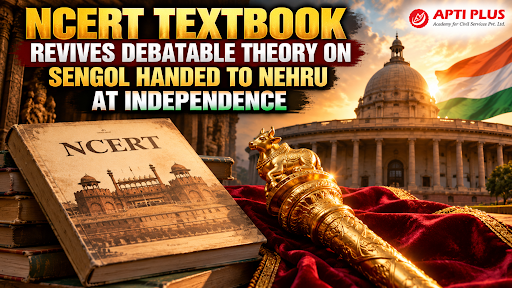
The National Council of Educational Research and Training (NCERT) has officially incorporated the narrative of the Sengol into its newly revised curriculum under the National Education Policy (NEP) 2020.
What is Sengol?
Traditional Tamil Symbol: The Sengol is a historic, gold-plated silver sceptre that symbolizes righteous authority, ethical governance, and the transfer of power.
Royal Sceptre: A physical insignia of supreme executive legitimacy, moral authority, and kingly duty handed over to an ascending monarch during royal coronation rites (Pattabishekam).
Symbol of Authority: Signifies that temporal sovereign power is held in sacred public trust, subordinating royal prerogative to ethical virtue, truth, and judicial righteousness.
Tamil Cultural Tradition: Represents an unbroken continuum of civilizational heritage, spiritual blessing, and institutional investiture practiced across regional dynasties.
Chola-Era Associations: Extensively associated with the imperial Chola Dynasty (9th–13th century CE), during whose coronation ceremonies the royal preceptor (Rajaguru) conferred the sacred sceptre upon the new ruler to validate dynastic transition.
-
The 1947 sceptre measures 5 feet in length, crafted in silver, coated in gold, and surmounted by the recumbent bull Nandi (representing eternal justice and unwavering steadfastness).

What is the 1947 Sengol Narrative?
Transfer of Power: Veteran freedom fighter and statesman C. Rajagopalachari (Rajaji) recommended adopting the ancient Chola sceptre investiture ceremony to symbolize the symbolic handover of sovereign authority from imperial Britain to independent India.
Lord Mountbatten: Contends that the last Viceroy of India, Lord Mountbatten, was initially presented with the sceptre, which was then ritually consecrated with sacred water and handed over to Prime Minister Jawaharlal Nehru on the night of August 14, 1947.
Jawaharlal Nehru: Documents Nehru receiving the gold-plated sceptre at his residence in the presence of emissaries and Vedic scholars, accompanied by the chanting of the Thevaram hymn (specifically Sambandar's Kolaru Pathigam).
Tamil Religious Leaders: The ceremony was conducted by senior representatives of the Thiruvaduthurai Adheenam, who commissioned Madras-based traditional jewelers Vummidi Bangaru Chetty to craft the five-foot sceptre.
Independence Ceremony: Depicts the ritual as a sacred indigenous milestone anchoring India's transition to self-rule hours before the official delivery of the "Tryst with Destiny" speech.
Parliament Museum Display: Following 1947, the sceptre was preserved at the Allahabad Museum (labeled as a golden walking stick presented to Nehru) before being formally installed near the Speaker's Chair in the New Parliament Building in May 2023.
Why is the Historical Interpretation Debated?
Documentary Evidence Gaps: Independent historians point out that archival records—including the Transfer of Power (1942–47) documents published by the British Government, the private papers of Lord Mountbatten, and Nehru's official correspondence—contain no explicit reference to the Sengol as a formal instrument of power transfer.
Oral Historical Accounts: Prevailing official narrative relies heavily on institutional oral traditions, commemorative souvenirs of the Adheenam, and retrospective media recollections rather than contemporary official minutes.
Contemporary Records and News Reports: Newspaper reports from August 1947 reported that Adheenam pontiffs visited Delhi and presented the sceptre along with Pitambaram (sacred cloth) to Nehru as a religious blessing and goodwill gift.
Different Historical Interpretations: Divergence between viewing the event as a central state-sponsored constitutional rite of succession versus an informal, private ceremonial blessing bestowed by a traditional monastic order.
Need for Source-Based History: Historians emphasize the necessity of cross-verifying secondary claims against primary archival evidence, official gazettes, and contemporaneous diaries before canonizing narratives into standard textbooks.
Conclusion
The Sengol symbolizes Tamil ethical governance, but its textbook portrayal must rely on primary historiography to balance tradition with objective inquiry.
Source: THEHINDU
|
PRACTICE QUESTION Q1. With reference to the 'Sengol' and its cultural traditions, consider the following statements: 1. In classical Tamil statecraft, the Sengol symbolized the moral authority of a king and the principle of righteous rule. 2. The historical ritual of conferring the royal sceptre during coronation ceremonies was prominently associated with the Chola dynasty. 3. The five-foot Sengol presented to Jawaharlal Nehru in 1947 features the recumbent bull Nandi at its crest. Which of the statements given above is/are correct? (a) 1 and 2 only (b) 2 and 3 only (c) 1 and 3 only (d) 1, 2 and 3 Answer: (d) Explanation: Statement 1 is correct: In classical Tamil statecraft, the Sengol (derived from the Tamil word Semmai, meaning righteousness) symbolized the moral authority of a ruler and the constitutional principle of Dharma or righteous governance. Statement 2 is correct: The historical ritual of handing over the royal sceptre from the high priest to the king during coronation ceremonies was highly prominent during the Chola dynasty to validate the transfer of power. Statement 3 is correct: The five-foot-long gold-plated Sengol, which was presented to India's first Prime Minister Jawaharlal Nehru on August 14, 1947, features a hand-carved recumbent bull, Nandi, at its crest. Nandi symbolizes the concept of Nyaya (justice) and unyielding order. |