Why In News?
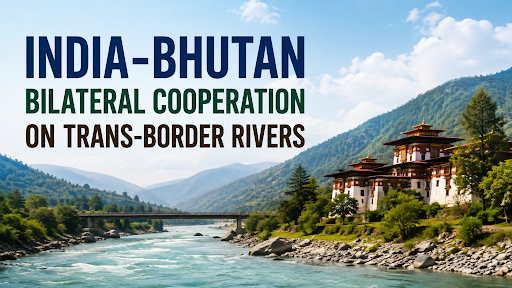
India and Bhutan held a high-level bilateral meeting on trans-border rivers in New Delhi, reviewing flood forecasting, hydrological data sharing, and the Punatsangchhu-I Hydroelectric Project.
What Are Trans-Border Rivers?
Trans-border rivers (also called transboundary rivers) are rivers that cross international boundaries, flowing through or forming the border between two or more countries.
They are shared water resources, requiring cooperative management since actions taken upstream directly affect downstream availability, flow timing, and flood risk.
Upstream and downstream countries have asymmetric stakes: the upstream country controls dam operations and water release timing, while the downstream country bears flood or scarcity risk from those decisions — making data sharing and institutional cooperation essential.
|
The four major transboundary river systems flowing between Bhutan and India are Manas, Sankosh, Raidak, and Torsa. All of these rivers originate in the Himalayas (some extending into Tibet), traverse southern Bhutan, and enter India via the states of Assam and West Bengal before eventually joining the Brahmaputra River system |
India-Bhutan Water Partnership
Bilateral water resources cooperation between India and Bhutan operates through a standing institutional mechanism for reviewing trans-border river issues, distinct from ad hoc crisis response.
Hydrological data sharing: Bhutan shares river flow, rainfall, and water-level data from stations on rivers flowing into India, enabling downstream flood forecasting.
Flood management: joint review of existing arrangements and identification of gaps in monitoring coverage.
Hydro-meteorological cooperation: includes technical support for upgrading Bhutan's observation network, since better upstream monitoring directly improves downstream forecasting accuracy.
Hydropower development: cooperation extends beyond flood management into joint hydropower projects, most significantly the Punatsangchhu-I and Punatsangchhu-II projects, which supply power to the Indian grid.
|
The India-Bhutan water and energy partnership began with the 1961 Jaldhaka agreement. It centers on harnessing Himalayan river potential for clean hydropower, revenue generation for Bhutan, grid stability for India, and expanded trans-boundary river cooperation. |
Importance of Bhutan for India's Water Security
Himalayan river systems: rivers flowing from Bhutan form tributary networks feeding into India's northeastern river systems.
Brahmaputra basin: Bhutanese rivers are part of the wider Brahmaputra basin, whose flood behaviour directly affects Assam.
Flood management in Assam: Assam's history of severe flooding — a recurring feature of the monsoon season — makes upstream data from Bhutan a direct input into the state's disaster preparedness.
Hydropower cooperation: joint projects give India both a clean energy source and a stake in maintaining strong bilateral coordination on river management, since project operation and flood management are technically linked.
Ecological security: joint monitoring supports better understanding of glacial and mountain-hazard risks that could otherwise destabilise river flow patterns without warning.
Punatsangchhu-I Hydroelectric Project
Situated on the Punatsangchhu River, about 80 km east of Bhutan's capital, Thimphu.
Implemented under a Bilateral Agreement signed in 2007, with the Government of India funding 40% as grant and 60% as loan at 10% annual interest.
Designed for 1,200 MW capacity (revised up from an initial 1,095 MW), expected to generate approximately 5,670 million units annually, with surplus power exported to India.
Source: PIB
|
PRACTICE QUESTION Q. With reference to the Punatsangchhu-I Hydroelectric Project, consider the following statements:
Which of the statements given above is/are correct? (a) 1 only (b) 2 only (c) Both 1 and 2 (d) Neither 1 nor 2 Answer: (c) Explanation: Statement 1 is correct: The Punatsangchhu-I Hydroelectric Project (PHEP-I) is a 1,200 MW run-of-the-river project constructed on the Punatsangchhu River in the Wangdue Phodrang district of Bhutan. Under the bilateral Inter-Governmental Agreement between India and Bhutan, the project's financing model is split into 40% grant and 60% loan provided by the Government of India. Statement 2 is correct: One of the primary pillars of the India-Bhutan energy partnership dictates that all surplus electricity generated by the project after meeting Bhutan's domestic consumption will be exported to India at a mutually determined tariff. |