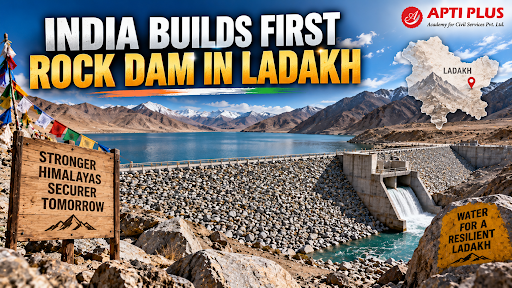
Why In News?
India inaugurated its first rock check dam across the Indus River at Upshi in Leh at 11,400 feet to secure village irrigation.
What is a Rock Check Dam?
A rock check dam is a small, permeable barrier built across a drainage ditch, stream, or channel using stones or rocks to slow down flowing water and trap sediment.
-
Rock-Based Permeable Structure: Constructed using un-cemented boulders, loose stones, and wire gabions that blend into the natural riverbed.
-
Temporary Water Retention: Traps seasonal surface runoff upstream without creating a massive, ecologically destructive reservoir.
-
Decentralised Hydraulic Control: Regulates flash runoff energy, arrests scouring, and promotes localized silt deposition along riverbanks.
-
Local Water Management Tool: Serves as a modular, cost-effective community asset built and maintained using local stone resources.
How It Works
-
Slows water flow: Water hits the piles of rocks and loses its speed and kinetic energy.
-
Traps sediment: Slower water drops heavy dirt and soil particles behind the dam instead of washing them away.
-
Allows seepage: Water slowly leaks through the gaps between the rocks or cascades safely over the top.

Main Benefits
-
Controls flow & prevents erosion: Reduces stream velocity to stop gully formation, protecting soil while creating upstream pondage to raise water tables.
-
Supports groundwater & irrigation: Promotes infiltration into alluvial aquifers and elevates water heads to feed canals and lift pipes.
-
Cost-effective: Uses local, natural materials like stone and gravel instead of expensive concrete.
-
Boosts drought resilience: Saturates banks for crop germination and buffers against early-spring shortages caused by delayed snowmelt.
Why Water Scarcity in Ladakh?
|
Significance for Himalayan Water Management
-
Decentralised Water Management: Shifts focus from mega-dams to localized micro-interventions tailored to micro-catchment topographies.
-
Local Water Conservation: Captures fleeting river volume directly within high-altitude valleys, maximizing local utilization efficiency.
-
Scalable Climate Adaptation: Offers a low-carbon engineering model resilient to high-altitude seismic activity and flash flood surges.
-
Low-Cost Infrastructure: Drastically minimizes fiscal expenditures by eliminating expensive concrete pouring, heavy machinery, and haulage.
-
Community-Led Participation: Empowers traditional village water masters ('Churpons') to manage and maintain weir gates autonomously.
-
Strategic Border Water Security: Enhances civil-military water stability along the strategic Leh-Manali transit corridor and LAC frontier.
Source: INDIATODAY
|
PRACTICE QUESTION Q. Analyze how small-scale decentralized rock check dams address cold-desert water scarcity and foster climate adaptation in the Himalayan region. (10 Marks, 150 Words) |