Why In News?
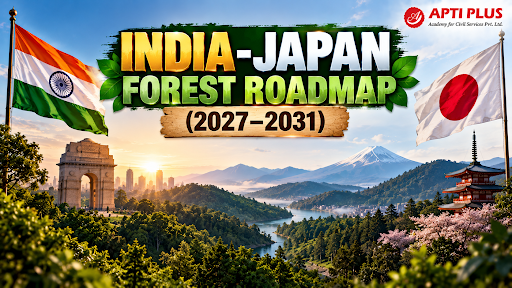
At the 7th India-Japan Joint Working Group meeting in Bengaluru, both nations endorsed the strategic Forest Cooperation Roadmap (2027–2031).
What is the India-Japan Forestry Cooperation Framework?
It is a bilateral partnership based on a Memorandum of Cooperation (MoC) signed in 2015 between India’s Ministry of Environment, Forest and Climate Change (MoEFCC) and Japan’s Ministry of Agriculture, Forestry and Fisheries (MAFF).
Supported by concessionary loans and technical assistance from the Japan International Cooperation Agency (JICA), financing large-scale community forestry and biodiversity conservation projects across states including Himachal Pradesh, Odisha, Tamil Nadu, Uttarakhand, Tripura, and Gujarat.
Scope of Collaboration: Sustainable forest management, joint wildlife habitat restoration, high-altitude watershed protection, scientific capacity building, and nature-based solutions for disaster risk reduction.
Core Pillars of the 2027–2031 Forest Roadmap
The newly endorsed 5-year roadmap focuses bilateral action on three technological and ecological pillars:
-
Trees Outside Forests (TOF): Scaling up agroforestry, farm forestry, urban green cover, and linear roadside/canal plantations to expand carbon sinks outside traditional recorded forest boundaries.
-
Forest Genetics and Tree Breeding: Conserving forest genetic resources (FGR), establishing germplasm cryobanks, clonal seed orchards, and breeding superior, fast-growing, climate-resilient indigenous tree varieties through partnerships between the Indian Council of Forestry Research and Education (ICFRE) and Japan’s Forestry and Forest Products Research Institute (FFPRI).
-
Digital Forest Stack Technologies: Developing an interoperable digital public infrastructure integrating satellite earth observation (ISRO and JAXA L-band radar), drone-borne LiDAR, artificial intelligence for biomass estimation, and dynamic digital forest inventories.

What is 'Forest Stack'?
|
Significance of India-Japan Forestry Cooperation
Nature-Based Solutions (NbS) for Climate Resilience: Combines Japanese slope-stabilization forestry engineering (Sabo works) with Indian watershed development to prevent mountain landslides and flash floods.
Kunming-Montreal Global Biodiversity Framework (KMGBF): Accelerates bilateral contributions toward Target 3 (30x30 Target)—ensuring that at least 30% of degraded terrestrial habitats are brought under effective conservation by 2030.
Green Public Diplomacy in the Indo-Pacific: Deepens the India-Japan Special Strategic and Global Partnership, demonstrating shared leadership in green technological innovation and South-South capacity building.
Source: PIB
|
PRACTICE QUESTION Q. Achieving India's ambitious climate pledge of expanding national carbon sinks while ensuring rural livelihood security requires breaking away from traditional silviculture toward digital forestry and agroforestry. Discuss. 150 words |