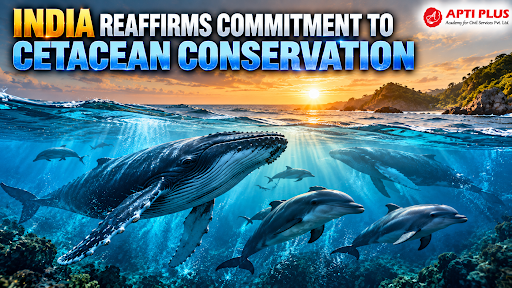
Why In News?
India reaffirmed its commitment to the global conservation of whales and other cetaceans at the 70th meeting of the International Whaling Commission (IWC-70) held in Hobart, Australia.
What Are Cetaceans?
Taxonomic Classification: Cetaceans are a specialized order of fully aquatic, placental marine mammals comprising whales, dolphins, and porpoises.
Two Major Suborders:
-
Mysticeti (Baleen Whales): Filter-feeding cetaceans equipped with keratinous baleen plates instead of teeth (e.g., Blue Whale, Humpback Whale, Bryde's Whale).
-
Odontoceti (Toothed Whales): Carnivorous cetaceans possessing teeth, utilizing active echolocation for navigation and hunting (e.g., Sperm Whale, Killer Whale, Indo-Pacific Humpback Dolphin, Ganges River Dolphin).
Physiological Adaptations: Evolved dorsal blowholes for atmospheric respiration, thick insulating subcutaneous blubber layers for thermal regulation, streamlined fusiform bodies, and horizontal tail flukes for propulsion.
Ecological Engineers (The "Whale Pump"): Feed in deep ocean layers and release nutrient-rich fecal plumes at the sunlit surface, fertilizing marine phytoplankton that absorb atmospheric carbon dioxide and produce oxygen.

What Is The International Whaling Commission (IWC)?
Origin: Established under the International Convention for the Regulation of Whaling (ICRW) signed in Washington, D.C., on December 2, 1946.
Global Membership: Comprises 89 member governments, operating as the premier international body tasked with whale stock management and cetacean habitat conservation.
The 1986 Commercial Whaling Moratorium: In 1982, the IWC adopted a historic zero-catch quota on commercial whaling that took legal effect in 1986, establishing a binding pause on industrial whale slaughter.
Evolution of Mandate: Transitioned from an initial resource-management cartel for whaling fleets into a global conservation organization addressing non-hunting threats (bycatch, vessel collisions, chemical contaminants, underwater noise).
What Is India’s Role In The IWC?
Member Since 1981: India formally acceded to the International Convention for the Regulation of Whaling in 1981, consistently maintaining a pro-conservation, anti-commercial whaling stance.
Opposition to Commercial and "Scientific" Whaling: Consistently votes to uphold the 1986 commercial whaling moratorium, opposing unilateral exemptions and lethal "scientific research" permits.
Promoting Non-Lethal Marine Science: Advocates for collaborative, non-invasive satellite telemetry, passive acoustic monitoring (PAM), and photo-identification databases across the Indian Ocean rim.
Indian Ocean Sanctuary: Supported the declaration of the Indian Ocean Whale Sanctuary (established in 1979) to safeguard breeding and nursery grounds across the tropical Indian Ocean basin.
Riverine Cetaceans vs Marine Cetaceans in Indian Waters
|
Source: PIB
|
PRACTICE QUESTION Q. With reference to cetaceans and their conservation status in India, consider the following statements: 1. All cetacean species found in Indian waters are granted the highest legal protection under Schedule I of the Wild Life (Protection) Act, 1972. 2. The Arabian Sea Humpback Whale is an exceptional subpopulation of humpback whales that does not undertake annual polar migrations. 3. India has been an active member of the International Whaling Commission (IWC) since its inception in 1946. Which of the statements given above are correct? (a) 1 and 2 only (b) 2 and 3 only (c) 1 and 3 only (d) 1, 2 and 3 Answer: (a) Explanation: Statement 1 is correct: All cetacean species (whales, dolphins, and porpoises) occurring in Indian national waters receive the highest level of legal protection under Schedule I of the Wild Life (Protection) Act, 1972. Statement 2 is correct: The Arabian Sea Humpback Whale is a unique and genetically distinct subpopulation that remains year-round in tropical and subtropical waters, meaning it does not undertake the long seasonal polar migrations typical of other humpback populations. Statement 3 is incorrect: India has not been a member of the International Whaling Commission since its inception in 1946; instead, India joined the commission later in 1981. |