Why In News?
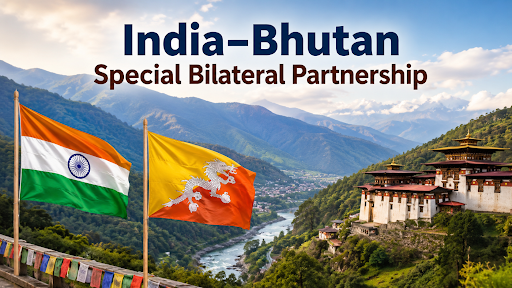
India and Bhutan concluded the 5th India–Bhutan Development Cooperation Talks in Thimphu.
Key Outcomes of the Talks
Project-Tied Assistance (PTA): India approved 12 new PTA projects worth ₹332 crore, taking the total to 82 projects worth ₹6,860 crore, covering healthcare, agriculture, disaster management and urban infrastructure.
Concessional Line of Credit: EXIM Bank of India signed a ₹4,000-crore concessional Line of Credit to support Bhutan's energy, hydropower and infrastructure sectors, strengthening Bhutan's 13th Five-Year Plan.
Medical Education Partnership: AIIMS New Delhi and Khesar Gyalpo University of Medical Sciences of Bhutan (KGUMSB) signed an MoU to enhance medical education, research, faculty exchange and clinical training.
Green Mobility: India handed over 45 Electric Vehicles (EVs) to Bhutan, supporting its Low Carbon Development Strategy and clean mobility goals.
Eco-Friendly Infrastructure: Joint inauguration of Thimphu Ecological Park and Olakha Park promotes sustainable urban development and green public spaces.
Development Partnership: India has committed ₹10,000 crore under Bhutan's 13th Five-Year Plan (2024–29), including ₹7,000 crore for PTA, ₹1,000 crore for High Impact Community Development Projects (HICDPs), ₹1,500 crore for the Economic Stimulus Programme and ₹500 crore as Programme Grant.

Strategic and Bilateral Importance of Bhutan
Strategic Buffer State: Bhutan acts as India's Himalayan buffer against Chinese strategic expansion, contributing to stability in the eastern Himalayan region.
Siliguri Corridor Security: Bhutan's geography helps protect the Siliguri Corridor ("Chicken's Neck"), India's narrow link to the eight North-Eastern States.
Doklam Tri-Junction: The Doklam Plateau remains critical after the 2017 India-China standoff, making India-Bhutan security coordination indispensable.
Hydropower Partnership: Hydropower is the cornerstone of bilateral ties. Projects such as Mangdechhu (720 MW) and Punatsangchhu-II (1,020 MW) enhance Bhutan's revenues while contributing to India's clean energy security.
Economic Interdependence: Hydropower exports account for around 63% of Bhutan's export earnings, with India remaining Bhutan's largest trading and development partner.
Neighbourhood First Policy: Bhutan is a key pillar of India's Neighbourhood First Policy and Act East Policy, strengthening connectivity, regional integration and people-to-people ties.
Border Management & Security: Close cooperation in border management, intelligence sharing and countering transnational crimes strengthens regional security.
Climate & Sustainability Partnership: Both countries cooperate on renewable energy, e-mobility, biodiversity conservation and disaster resilience, supporting their commitments under the Paris Agreement and SDGs.
People-to-People Relations: Educational scholarships, capacity-building programmes, cultural exchanges and healthcare cooperation reinforce the enduring friendship between the two countries.
Regional Connectivity: Collaboration on roads, digital connectivity, trade facilitation and cross-border infrastructure supports sustainable economic integration across the Himalayas.
Challenges In India-Bhutan Partnership
Project Delays: Rugged Himalayan terrain, geological instability and cost overruns continue to delay strategic hydropower projects such as Punatsangchhu-I, affecting power exports and revenue generation
Climate Vulnerability: Glacial Lake Outburst Floods (GLOFs), landslides and flash floods threaten hydropower projects, roads and border infrastructure, requiring climate-resilient engineering.
Strategic Competition: China's growing engagement in the Himalayas, including border negotiations and infrastructure expansion, has increased the strategic significance of India's Neighbourhood First Policy and development partnership with Bhutan.
Ecological Balance: Bhutan must generate employment and economic growth while preserving its constitutional commitment to maintain at least 60% forest cover and its carbon-negative status.
Youth Outmigration: Rising youth unemployment and migration reduce skilled manpower, posing challenges to long-term economic development.
Trade & Connectivity Bottlenecks: Limited cross-border logistics, rail connectivity and border infrastructure constrain bilateral trade and regional integration.
Way Forward
Cross-Border Connectivity: Fast-track the Kokrajhar–Gelephu and Banarhat–Samtse railway links, along with all-weather roads and integrated check posts under the BBIN connectivity framework.
Green Energy Diversification: Expand cooperation in solar, wind, battery storage and pumped storage hydropower. Bhutan's National Energy Policy 2025 targets 25,000 MW by 2040 (20,000 MW hydropower and 5,000 MW solar).
Sustainable Financing: Promote PPP models, multilateral financing and private investment to reduce sovereign debt risks, as demonstrated in the Dorjilung Hydroelectric Project.
Digital Integration: Expand RuPay, BHIM-UPI, digital customs and paperless trade systems to facilitate seamless cross-border commerce.
Trade Facilitation: Upgrade Integrated Check Posts (ICPs) such as Darranga, simplify customs procedures and improve multimodal logistics.
Regional Connectivity: Strengthening BBIN connectivity, border infrastructure and Northeast integration helps reinforce Bhutan's economic integration with India while offering alternatives to external strategic dependence.
Climate-Resilient Infrastructure: Adopt disaster-resilient hydropower, early warning systems and climate-smart infrastructure in line with Sendai Framework recommendations.
Support Gelephu Mindfulness City (GMC): Deepen India's cooperation in green infrastructure, education, healthcare, technology, logistics and clean energy to develop GMC as a regional economic hub connecting South and Southeast Asia.
Regional Energy Market: Accelerate cross-border electricity trade through a resilient regional power grid, improving energy security and clean energy exports across South Asia.
Conclusion
The India-Bhutan development talks cement an unbreakable partnership built on mutual trust, clean energy, and shared prosperity, acting as a powerful anchor for peace in the Himalayas.
Source: INDIANEXPRESS
|
PRACTICE QUESTION Q. The proposed Gelephu Mindfulness City, recently in the news for fostering South Asia to Southeast Asia connectivity, borders which Indian state to create a dynamic economic corridor? a) Sikkim b) Arunachal Pradesh c) Assam d) West Bengal Answer: c Explanation: Gelephu Mindfulness City project is located in southern Bhutan along the international boundary with Assam, aiming to serve as an economic gateway connecting South Asia to Southeast Asia. |