Why In News?
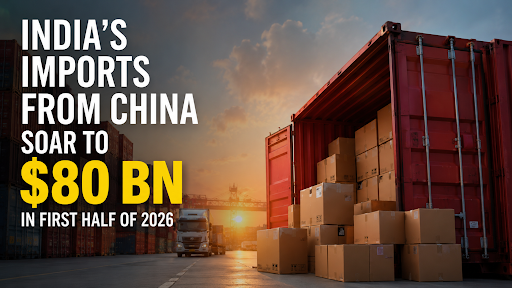
India’s imports from China surged by 21.8% to reach a record $79.41 billion in the first half of 2026, widening the bilateral trade deficit to $67.1 billion.
What is the Current Trend in India–China Trade?
Bilateral trade surpasses the record $155.62 billion set in 2025.
Indian exports to China rose by 37.2% to $12.31 billion in H1 2026, primarily driven by Printed Circuit Boards (PCBs) and refined petroleum.
Agricultural and fuel imports constitute less than 1.5% of total trade, as the relationship centers heavily on industrial inputs.
36% of imports consist of electrical machinery and electronics, embedding Chinese inputs deep within Indian manufacturing chains.
Why India's Imports from China Increased?
Intermediate Goods Dependence: India relies on Chinese active components, cells, and chemicals for export manufacturing, with electronics alone accounting for $46.4 billion (35% of total imports).
Cost Competitiveness: Chinese industrial parks provide subsidized electricity, land, and financing, rendering Indian-manufactured battery cells 20–30% costlier than Chinese alternatives.
Industrial Demand: India’s renewable energy and EV targets necessitate massive imports of solar modules and lithium-ion batteries due to near-zero domestic cell manufacturing capacity.
Technology Integration: China supplies 43% of India’s total electronics imports and 40% of machinery, serving as non-discretionary inputs for the digital economy.
Global Chokepoints: China controls midstream processing, refining 68% of Silicon, 58% of Lithium, and 87% of Rare Earth Elements (REEs) globally.
What are the Major Categories of Imports from China?
Electronics and Electrical Equipment: Comprises 36% of import value, including telecom gear and lithium-ion batteries.
Machinery and Industrial Components: Accounts for 21.7% of imports, forming the capital backbone for Indian factories.
Active Pharmaceutical Ingredients (APIs): China supplies 60–70% of India’s API imports, acting as the critical upstream node for the pharmaceutical sector.
Solar and Renewable Infrastructure: India relies on Chinese Tellurium (controlling 73.42% of global production) and processed Silicon.
Chemicals: China accounts for 44% of India’s organic chemical imports.
Telecommunications: Includes high-tech servers, cables, and 5G network components.
Why is Rising Dependence on Chinese Imports a Strategic Concern?
Supply Chain Vulnerability: India maintains 100% import dependence for 10 critical minerals (e.g., Lithium, Cobalt, Nickel) and high reliance on Bismuth (85.6%) and Silicon (76%).
Persistent Deficit: The $112.1 billion trade deficit in FY26 reflects a fundamental industrial capability gap.
National Security: Vulnerabilities in Silicon (semiconductors/C4ISR) and Titanium (aerospace/naval) threaten defense modernization.
Manufacturing Bottlenecks: The 50GWh Advanced Chemistry Cell (ACC) PLI scheme has achieved only 1.4GWh (2.8%) of installed capacity due to supply chain delays.
Geopolitical Weaponization: China restricts mineral exports, evidenced by the December 2023 ban on rare earth processing technologies and controls on gallium and germanium.
Benefits of Trade with China
Export Competitiveness: Chinese components support India’s $29.4 billion smartphone export surge in FY26.
Manufacturing Support: Access to intermediates facilitated a 40-fold increase in PCB exports to China, reaching $1.5 billion in FY26.
EV Sector Growth: Immediate access to LFP and NMC battery chemistry sustains India’s electric vehicle transition.
Consumer Welfare: Lower-cost imports keep inflation in check for household appliances and electronics.
Measures to Reduce Strategic Dependence
Strengthening Domestic Manufacturing
Implementing Approved List of Models and Manufacturers (ALMM) and extending implementation timelines for PLI beneficiaries by waiving strict penalties to allow the ecosystem to mature.
Diversifying Import Sources
Executing a "China+1" strategy by securing critical minerals through the Minerals Security Partnership (MSP) and bilateral deals with Australia and Chile.
Enhancing Global Supply Chain Partnerships
Leveraging platforms like the Quad to build resilient, trusted-source telecommunications and technology architectures.
Promoting Innovation and Technology Development
Fostering public-private R&D into alternative battery chemistries like Sodium-ion and Vanadium redox flow to bypass Lithium constraints.
Expanding Export Competitiveness
Scaling up domestic production of Active Pharmaceutical Ingredients (APIs) and advanced electronics modules to correct the trade imbalance through value-added exports.
Supporting Critical Sector Self-Reliance
Deploying tariff measures like Basic Customs Duty (BCD) and anti-dumping duties, alongside dedicated PLI schemes for battery components (cathodes, anodes) and critical mineral recycling.
Conclusion
India must navigate its trade relationship with China through "managed interdependence," selectively de-risking vulnerable supply chains like critical minerals and electronics while rapidly scaling domestic manufacturing capabilities to secure strategic autonomy.
Source: THEHINDU
|
PRACTICE QUESTION Q. "India's ballooning trade deficit with China is not merely an economic imbalance but a strategic vulnerability." Analyze. 150 words |