Why In News?
A comprehensive national bioenergy assessment reported by The Economic Times reveals India possesses 62 MMT of annual Compressed Biogas (CBG) potential, with cattle dung serving as the largest feedstock source.
What is Compressed Biogas?
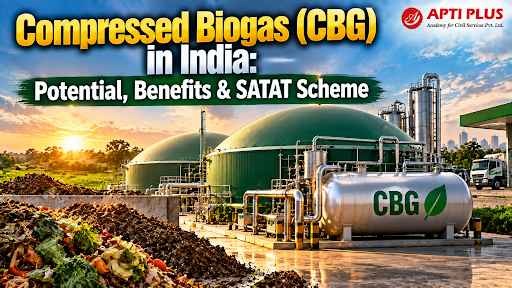
Compressed Biogas (CBG) is a clean, renewable, methane‑rich fuel produced by the anaerobic digestion of organic waste such as agricultural residue, cattle dung, municipal solid waste, sewage sludge, and food waste.
It is purified to yield 90–95 % methane (CH₄), making it chemically and energetically equivalent to Compressed Natural Gas (CNG) and suitable for use in vehicles, industries, and households.
Production Process
-
Feedstock Collection: Organic waste (crop residue, animal dung, kitchen waste, etc.) is collected.
-
Anaerobic Digestion: Microbes decompose the biomass in oxygen‑free digesters, producing raw biogas.
-
Purification: Carbon dioxide, hydrogen sulfide, and moisture are removed to obtain high‑purity methane.
-
Compression & Storage: The purified gas is compressed at high pressure (≈ 200 bar) for transport and use.
What are the Major Feedstocks?
-
Animal Waste: Cattle dung (gobar) and poultry litter provide stable, moisture-rich substrates packed with active methanogenic microbes.
-
Agricultural Residues: Surplus crop wastes, including paddy straw, wheat stubble, and maize stalks, offering high cellulosic carbon content.
-
Municipal Solid Waste: Segregated urban organic kitchen discards and market refuse processed to divert municipal organic waste.
-
Sewage Treatment Biomass: Concentrated biological sludge extracted from municipal wastewater treatment plants across tier-1 and tier-2 cities.
-
Sugarcane Press Mud: High-yield agro-industrial cake generated during sugar juice clarification, rich in fermentable organic compounds.
What is India’s CBG Potential?
Total Annual CBG Potential: 62 Million Metric Tonnes (MMT) of purified green biogas per year.
-
Total Annual Feedstock Requirement: 472 MMT of organic waste — agricultural residues, animal dung, municipal solid waste, sewage biomass, and sugar‑mill press mud.
-
Animal Waste Contribution: 25 MMT CBG potential from bovine manure, leveraging India’s vast livestock population.
-
Agricultural Residues Contribution: 20 MMT CBG potential from surplus crop straw, helping mitigate north India’s stubble‑burning crisis.
-
Municipal Solid Waste Contribution: 5 MMT CBG potential from wet urban waste, reducing landfill footprints and methane emissions.
-
Sewage Biomass Contribution: 10 MMT CBG potential from municipal wastewater sludge, generating clean urban energy.
-
Press Mud Contribution: 2 MMT CBG potential from sugar‑mill by‑products, enabling circular industrial energy recovery.
What are the Major Challenges?
Challenge Area |
Details |
Impact |
|
Feedstock Collection |
Low‑density crop straw requires costly automated balers and manual loading, raising operational expenses. |
Increases feedstock procurement cost and limits scalability. |
|
Transportation Costs |
Bulky biomass becomes uneconomical beyond a 25 km radius due to high freight charges. |
Restricts plant siting and regional feedstock mobility. |
|
Fragmented Agricultural Residues |
Smallholder farm fragmentation complicates long‑term feedstock contracts and aggregation logistics. |
Reduces supply reliability and investor confidence. |
|
Short Harvest Windows |
Only 15–20 days between paddy harvest and wheat sowing for straw collection and evacuation. |
Causes feedstock shortages and seasonal plant idling. |
|
Limited CBG Plants |
High capital cost (₹ 35–50 crore per 10‑TPD facility) limits operational capacity to < 100 plants nationwide. |
Slows national rollout and economies of scale. |
|
Financing Constraints |
Banks perceive bio‑energy projects as high‑risk, imposing elevated interest rates and collateral demands. |
Hampers private investment and project viability. |
|
Market Connectivity |
Absence of pipeline linkage to City Gas Distribution (CGD) networks forces reliance on mobile cascades for transport. |
Raises logistics cost and reduces competitiveness. |
What are the Government Initiatives?
Initiative |
Key Features |
Objective |
|
SATAT Scheme (Sustainable Alternative Towards Affordable Transportation) |
Targets 5,000 commercial CBG plants producing ≈ 15 MMT green fuel annually; assured 10‑year offtake by Oil Marketing Companies (OMCs). |
Promote CBG as a transport fuel, reduce import dependence, and create rural waste‑to‑wealth ecosystems. |
|
National Bioenergy Programme (NBP) |
Provides capital subsidy up to ₹ 4 crore per plant; supports biogas, bio‑CNG, and biomass gasifier projects. |
Encourage private investment and expand decentralized bioenergy infrastructure. |
|
Bioenergy Policy Blending Mandate |
Mandates phased blending of CBG into transport CNG and domestic PNG, rising to 5 % by 2028. |
Integrate CBG into national gas grid and ensure market stability. |
|
Waste‑to‑Energy Programmes |
Financial incentives for municipal sewage‑sludge plants converting wet waste into biogas. |
Promote urban circular economy and reduce landfill methane emissions. |
|
Organic Manure Promotion |
₹ 1,500 per MT subsidy for Fermented Organic Manure (FOM) generated as a CBG by‑product. |
Enhance soil fertility and support organic farming. |
|
Gas Grid Integration & Offtake Agreements |
Offer 10‑year assured purchase contracts at indexed prices for CBG producers. |
Provide market certainty and attract private entrepreneurs. |
|
GOBARdhan
|
₹ 23,731 crore national initiative to unify SATAT and NBP; aims for 5,000 plants by 2030 and ten‑fold increase in CBG output by 2035. |
Build a national bioenergy ecosystem linking rural waste management with clean fuel generation. |
Way Forward
Promoting FPO-Led Feedstock Aggregation: Mobilize Farmer Producer Organisations (FPOs) as rural biomass aggregators through subsidized baling equipment.
-
Example: Punjab’s In-Situ Crop Residue Management Scheme, providing 50–80% subsidies on mechanized straw balers.
Developing Cluster-Based Regional Bio-Hubs: Co-locate industrial-scale CBG plants near large dairy farms and sugar clusters to minimize transport runs.
-
Example: Banaskantha Dairy Bio-CNG Project (Gujarat), running commercial CNG bottling purely on clustered dairy cow dung.
Mandating Pipeline Grid Injection Infrastructure: Require City Gas Distribution (CGD) entities to install bio-methane injection manifolds along pipelines.
Expanding Concessional Green Credit Lines: Include commercial CBG ventures under Priority Sector Lending (PSL) with interest subventions.
Standardizing Fermented Organic Manure Distribution: Brand and bundle Fermented Organic Manure alongside subsidized synthetic fertilizers across retail outlets.
-
Example: PM PRANAM Scheme, incentivizing states to balance chemical fertilizers with fermented organic by-products.
Conclusion
Unlocking India’s 62 MMT compressed biogas potential can substitute costly LNG imports while converting agricultural residue challenges into rural green wealth.
Source: ECONOMICTIMES
|
PRACTICE QUESTION Q. Evaluate how harnessing India's compressed biogas potential can simultaneously advance energy security and mitigate environmental crises like stubble burning. (10 Marks, 150 Words) |