Why In News?
New climate-resilient moth bean varieties developed by ICAR-CAZRI demonstrated remarkable drought survival during Kharif 2026 dry spells.
What is Moth Bean?
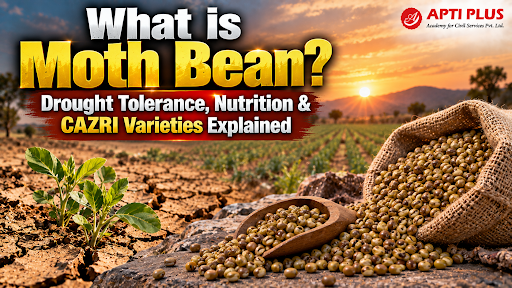
Moth bean, scientifically known as Vigna aconitifolia, is a small, drought-hardy legume native to India that is widely grown for its protein-rich seeds and sprouts.
|
|
Details |
|
Nature |
Drought‑tolerant pulse crop, capable of surviving extreme heat and dehydration. |
|
Cropping Season |
Kharif crop, sown between June–July and harvested in September–October under rainfed conditions. |
|
Agro‑Climatic Adaptation |
Thrives in hot arid regions with 200–300 mm annual rainfall; ideal for marginal sandy soils. |
|
Geographical Distribution |
Predominantly grown in western Rajasthan, which accounts for about 85 % of India’s total moth bean acreage; also cultivated in Gujarat, Haryana, and parts of Madhya Pradesh. |
|
Agronomic Role |
Integral to Thar Desert agriculture — stabilizes sand dunes, improves soil fertility through nitrogen fixation, and provides fodder during droughts. |
|
Nutritional Value |
Contains 22–24 % crude protein, rich in essential amino acids; consumed as dal, sprouts, and livestock feed. |
|
Economic Importance |
Serves as a staple food and fodder crop in arid zones; supports rural livelihoods through pulse trade and animal husbandry. |
Why is Moth Bean Important for India?
Pulse Self‑Reliance: Diversifies India’s domestic legume basket, reducing dependence on imported pulses such as pigeon pea (tur/arhar) and yellow peas.
Dryland Agriculture Backbone: Thrives in rainfed arid agro‑ecosystems, which constitute nearly 50 % of India’s net cultivated area — crucial for marginal farmers.
Farmer Income Security: Provides assured cash yields for desert smallholders; serves as the primary raw ingredient for the iconic Bikaneri bhujia industry, linking agriculture to rural enterprise.
Climate‑Resilient Crop: Endures temperatures above 42 °C and survives prolonged droughts with minimal water use, exemplifying agro‑ecological sustainability.
Low‑Rainfall Adaptation: Requires only 150–250 mm cumulative rainfall over a 60–75 day lifecycle, making it ideal for monsoon‑deficit regions.
Nutritional & Soil Security: Combating protein malnutrition in dryland populations; simultaneously fixes atmospheric nitrogen, rejuvenating degraded soils.
What are the Climate-Resilient Features?
Feature |
Details |
Advantage |
|
Drought Tolerance |
Possesses a deep taproot system penetrating beyond 1 meter, enabling extraction of subsoil moisture during prolonged droughts. |
Sustains growth and seed formation under extreme water scarcity. |
|
Early Flowering |
Initiates reproductive blooming within 30–35 days of sowing. |
Escapes terminal drought stress and ensures timely seed setting. |
|
Moisture‑Use Efficiency |
Exhibits specialized stomatal conductance that minimizes transpiration during high‑temperature daylight hours. |
Conserves water and maintains physiological activity under heat stress. |
|
Developmental Plasticity |
Temporarily suspends vegetative growth during dry spells and resumes flowering after episodic rainfall. |
Enables survival through erratic monsoon patterns. |
|
Rapid Reproductive Development |
Condenses pod‑filling and grain‑hardening into short time windows. |
Completes reproductive cycle before soil moisture depletion. |
|
Adaptation to Erratic Rainfall |
Shows multi‑tiered pod‑setting, allowing staggered grain formation across intermittent showers. |
Maximizes yield stability under unpredictable rainfall. |
Source: PIB
|
PRACTICE QUESTION Q. With reference to Moth Bean (Vigna aconitifolia), consider the following statements: 1. It is a drought-hardy Kharif legume cultivated predominantly in the hot arid agro-ecosystem of western India. 2. It requires heavy water irrigation exceeding 800–1000 mm throughout its vegetative growth cycle. 3. Its physiological trait of 'developmental plasticity' allows the crop to arrest vegetative growth during dry spells and resume reproduction upon rainfall. Which of the statements given above are correct? A) 1 and 2 only B) 1 and 3 only C) 2 and 3 only D) 1, 2, and 3 Answer: B Explanation: Statement 1 is correct: Moth Bean (Vigna aconitifolia) is a drought-hardy Kharif pulse crop cultivated extensively in the arid and semi-arid agro-ecological zones of western India, particularly in the Thar Desert region of Rajasthan, Gujarat, and Haryana. Rajasthan alone contributes over 90% of India's moth bean production. Statement 2 is incorrect: Moth bean has a very low water requirement rather than needing heavy irrigation. It thrives optimally on minimal water, typically requiring only 250–500 mm of annual rainfall, and can survive on as little as 150–250 mm. Statement 3 is correct: A defining physiological feature of moth bean is its developmental plasticity. This trait allows the crop to adjust its growth, flowering, and maturity duration flexibly in response to fluctuating environmental moisture levels, allowing it to halt vegetative growth during severe dry spells and complete reproduction once moisture is available. |