Why In News?
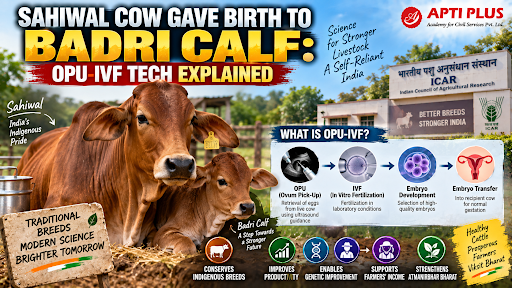
A purebred Badri calf was successfully delivered by a surrogate Sahiwal cow in Uttarakhand using OPU-IVF technology.
What is the Badri Cattle Breed?
Indigenous Breed: Officially registered as Uttarakhand's first native cattle breed by ICAR-National Bureau of Animal Genetic Resources (NBAGR) under accession code INDIA_CATTLE_2400_BADRI_03040.
Himalayan Cattle: A compact, agile Bos indicus breed weighing 200–250 kg, genetically adapted to navigate rugged mountain elevations up to 2,500 meters. Locally called “Pahadi” cattle.
Local Adaptation:
-
Well adapted to steep terrains, cold climate, and scarce fodder.
-
Grazes mainly on herbs and shrubs of the mountains.
-
Milk is valued for its medicinal properties and organic purity.
Physical Appearance
-
Colours: Black, Brown, Grey (rarely white in females).
-
Horns: Curved upward and inward.
-
Body: Small, active, sure‑footed; straight forehead, prominent poll, medium‑large hump.
Genetic Resource: Yields premium A2 beta-casein milk rich in antioxidants and polyunsaturated fatty acids without requiring chemical antibiotic regimens.
Livelihood Support: Serves as a primary milk, manure, and draught source for hill marginal farmers, though average milk output remains modest at 1–3 litres/day.

How was the Badri Calf Produced?
Stage |
Description |
|
1️⃣ Genetically Superior Badri Donor |
High-genetic-merit Badri cows with proven milk yield records were selected as donor mothers in Uttarakhand. |
|
2️⃣ Collection of Oocytes |
Using ultrasound-guided transvaginal aspiration, technicians collected immature oocytes (egg cells) from the elite Badri donors. |
|
3️⃣ In-Vitro Fertilisation (IVF) |
The oocytes were matured in a controlled laboratory environment and fertilized with cryopreserved semen from an elite pedigreed Badri bull. |
|
4️⃣ Embryo Development |
The fertilized embryos were cultured for seven days until they reached the blastocyst stage, which is optimal for implantation. |
|
5️⃣ Sahiwal Recipient Cow |
A healthy Sahiwal cow was hormonally synchronized using prostaglandin to match the embryo’s developmental stage. She served as the surrogate mother for gestation. |
|
6️⃣ Successful Birth |
The embryo transfer led to full-term gestation, resulting in the birth of a pure Badri calf. |
Why choose Sahiwal as a Surrogate?
While the native Badri cow is short-statured (200-250 kg) with smaller pelvic dimensions, the Sahiwal cow is larger and hardier (350-400 kg) with a mature uterine volume. Choosing a Sahiwal cow as a surrogate ensures excellent fetal growth space, zero calving difficulties (dystocia), and maximum gestational safety for the premium embryo.
Source: INDIANEXPRESS
|
PRACTICE QUESTION Q. With reference to Badri cattle and assisted reproductive technologies in India, consider the following statements: 1. Badri cattle is the first certified indigenous cattle breed registered from the state of Uttarakhand by ICAR-NBAGR. 2. Ovum Pick-Up (OPU) allows non-surgical collection of oocytes from live donor cattle without requiring hormonal superovulation. 3. The milk produced by Badri cattle contains the A1 beta-casein protein variant predominantly found in European dairy breeds. Which of the statements given above are correct? A) 1 and 2 only B) 2 and 3 only C) 1 and 3 only D) 1, 2, and 3 Answer: A Explanation: Statement 1 is correct: Badri cattle is recognized as the first certified indigenous cattle breed from Uttarakhand by the ICAR-National Bureau of Animal Genetic Resources (NBAGR). It is also designated as the state animal of Uttarakhand. Statement 2 is correct: Ovum Pick-Up (OPU) is an advanced reproductive technique that retrieves oocytes (immature egg cells) transvaginally and non-surgically from live donor cows without needing hormonal superovulation. Statement 3 is incorrect: Indian indigenous cattle breeds like Badri produce milk that predominantly contains the A2 beta-casein protein variant, whereas A1 beta-casein is typically found in crossbred or European dairy cattle. |