Why In News?
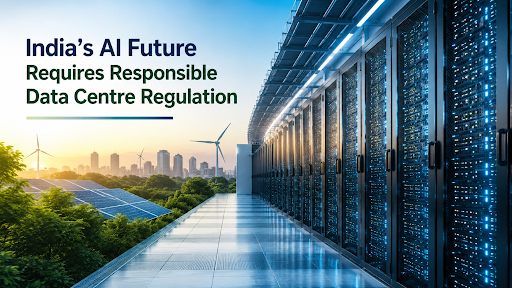
India's rapid $90 billion AI data centre expansion threatens to trigger severe local power and water crises unless immediate environmental regulations are enforced.
What are AI Data Centres?
AI Data Centres act as the physical backbone of the digital economy, housing highly specialized computing hardware like Central Processing Units (CPUs) and Graphical Processing Units (GPUs).
These facilities operate continuously to train AI models, process massive volumes of information, and run applications in real time.
Why are AI Data Centres Important for India?
IndiaAI Mission: Data centres provide computing power for the IndiaAI Mission, supported by a government allocation of ₹10,371.92 crore to foster native innovation.
Digital Economy: These hubs power critical digital public infrastructure, including UPI and Aadhaar, while supporting the projected 840 million 5G subscriptions by 2029.
Investment Attraction: India leverages a 21-year tax holiday to entice global tech giants, with domestic conglomerates like Reliance, Tata, and Adani partnering with firms like Google, Meta, and OpenAI.
Digital Sovereignty: Localized data storage ensures data localization, protecting national information from foreign interference and international sanctions.
Major Regulatory Challenges
Electricity Demand: Data centres act as "inflexible base loads," with demand expected to hit 13.6 GW by 2031-32, placing extreme strain on national transmission grids.
Water Consumption: Cooling requirements drive water usage from 150.30 billion litres in 2025 to 358.66 billion litres by 2030.
Groundwater Depletion: The Yotta Data Centre in Uttar Pradesh exemplifies the crisis, as local groundwater levels plummeted from 30 meters to 180-250 meters.
Carbon Emissions: Reliance on coal-based power persists due to the inconsistency of renewable sources, contributing to the 1% of global energy-related Greenhouse Gas Emissions attributed to data centres. (Source: International Energy Agency)
Urban Planning: Facilities cluster in water-stressed zones like Mumbai (40%), Chennai (25%), and Hyderabad (15%), where 50 existing centres compete directly with agriculture and local citizens. (Source: World Resource Institute)
Electronic Waste: Rapid technological evolution forces the frequent disposal of servers, generating hazardous volumes of e-waste.
Need For Responsible Regulation
Resource Scarcity: India holds 18% of the global population but only 4% of freshwater resources, making unregulated expansion a threat to water security.
Net Zero Goals: Strict regulations are vital to ensure India meets its Net Zero emissions by 2070 target by mandating renewable integration.
Environmental Accountability: Current gaps allow data centres to bypass the rigorous Environmental Impact Assessments (EIA) required of other heavy industries.
Community Protection: Regulation prevents rural communities from bearing the environmental costs of corporate profit-seeking.
Climate Resilience: Decentralized and regulated infrastructure ensures the digital backbone remains functional during extreme heat waves and natural disasters.
Measures for Sustainable AI Infrastructure
Renewable Procurement: Mandate that data centres source 70-80% of electricity from green energy within five years and establish Renewable Energy Zones.
Water Efficiency: Enforce the use of closed-loop cooling and treated wastewater to reduce freshwater consumption by 50-70%.
Energy Standards: Mandate Power Usage Effectiveness (PUE) limits below 1.25.
Cross-Ministry Oversight: The Ministry of Electronics and IT and the Ministry of Power must collaborate to evaluate grid and water impacts before project approval.
Circular Economy: Make recycling programs mandatory for all retired IT equipment.
National Guidelines: Develop a unified National Data Centre Policy prioritizing sustainability.
Advanced Technologies: Implement Small Modular Reactors (SMRs) for zero-carbon base-load power and repurpose server waste heat for district heating networks.
Grid Flexibility: Legally require operators to reduce power intake during national grid shortages.
Conclusion
India must rapidly implement resource-first regulations that successfully balance massive artificial intelligence growth with strict environmental resilience to build a sustainable digital future.
Source: indianexpress
|
PRACTICE QUESTION Q. "India's AI ambitions must be supported by sustainable digital infrastructure that balances technological growth with environmental stewardship." Discuss. 150 words |