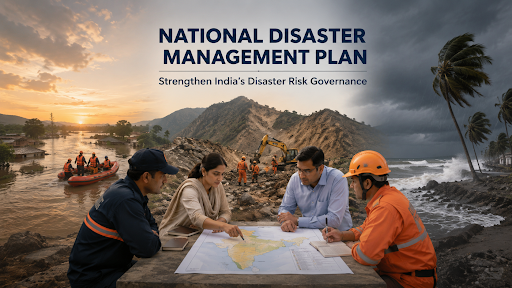
Why In News?
Rajya Sabha update by the Ministry of Home Affairs on the National Disaster Management Plan (NDMP), emphasizing its four core pillars—legal mandates, global climate alignments.
What is the National Disaster Management Plan (NDMP)?
The NDMP acts as India's apex statutory blueprint for disaster risk reduction (DRR), preparedness, emergency response, and post-disaster recovery.
It directs a multi-tiered framework linking central ministries, state governments, and district authorities to ensure swift, coordinated action during crises.
Key Pillars of the NDMP
Derives statutory authority directly from the Disaster Management Act, 2005, translating national policies into legally binding operational protocols.
Dynamic Framework: The NDMP is a "dynamic document" revised periodically to incorporate technological advancements and global best practices. Testbook
Phases of Management: It provides actionable guidelines for all phases of disaster management: prevention, mitigation, preparedness, response, and recovery. Testbook
International Alignment: The plan aligns with global goals, including the Sendai Framework for Disaster Risk Reduction, the Sustainable Development Goals (SDGs), and the Paris Agreement on Climate Change.
Prime Minister's 10-Point Agenda: It incorporates the Prime Minister's holistic approach to disaster risk reduction, which emphasizes community preparedness, women's leadership, and the use of technology and social media.
Social Inclusion: A core principle ensuring that the specific needs of vulnerable populations are addressed during disaster response and recovery.

Major Challenges in Disaster Risk Governance
Rapid Urbanisation: Dense cities face compounding risks, as seen in Odisha where public infrastructure exposure stands at ₹1.81 lakh crore across just 10 asset classes. (Source: UNDP)
.
Climate Change and Extreme Weather: Unpredictable climatic shifts cause fatal consequences, with lightning emerging as a leading killer, causing nearly 36% of all natural hazard fatalities in 2022.
Local Capacity Gaps: Rural and tribal districts suffer from a severe digital divide, leading to incomplete resource logs within the IDRN portal.
Inter-Agency Coordination Bottlenecks: Fragmented state-level implementation and manual relief processes frequently stall complex reconstruction projects across differing jurisdictions.
Financing Deficits: The global climate infrastructure financing gap reaches $1.4 trillion annually, forcing states to rely on delayed post-disaster borrowing rather than proactive funding.
Measures to Strengthen India's Disaster Resilience
Mainstreaming DRR into Infrastructure: Mandates Resilience Cost-Benefit Analysis in public projects, as early interventions generate returns of up to 12 times the initial investment.
Expanding AI, GIS, and Early Warning Systems: Implements the Web-DCRA & DSS tool nationwide (proven successful during Cyclones Biparjoy and Michaung) and expands DRDO's AI-based Autonomous Avalanche Forecasting System.
Community-Based Disaster Preparedness: Localises response strategies by providing communities with specialized training in indigenous rescue techniques to reduce dependency on external, delayed aid.
Empowering Local Governments: Establishes an Urban Disaster Management Authority (UDMA) in every major city, replicating Karnataka's activation of a UDMA for Bengaluru.
Updating Disaster Risk Databases: Operationalises the statutory National Disaster Database to map emerging disaster risks, funding allocations, and real-time mitigation plans.
Enhancing Multi-Hazard Risk Assessments: Shifts funding formulas to reflect true geographic vulnerability using data from tools like the Flood Hazard Atlas created by the National Remote Sensing Centre (NRSC).
Adopting Parametric Risk Pooling: Establishes an India Infrastructure Resilience Fund that releases automatic payouts within 14 days based on raw hazard data, such as cyclone wind speeds exceeding 250 km/h.
Conclusion
Shifting India's disaster management paradigm from reactive relief to proactive, technology-driven resilience remains paramount to safeguarding the nation's socioeconomic development against escalating climate threats.
Source: pib
|
PRACTICE QUESTION Q. "Disaster resilience requires mainstreaming disaster risk reduction into all sectors of development." Examine. 150 words |