Why In News?
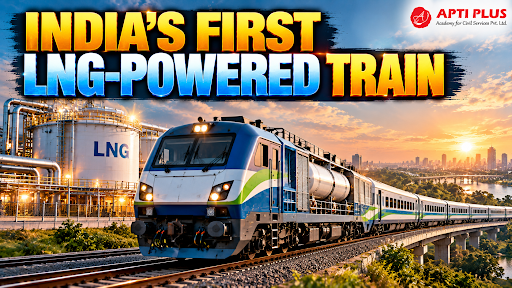
Indian Railways launched India's first Liquefied Natural Gas (LNG)–diesel dual-fuel DEMU train from Sabarmati Railway Station in Ahmedabad to Mahesana Junction in Gujarat.
What Is Liquefied Natural Gas (LNG)?
Liquefied Natural Gas (LNG) is natural gas that has been super-cooled to approximately −162°C (−260°F) into a liquid state for safe and economical storage and long-distance transport.
Key Properties & Composition
-
Composition: Primarily composed of methane (CH₄) along with minor fractions of other hydrocarbons.
-
Volume Reduction: The cryogenic liquefaction process shrinks the volume of natural gas by 600 times, making ocean transport via specialized cryogenic ships viable where pipelines are absent.
-
Physical State: It is odorless, colorless, non-toxic, and non-corrosive. When leaked, it vaporizes and is lighter than air, allowing it to disperse quickly.
-
Environmental Impact: Regarded as the cleanest fossil fuel, emitting significantly fewer sulfur oxides, nitrogen oxides, and carbon dioxide (40% less than coal) than traditional liquid and solid fuels.

Key Differences: LNG vs LPG vs CNG
|
Feature |
LNG (Liquefied Natural Gas) |
LPG (Liquefied Petroleum Gas) |
CNG (Compressed Natural Gas) |
|
Main Component |
Primarily Methane (CH₄) |
Propane and Butane (C₃H₈, C₄H₁₀) |
Primarily Methane (CH₄) |
|
Source/Origin |
Natural gas fields |
Byproduct of oil refining & gas processing |
Natural gas fields |
|
Physical State |
Liquid (at extreme cold: -162°C) |
Liquid (under moderate pressure) |
Gas (under high pressure: 200–250 bar) |
|
Primary Transport |
Cryogenic ships and pipelines |
Pressurized cylinders via road |
High-pressure cascades/pipelines |
|
Core Use |
Power plants, heavy transport, industry |
Household cooking & heating |
Urban vehicular transport (City gas) |
Significance for India
-
Energy Transition & Net-Zero: Acts as a "bridge fuel" in India's path toward its 2070 Net-Zero target, helping heavy industries and transport shift away from coal and diesel.
-
Import Dependency & Energy Security: India imports about 60% of its LPG consumption and out of these imports about 90% come through the Strait of Hormuz. Supply chain vulnerabilities (such as disruptions in West Asia) directly impact domestic availability and industrial feedstock costs.
-
Emerging Infrastructure: India is expanding its regasification terminals, city gas distribution (CGD) networks, and introducing alternative transport applications (such as LNG-diesel dual-fuel trains and long-haul LNG trucks).
About LNG-Diesel Dual-Fuel Train
-
Dual-Fuel System: Uses a mix of Liquefied Natural Gas (LNG) and diesel, allowing the engine to switch between both fuels.
-
Diesel Substitution: LNG replaces about 40% of standard diesel consumption.
-
Power Units: Two upgraded 1,400 HP Driving Power Cars (DPCs) at the Sabarmati Integrated Coaching Depot.
-
Tank Capacity: Each power car has an LNG tank holding roughly 2,200 litres.
-
Environmental Impact: Lowers emissions of carbon dioxide, nitrogen oxides, and particulate matter.
Operational Benefits
-
Diesel Substitution: The electronically controlled gas-injection system allows Liquefied Natural Gas (LNG) to replace roughly 40% of conventional diesel consumption.
-
Dual-Fuel Flexibility: Engines can seamlessly switch between LNG and diesel depending on fuel availability, preventing operational bottlenecks if LNG supply is low.
-
Retrofit Capability: Existing diesel-powered Driving Power Cars (DPCs, such as the 1,400 HP units modified by the Integral Coach Factory) can be retrofitted rather than requiring brand-new locomotive builds.
-
Practical Range: Cryogenic tanks store 2,200 litres of LNG at –162°C per DPC, supporting a range of about 444 km of daily operation.
Economic Benefits
-
Fuel Cost Reductions: Lower relative pricing for natural gas generates an estimated annual savings of ₹11.9 lakh per DPC, totaling about ₹23.9 lakh for an 8-coach train rake.
-
Lower Import Dependence: Diversifying the railway energy mix cuts down expensive fossil-fuel diesel imports, supporting macroeconomic energy security. Cost-Effective Decarbonization: Acts as an affordable transitional bridge toward Indian Railways' larger goal of net-zero carbon/zero diesel operations by 2030 compared to more expensive alternatives like pure hydrogen tech.
Environmental Benefits
-
Emission Cuts: Significantly curbs emissions of carbon dioxide (CO₂), nitrogen oxides, and particulate matter (PM).
-
Improved Air Quality: Eliminates heavy visible smoke and lowers local pollutants around non-electrified rail corridor
Source: INDIANEXPRESS
|
PRACTICE QUESTION Q. With reference to Liquefied Natural Gas (LNG) and dual-fuel rail technology, consider the following statements: 1. LNG is natural gas cooled to approximately -162°C, reducing its volume by about 600 times compared to its gaseous form. 2. In a diesel-LNG dual-fuel compression-ignition engine, natural gas auto-ignites purely through cylinder air compression without requiring any pilot diesel injection. 3. Methane slip refers to the unburned release of methane gas across the combustion cycle and supply chain. Which of the statements given above are correct? (a) 1 and 2 only (b) 2 and 3 only (c) 1 and 3 only (d) 1, 2 and 3 Answer: (c) Explanation: Statement 1 is correct: Liquefied Natural Gas (LNG) is natural gas (predominantly methane) that has been cooled to approximately -162°C. This cryogenic process liquefies the gas and reduces its volume by about 600 times, making it much easier and safer to store and transport. Statement 2 is incorrect: In a diesel-LNG dual-fuel compression-ignition engine, natural gas has a high auto-ignition temperature and cannot ignite purely through compression under typical engine conditions. Therefore, a small amount of pilot diesel injection is required to auto-ignite under compression, which then acts as an ignition source to burn the air-LNG mixture. Statement 3 is correct: Methane slip is the term used to describe the escape of unburned methane into the atmosphere from the engine's combustion cycle, as well as leaks throughout the fuel supply chain. Because methane is a potent greenhouse gas, minimizing methane slip is a major environmental focus in dual-fuel technology. |