Why In News?
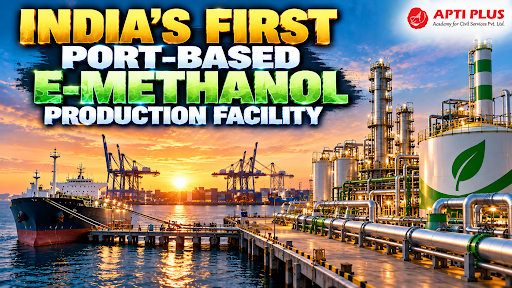
The foundation stone for India’s first port-based e-methanol production and bunkering facility was laid at Deendayal Port in Kandla, Gujarat.
What Is E-Methanol?
E-methanol (electronic methanol or green synthetic methanol, CH3OH) is an advanced electro-fuel produced by synthesising green hydrogen with captured carbon dioxide.
Zero Net-Carbon Profile: Because it utilizes captured biogenic carbon dioxide alongside renewable electricity, its lifecycle greenhouse gas (GHG) emissions are up to 95% lower than conventional marine heavy fuel oil (HFO).
Liquid at Ambient Conditions: Unlike pure hydrogen (which requires cryogenic cooling to -253°C or 700-bar compression) or LNG (requiring -162°C ), e-methanol remains stable as a liquid at ambient temperature and atmospheric pressure.

Why Is Green Methanol Important For Global Shipping?
IMO Decarbonisation Mandates: The International Maritime Organization (IMO) mandates reducing the carbon intensity of international shipping by at least 40% by 2030 and reaching net-zero GHG emissions by or around 2050.
Rapid Dual-Fuel Fleet Adoption: Global ocean carriers (such as Maersk, CMA CGM, and COSCO) have placed commercial orders for hundreds of methanol-ready container vessels, creating massive captive demand for certified green bunker fuel.
Infrastructure Retrofit Feasibility: Converting vessel fuel tanks and bunkering pipelines for liquid methanol costs approximately 60–70% less than retrofitting for cryogenic LNG or liquid hydrogen.
Compliance with EU Carbon Borders: Shields international shipping lines from penalties under the EU Emissions Trading System (EU ETS) and the FuelEU Maritime Regulation.
Source: ECONOMICTIMES
|
PRACTICE QUESTION Q. With reference to 'E-Methanol' (Green Synthetic Methanol), consider the following statements: 1. It is produced by catalytically reacting green hydrogen with captured carbon dioxide. 2. Unlike liquid hydrogen and LNG, e-methanol remains in a liquid state at ambient temperature and pressure. 3. Its combustion completely eliminates carbon dioxide emissions at the vessel tailpipe without producing any water vapour. Which of the statements given above are correct? (a) 1 and 2 only (b) 2 and 3 only (c) 1 and 3 only (d) 1, 2 and 3 Answer: (a) Explanation: Statement 1 is correct: E-methanol (Green Synthetic Methanol) is synthesized by combining green hydrogen (produced via water electrolysis powered by renewable energy) with captured carbon dioxide (obtained through direct air capture or industrial emissions) in a catalytic chemical reaction. Statement 2 is correct: Unlike liquid hydrogen and Liquefied Natural Gas (LNG), which require cryogenic temperatures and high pressure to remain stable, e-methanol is a liquid fuel under ambient temperature and pressure. This property allows it to use existing refueling infrastructure and conventional bunkering facilities without specialized storage requirements. Statement 3 is incorrect: When e-methanol is combusted, it releases both carbon dioxide and water vapour at the tailpipe. It is considered "low-carbon" or "carbon-neutral" on a lifecycle basis because the CO2 emitted during combustion equals the 𝐶𝑂2 captured during its production, creating a closed carbon loop. It does not completely eliminate tailpipe emissions, nor does it avoid producing water vapour. |