Why In News?
The Union Ministry of Health and Family Welfare launched the central 'e-Pratyaropan' digital platform and new national guidelines to reform India's transplant ecosystem.
Current Status and Trends of Organ Donation in India
Record-Breaking Transplants: India performed 20,138 organ transplants in 2025, representing a 6.5% increase over 2024 (18,911), according to the National Organ and Tissue Transplant Organisation (NOTTO) Annual Report 2025–26.
Global Standing: India ranks third globally in total organ transplants, following the United States and China.
Regional Leaders: Delhi-NCR records the highest volume with 4,564 transplants in 2025, followed by Tamil Nadu (2,796) and Maharashtra (2,136).
Dominant Procedures: Kidney transplants dominate India's ecosystem, accounting for 62.03% of all transplants in 2025, followed by liver transplants at 20.46%.
Deceased Donation Leadership: Tamil Nadu remains the leading state in deceased organ donation, registering 266 deceased donors in 2025, followed by Telangana (205) and Karnataka (198).
Aadhaar-Based Pledges: The National Digital Organ Donation Pledge Portal records more than five lakh Aadhaar-verified organ donation pledges since 2023.
About Organ Donation
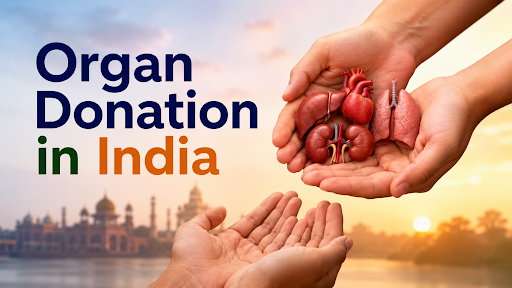
Organ donation is the voluntary donation of human organs or tissues by a living or deceased donor to a patient suffering from terminal (end-stage) organ failure. A single deceased donor can save up to eight lives
Living Organ Donation
-
Healthy Donors: A living person voluntarily donates an organ (such as a kidney or a segment of their liver).
-
Global Leadership: India ranks first worldwide in living donor transplants.
-
Liver Reserve and Regeneration: Living liver donation is highly effective because a person can function normally with only 25% of their liver, and the organ completely regenerates to its normal size within a few weeks.
Deceased Organ Donation
-
Post-Mortem Retrieval: Doctors retrieve healthy organs from a person who has died.
-
Rising Numbers: India’s deceased donor transplants increased from 837 in 2013 to 3,526 in 2025.
Brain Stem Death
-
Permanent, board-certified loss of all brain stem functions. Despite brain death, ventilators temporarily maintain heartbeat and blood flow to preserve vital organs for retrieval.
Legal and Institutional Framework
The Transplantation of Human Organs and Tissues Act (THOTA), 1994 regulates the removal, storage, and transplantation of human organs and tissues in India, criminalizing commercial dealings and organ trading to protect poor communities from financial exploitation.
THOTA Rules, 2014 govern the legal processes of donation and standardize the role of Authorisation Committees, which interview donors to confirm altruistic intent and eliminate emotional or financial coercion.
In August 2026, the government released the National Brain Stem Death Certification Guidelines to provide a clear, standardized, and practical step-by-step protocol for hospital doctors to certify brain deaths in ICUs.
The National Organ and Tissue Transplant Organisation (NOTTO) in New Delhi acts as the apex coordinating body under the Union Ministry of Health and Family Welfare, managing the national registry, waitlists, and organ procurement policies.
Government Initiatives
e-Pratyaropan Portal: Integrating hospitals, doctors, and donors/recipients with a national waiting list and real-time monitoring.
Jug Jug Jiyo Abhiyaan: Nationwide community campaign promoting organ donation in every Indian village.
NOTTO Mobile App: Mobile application providing citizens and administrators on-the-go access to transplant services.
National Organ Transplant Programme (NOTP): Central scheme funding states to upgrade ICUs, train coordinators, and manage organ retrieval and logistics.
One Nation One Organ Allocation System: Remove restrictive domicile requirements, eliminate the recipient upper age limit of 65 years, and make waitlist registration completely free.
National Organ Donation Registry: Centralized, digital registry to map donors and recipients transparently and prevent commercial manipulation.
Green Corridor: Police and civil administrations create a manual, traffic-free path to transport harvested organs rapidly between hospitals, saving precious time.
Challenges in the Indian Transplant Ecosystem
Low Deceased Organ Donation Rate: India's deceased donation rate remains critically low at below 1 per million population (pmp), compared to Spain's 52.6 pmp and the United States' 48 pmp.
Staffing and Funding Crises: While surgeons perform 13,476 kidney transplants in 2024, 175,000 patients remain on the waitlist with an average wait time of 3 to 5 years.
Inter-hospital Disparity: Some government hospitals do not perform a single transplant despite possessing the required equipment.
Myths and Social Barriers: Deep-rooted social fears, lack of awareness, and religious misconceptions prevent families from consenting to donate deceased relatives' organs.
Infrastructure Gaps: India lacks adequate ICU donor-maintenance beds, retrieval centers, and specialized transport coordination, leading to organ wastage.
Gender Disparity in Living Donations: Women make up 68% of living donors but only 22% of recipients, whereas men make up 78% of recipients but only 32% of living donors.
Way Forward
Public Awareness Campaigns: Scale up community outreach like the 'Jug Jug Jiyo Abhiyaan' to rural sectors to dispel myths and normalize the noble act of donation.
Mobile Organ Retrieval Centres (MORCs): Establish MORCs to harvest organs from potential brain-death donors in tier-2 and tier-3 cities without transplant facilities.
Faster Organ Allocation: Fully adopt 'e-Pratyaropan' to manage allocation matrices digitally and transparently without manual delays.
Capacity Building: Train dedicated ICU transplant coordinators, implement "required request" legislation to ask every brain-death family for consent, and establish dedicated air ambulance corridors.
Mandatory Brain-Death Audits: Introduce compulsory auditing of ICU deaths across all major hospitals to hold administrations accountable for non-reporting of potential donors.
National DCD Protocols: Formulate structured, uniform protocols for Donation after Circulatory Death (DCD) to allow organ retrieval when a patient's heart stops, expanding the donor pool beyond brain stem deaths.
Universal Financial Protection: Include transplant procedures mandatorily under insurance schemes, and ensure Ayushman Bharat (AB-PMJAY) coverage is accepted at all transplant-performing hospitals.
Curriculum Integration: Teach organ and tissue donation, brain death, and altruism concepts in school textbooks to build a compassionate future generation.
Source: thehindu
|
PRACTICE QUESTION Q. Consider the following statements regarding the legal and policy framework of organ donation in India: 1. Under the 'One Nation One Policy' approach, the government has removed the upper age limit of 65 years for waitlist registration of deceased donor organ recipients. 2. The Transplantation of Human Organs and Tissues Act (THOTA), 1994, strictly bans any form of swap transplantations in India. 3. Deceased organ recipient registration fees on the national waitlist have been made free. Which of the statements given above are correct? A) 1 and 2 only B) 2 and 3 only C) 1 and 3 only D) 1, 2, and 3 Answer: C) 1 and 3 only Explanation: Statement 1 is correct: Under the 'One Nation, One Policy' guidelines, the Union Ministry of Health and Family Welfare removed the previous upper age ceiling of 65 years, allowing patients of any age to register for deceased donor organ allocation. Statement 2 is incorrect: THOTA, 1994, permits swap or paired organ donations (where incompatible donor-recipient pairs exchange organs with other matched pairs), provided commercial dealings are strictly prevented. Statement 3 is correct: As part of unifying the policy across states, the government directed all states and union territories not to charge any registration fees for patients joining the deceased donor organ waitlist. |