Why In News?
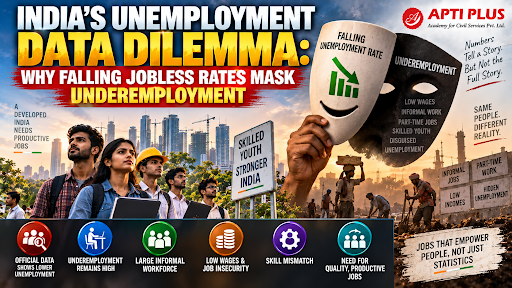
Experts raised concerns that India’s high-frequency headline employment metrics—specifically the Current Weekly Status (CWS) data—fail to reflect the underlying structural vulnerabilities of the labor market.
What is the Current Weekly Status?
-
Short Seven-Day Reference Window: Classifies an individual as employed if they worked for at least one hour on any single day during the preceding seven days.
-
Liberal Employment Threshold: Treats a person performing a single hour of casual farm weeding as fully employed for the entire survey week.
-
High-Frequency Monthly Indicator: Enables statistical tracking of rapid, short-term macroeconomic and seasonal labour market fluctuations.
-
Sensitivity to Seasonal Demand Spikes: Registers temporary drops in unemployment during peak kharif paddy transplanting or Diwali retail sales.
What is the Periodic Labour Force Survey?
|
Why is Measuring Unemployment Difficult in India?
Vast Informal Sector Dominance: Capturing gig workers, street vendors, and home-based piece-rate artisans through standardized household questionnaires is exceptionally complex. Circular and Seasonal Migration Flows: Millions of seasonal construction laborers migrate between Uttar Pradesh and brick kilns without permanent urban addresses.
Multiple Concurrent Occupations: Workers frequently combine subsistence farming, driving e-rickshaws, and seasonal wage labor, defying single-job classifications.
Prevalence of Self-Employment: Over 57% of Indian workers are categorized as self-employed, including unpaid family helpers on small family farms.
Database Fragmentation Across Ministries: Administrative payroll registries (EPFO, ESIC, NPS) conflict with household survey findings from PLFS and the e-Shram portal.
Severe Disguised Agricultural Unemployment: Five family members cultivate a marginal land plot where two workers would suffice, masking zero marginal labor productivity.
Difference Between Unemployment and Underemployment
|
Why Can a Lower Unemployment Rate Be Misleading?
Distress-Driven Surge in Farm Work: Economic shocks often push rural women into unpaid family farm labor, artificially increasing employment numbers without income growth.
Rise of Precarious Gig and Daily Wage Work: Headline employment gains are driven by insecure delivery gigs lacking medical insurance or paid leave.
Stagnant or Falling Real Wages: Real agricultural and manufacturing wage rates have remained largely stagnant despite falling headline unemployment percentages.
De-Industrialization Structural Distortion: The share of agriculture in total employment increased from 42.5% to over 45%, reversing structural transformation milestones.
What are the Major Employment Indicators
|
Way Forward
Publish Seasonally-Adjusted Unemployment Indices: Empower National Statistical Office (NSO) to release seasonally-adjusted labour indices alongside raw figures to eliminate agricultural rainfall distortions.
Revive Current Daily Status (CDS) in High-Frequency Surveys: Reintroduce half-day time accounting to capture exact hours worked and measure acute underemployment.
Integrate e-Shram with EPFO and PLFS Datasets: Establish a unified National Labour Database linking 30 crore registered unorganized workers on the e-Shram portal with formal payrolls.
Formulate Comprehensive Decent Work Indices: Adopt the ILO Decent Work Indicators framework tracking real wage trajectories, contract length, and workplace safety.
Conduct High-Frequency Enterprise Establishment Surveys: Launch quarterly job creation surveys covering MSME industrial clusters to measure demand-side hiring trends.
Institutionalize Dynamic Time-Use Surveys (TUS): Conduct bi-annual Time-Use Surveys to accurately quantify unpaid domestic and care work performed by rural women.
Conclusion
Modernizing India's labour statistical architecture from binary unemployment headcounts to comprehensive job-quality and underemployment indices is imperative to drive inclusive economic policy.
Source: THEHINDU
|
PRACTICE QUESTION Q. Consider the following statements regarding underemployment in the Indian economy: 1. Disguised unemployment occurs when marginal productivity of labor is zero or negative. 2. A decline in headline unemployment rate always indicates an expansion in formal, high-productivity jobs. 3. Unpaid family helpers in household agricultural enterprises are counted as employed under the Usual Status approach. Which of the statements given above are correct? (a) 1 and 2 only (b) 2 and 3 only (c) 1 and 3 only (d) 1, 2, and 3 Answer: (c) 1 and 3 only Explanation: Statement 1 is correct: Disguised unemployment refers to a situation where more people are engaged in an activity than are actually needed. If some people are removed, the total production remains unchanged. This implies that the marginal productivity of labor is zero or negative. It is highly prevalent in the Indian agricultural sector. Statement 2 is incorrect: A decline in the headline unemployment rate does not always indicate an expansion of formal, high-productivity jobs. The unemployment rate can decrease if workers shift into low-productivity self-employment, informal jobs, or unpaid family labor. It can also drop if discouraged workers stop looking for jobs altogether and exit the labor force. Statement 3 is correct: Under the Usual Status approach used in India's Periodic Labour Force Survey (PLFS), individuals are classified based on their activity over a reference period of 365 days. Unpaid family helpers who assist in household enterprises (like agriculture or small shops) are explicitly counted as employed (self-employed category). |